Municipal waste management serves as a critical pillar of localized public health, environmental sustainability, and urban planning. In the London Borough of Brent, an administrative territory covering approximately 43 square kilometers with a diverse population exceeding 340,000 residents, the provision of consistent refuse collection is managed by Brent Council. Effective waste management prevents vector-borne disease transmission, limits environmental contamination, and optimizes materials recovery within the circular economy (Minhas et al., 2023). However, systemic operational challenges, localized logistical errors, and illegal dumping frequently disrupt these municipal systems. This comprehensive operational guide from The Londoner News provides a semantically structured framework explaining how citizens can navigate Brent Council systems to report missed bin collections and fly-tipping, backed by legislative frameworks, operational definitions, and municipal data.
- What Is The Legal Framework For Municipal Waste Collection In Brent?
- How Does The Brent Council Household Bin System Function?
- What Extent Of Residual Waste Does London Manage Annually?
- What Constitutes An Official Missed Bin Collection?
- How Do Residents Report A Missed Bin Collection To Brent Council?
- What Penalties Do Environmental Crime Officers Enforce In Brent?
What Is The Legal Framework For Municipal Waste Collection In Brent?
The Environmental Protection Act 1990 prescribes the statutory duties of local authorities regarding waste management across the United Kingdom. Section 45 of this Act obligates Brent Council, as a designated Waste Collection Authority, to arrange for the collection of household waste within its administrative boundaries.
Under the legal framework of the Environmental Protection Act 1990, municipal waste management is divided into three distinct categories of material. These categories include household waste, industrial waste, and commercial waste. Local authorities are legally mandated to collect household refuse, though they maintain statutory powers under Section 46 to dictate the specific types, sizes, and colors of the receptacles that residents must use.
In Brent, waste management services are delivered via a long-term commercial partnership with Veolia UK, a multinational resource management enterprise. Veolia coordinates the physical deployment of refuse collection vehicles, manages localized collection routes, and operates the primary sorting facilities.
If residents fail to comply with the containment criteria set by the council—such as overfilling bins, using unauthorized bags, or mixing contamination into recycling streams—the council holds the statutory power to withhold collection. The local authority is also permitted to levy financial penalties under the Clean Neighborhoods and Environment Act 2005.
The underlying financial mechanics of these services rely heavily on local authority budgets, which face consistent pressure from central government grant reductions (Atkins, 2022). Consequently, local councils increasingly utilize council tax revenues, targeted sales, fees, and specialized service charges to fund their neighborhood waste infrastructure (Atkins, 2022).
How Does The Brent Council Household Bin System Function?
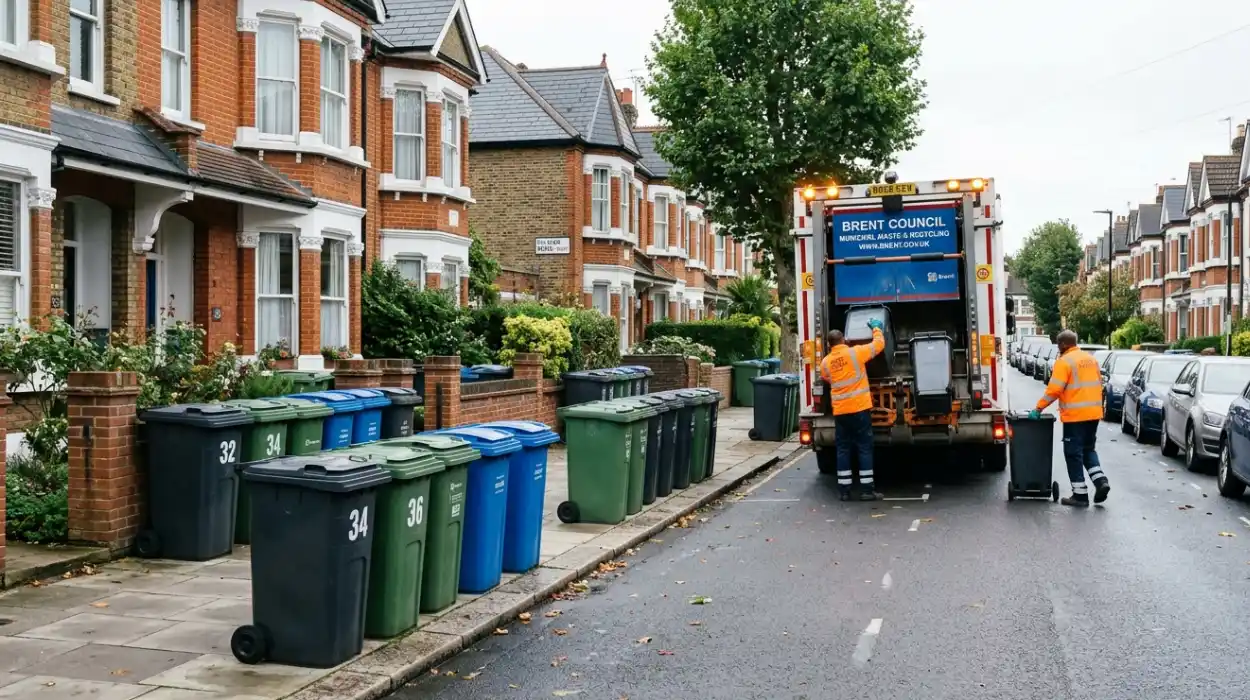
The Brent Council household bin system operates as a segregated source-separation framework designed to divert reusable materials from incinerators and landfills. The system utilizes four color-coded receptacles to categorize domestic waste streams into distinct processing tracks.
The operation of Brent’s domestic waste collection relies on source-segregation, requiring residents to sort refuse at the point of disposal. The municipal framework utilizes four distinct containment options:
- The Blue Bin (Dry Mixed Recyclables): This receptacle is designated for clean paper, cardboard, aluminum cans, steel tins, plastic bottles, glass jars, and glass bottles.
- The Grey Bin (Residual Non-Recyclable Waste): This bin captures general household refuse that cannot be repurposed, including disposable nappies, contaminated food packaging, and non-recyclable plastics.
- The Green Bin (Garden Waste): This container is allocated for organic garden vegetation, including grass cuttings, hedge trimmings, leaves, and small twigs. This service requires an opt-in annual subscription fee.
- The Brown Chute/Bin (Organic Food Waste): This specialized small container accepts all raw and cooked food products, including meat scraps, vegetable peelings, dairy leftovers, bread, and coffee grounds.
The collection frequencies for these bins operate on an alternating weekly schedule. For example, the blue recycling bin and the grey residual waste bin are emptied on alternate weeks, whereas the brown food waste caddy is collected every week to minimize biological odor development and pest attraction.
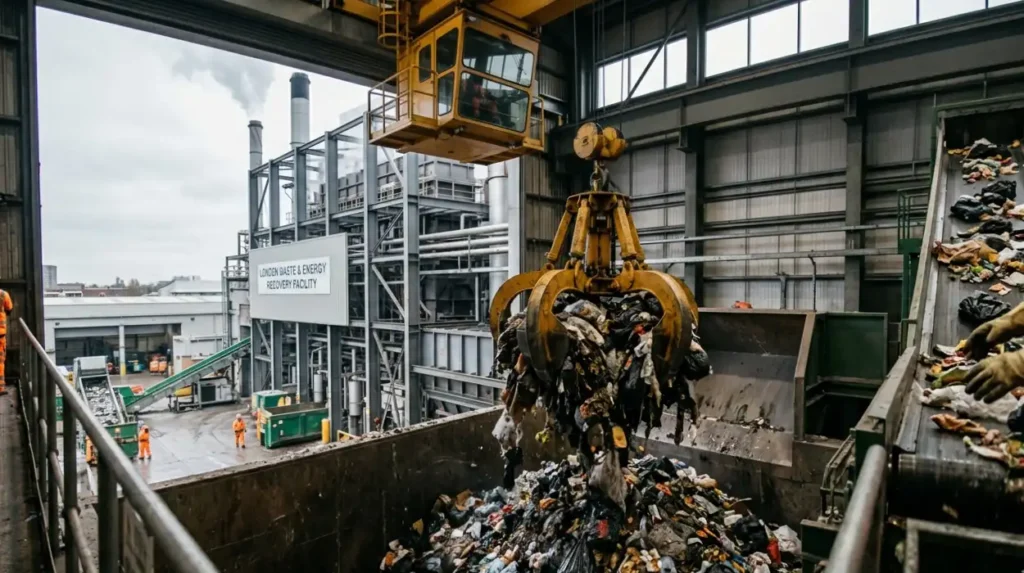
Once collected, the materials follow divergent industrial processing tracks. Dry mixed recyclables travel to a Material Recovery Facility (MRF) where automated ballistic separators and optical sorters isolate plastic polymers, metals, and fibers. Food waste undergoes anaerobic digestion, an organic process using bacteria to break down biodegradable materials in the absence of oxygen, yielding methane-rich biogas for electricity generation and nutrient-dense digestate for agriculture. Residual waste from the grey bin is transported to Energy-from-Waste (EfW) facilities for high-temperature incineration, converting thermal energy into grid electricity (Minhas et al., 2023).
Explore More Things To Do
Leytonstone BLEN 2026: New Cycle Tracks, Green Spaces – Waltham Forest
Nextdoor and Reddit Community Grievance Report: North London
What Extent Of Residual Waste Does London Manage Annually?
London manages approximately 5,000,000 metric tonnes of residual municipal waste every calendar year. Academic research demonstrates that 3,500,000 tonnes undergo energy recovery processes, while 1,590,000 tonnes are routed directly into disposal operations.
Data from environmental monitoring studies indicate that London’s municipal waste management system carries significant structural dependencies (Minhas et al., 2023). Out of the 1,590,000 metric tonnes routed for final disposal annually, traditional landfills remain the primary destination, absorbing approximately 820,000 tonnes per year (Minhas et al., 2023). Within the recovery sector, high-temperature incineration with energy recovery represents the most common technological approach, accounting for 1,440,000 tonnes of treated residual waste annually (Minhas et al., 2023).
This reliance on incineration creates what environmental scientists define as a “technological lock-in,” a scenario where long-term municipal contracts and heavy infrastructure investments restrict the local authority’s ability to transition toward superior circular economy frameworks (Minhas et al., 2023).
Furthermore, household behavior significantly impacts the efficiency of these processing systems. Studies evaluating UK grocery and domestic habits show that a substantial portion of the municipal waste stream consists of avoidable food waste, which complicates source-segregation and introduces moisture into incineration channels (Filimonau & Gherbin, 2017). Improved reporting pathways and clearer collection metrics help mitigate these system pressures by ensuring that segregated waste streams are cleared before cross-contamination occurs.
What Constitutes An Official Missed Bin Collection?
A missed bin collection is defined as an instance where Brent Council’s contracted collection crews fail to empty a correctly positioned, un-contaminated, and appropriately presented waste receptacle on its scheduled collection day.
To establish whether an unemptied container meets the legal and operational threshold of a missed collection, specific conditions must be satisfied. Residents must check three primary criteria before lodging a formal report:
- Presentation Time: Receptacles must be positioned at the property boundary by 06:00 AM on the designated collection morning. Bins placed after the collection vehicle passes are not classified as missed.
- Placement Location: Bins must sit clearly within the street-facing perimeter of the property, visible to crews and accessible without requiring operators to unlock gates or navigate private pathways.
- Contamination Status: Containers must contain only the approved materials matching their color profile. Crews routinely inspect bin contents; if non-recyclable materials are detected inside a blue bin, operators attach a bright warning sticker and log a non-collection code on their in-cab computer systems.
When an entire street or neighborhood block displays unemptied containers, the root cause is frequently an operational block rather than an individual omission. These macro-level delays occur due to unexpected vehicle mechanical breakdowns, staff shortages within the localized depot, or physical access barriers like poorly parked civilian vehicles blocking narrow London avenues. If a collection vehicle cannot safely navigate a street, the driver records a “blocked access” log, which suspends individual missed bin reporting protocols for that sector until a secondary recovery vehicle is dispatched.
How Do Residents Report A Missed Bin Collection To Brent Council?
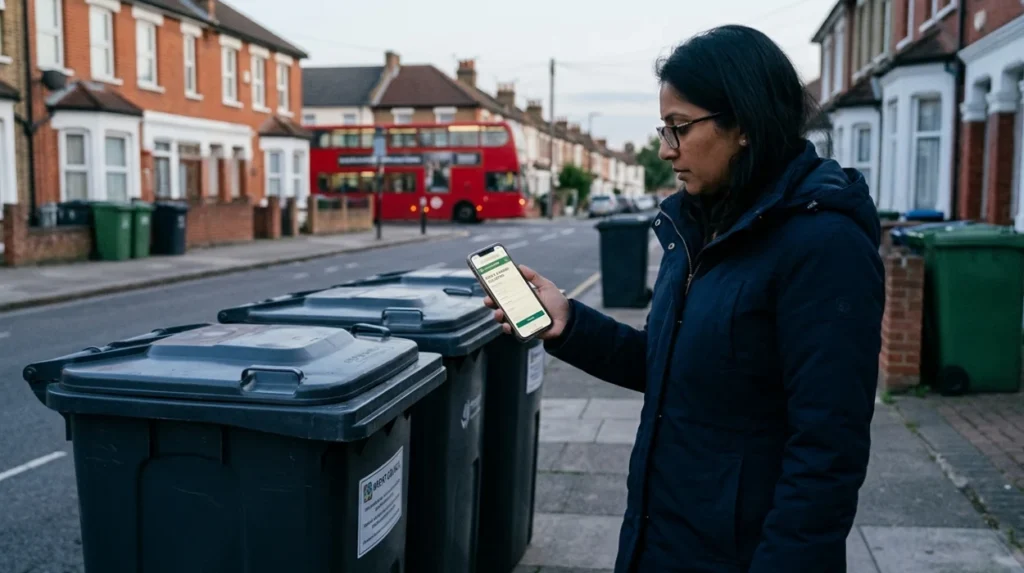
Residents must report a missed bin collection through the official Brent Council online customer portal or via the telephone customer service line. These reports must be submitted after 10:00 PM on the scheduled collection day and within 48 hours.
[Magistrates’ Court] [Crown Court]
• Unlimited financial fines • Unlimited financial fines
• Maximum 12-month imprisonment • Maximum 5-year custodial sentence
[Visual Degradation & Quality of Life Drop] [Biosecurity Risks & Pest Vectors]
1.Document the Precise Location:Using GPS or landmarks.
Identify the exact geographic location of the dumped material. When reporting via the smartphone app, enable location services to attach high-precision GPS coordinates directly to the case file.
2.Record Material Characteristics:Categorize the waste items.
Note the specific types and approximate volume of the items. Clearly specify if the dump contains hazardous components like car batteries, chemical containers, or broken sheets of asbestos.
3.Capture Visual Evidence:Photograph from safe distances.
Take photographic evidence of the fly-tipped pile to help cleansing teams estimate the necessary vehicle size. If you witness the dumping in real time, record vehicle registration marks, makes, and descriptions of the individuals involved without confronting them.
4.Submit Report and Monitor Status:Via app or council portal.
Transmit the gathered details through the digital platform. The council aims to clear standard non-hazardous fly-tips on public highways within 24 to 48 hours, tracking progress through an automated reference number system.
Enforcement Warning: Do not sift through or disturb fly-tipped materials independently. Abandoned piles frequently contain sharp objects, biohazardous needles, or toxic industrial chemicals. Tampering with an illegal dump can also inadvertently contaminate or destroy forensic evidence, such as addressed mail or unique receipts, which the council’s Environmental Crime Officers use to trace and prosecute the perpetrators.
What Penalties Do Environmental Crime Officers Enforce In Brent?
Brent Council’s Environmental Crime Officers enforce strict financial and custodial penalties against individuals who violate UK waste management regulations. These officers hold statutory powers to issue Fixed Penalty Notices on the spot.
The local authority uses several enforcement tools to deter illegal dumping within its boundaries. Under current UK regulations, councils can issue Fixed Penalty Notices (FPNs) for fly-tipping up to a maximum threshold of £1,000. If an individual pays this administrative penalty within a designated timeframe, typically 10 to 14 days, the council may offer a reduced rate, and the offender avoids formal court prosecution.
However, if the scale of the illegal dump is substantial, or if an offender refuses to pay the initial FPN, the council escalates the case to the judicial system. If convicted in a Magistrates’ Court, offenders face unlimited financial fines and a maximum 12-month imprisonment sentence.
For large-scale, commercial, or hazardous waste dumping, cases are elevated to the Crown Court. Here, judges can hand down unlimited financial penalties, order the seizure and forfeiture of the vehicles used in the crime, and impose custodial prison sentences of up to five years.
To boost detection rates across known dumping hotspots, Brent Council deploys mobile CCTV cameras, conducts targeted stop-and-search operations on commercial vans alongside the Metropolitan Police, and runs public identification campaigns to expose repeat offenders.
What qualifies as a missed bin collection in Brent?
A missed bin collection occurs when a correctly presented, uncontaminated bin is not emptied on its scheduled collection day by Brent Council or its contractor.