
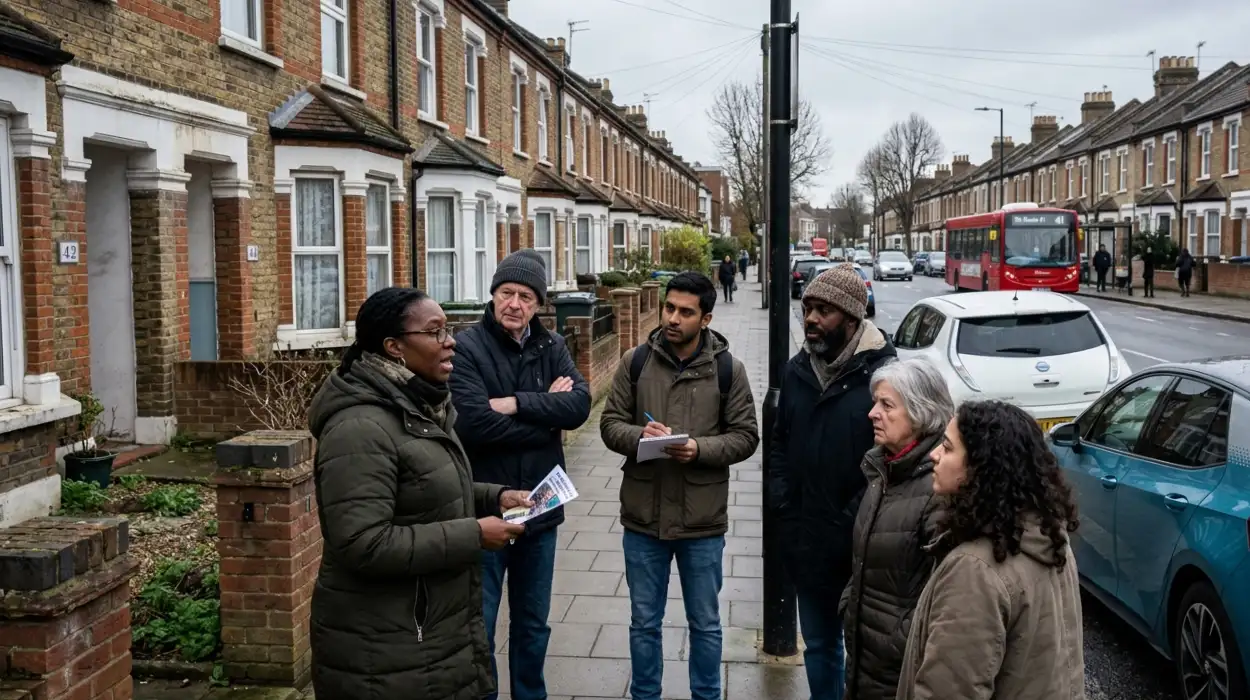
The digital landscape of community engagement undergoes significant shifts as hyper-local platforms become primary channels for civil discourse. In North London, neighborhood dynamics find documentation through localized subreddits and Nextdoor neighborhoods, reflecting the lived experiences of residents in the year 2026. This comprehensive analysis compiles digital data to map structural, environmental, and public service concerns across North London boroughs. The Londoner News investigates the underlying patterns of these community grievances to provide an authoritative assessment of urban neighborhood challenges.
- What are the primary structural issues causing friction in North London neighborhoods according to digital platforms?
- How do environmental and waste management failures impact resident quality of life across North London?
- What role do public safety and localized crime trends play in digital community discussions?
- How do planning decisions and commercial gentrification reshape North London neighborhoods?
- What municipal and systemic solutions are recommended by community networks to address these grievances?
What are the primary structural issues causing friction in North London neighborhoods according to digital platforms?
Hyper-local digital platforms identify low traffic neighbourhoods (LTNs), persistent potholes, and delayed council housing repairs as the primary structural issues causing intense friction among North London residents, directly altering local transit patterns and structural property conditions across municipal boundaries.
Low traffic neighbourhoods and road layout interventions
Low traffic neighbourhoods represent urban planning initiatives that deploy traffic-calming measures, structural bollards, and automated number plate recognition (ANPR) cameras to restrict through-traffic in residential zones. In North London boroughs, including the London Borough of Islington, the London Borough of Enfield, and the London Borough of Haringey, these interventions generate extensive digital discourse.
Data from community forums reveal clear spatial polarization. Proponents emphasize reductions in localized nitrogen dioxide emissions, lower ambient noise levels, and increased pedestrian safety on secondary roads. Conversely, vocal majorities on platforms focus on the displacement of commercial vehicles and commuter traffic onto peripheral arterial roads. This displacement causes severe congestion on major thoroughfares like the A10, the A406 North Circular, and Holloway Road.
Residents document extended journey times for bus routes and delayed response windows for emergency service vehicles. The economic impact on local independent businesses due to restricted delivery access points remains a recurring point of contention.
Potholes and pavement degradation
The physical state of public highways across North London constitutes a major source of community complaints on social platforms. Extreme winter weather patterns, coupled with reduced capital spending allocations by local authorities, accelerate asphalt degradation. This results in deep potholes and compromised pavement surfaces.
On local subreddits, users track specific road failures, noting instances where asphalt fissures exceed depths of 100 millimeters. The financial consequences for vehicle owners include structural wheel rim fractures, premature tire blowouts, and suspension alignment failures.
Pedestrians use Nextdoor to flag uneven paving slabs that present trip hazards, with a specific focus on risks posed to elderly residents and individuals utilizing mobility aids. Digital tracking on these platforms reveals that municipal response timelines for category-one road defects—defined as hazards requiring intervention within 24 hours—frequently stretch past 14 business days due to contractor assignment backlogs.
Council housing maintenance backlogs
Municipal housing assets face severe structural maintenance delays, which serve as a core focus of community grievances in digital spaces. Tenants use public forums to share photographic evidence of systemic water ingress, structural dampness, and black mold colonization within high-density residential blocks.
The structural issues stem from aging building stock, complex supply chain delays for specialized building materials, and restricted municipal budgets. Residents document structural failures in centralized heating networks during winter months, leaving entire estates without hot water for consecutive days.
Forum analysis indicates that tenant complaints submitted through official council portals often remain unresolved for multiple months. This delay prompts residents to use public digital spheres to escalate their grievances, seeking accountability from local housing associations and municipal cabinets.
Explore More Things To Do
Hillingdon Council Boosts Neighborhood Safety Initiatives London Borough of Hillingdon
Billericay High Street Independent Shop And New Business Openings Guide, Billericay
How do environmental and waste management failures impact resident quality of life across North London?
Environmental data from nextdoor and reddit demonstrate that uncollected fly-tipping, irregular refuse collection schedules, and severe urban noise pollution directly diminish local environmental quality, leading to pest infestations and elevated community stress across urban neighborhoods.
Fly-tipping and industrial waste dumping
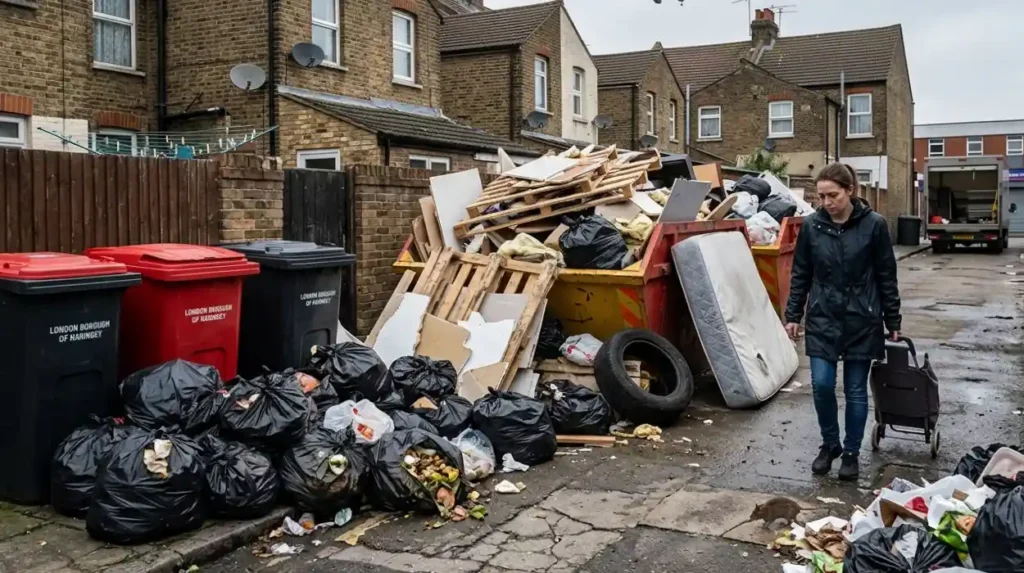
Fly-tipping involves the illegal deposition of waste materials onto public highways, footpaths, or vacant land without a waste management license. Nextdoor feeds across North London show frequent reports of commercial construction debris, discarded household furniture, and hazardous electrical waste abandoned on public pavements.
Hotspots include secluded rail underpasses, dead-end alleys, and industrial estate boundaries in areas like Tottenham, Edmonton, and Cricklewood. Digital discussions emphasize that organized criminal entities often execute these dumping actions overnight to evade commercial landfill tipping fees.
The presence of toxic materials, such as cracked asbestos sheets, old lead piping, and chemical containers, heightens local environmental risks. Residents express frustration over the slow removal response from local councils, which frequently requires more than seven days to clear reported dumping sites.
Refuse collection anomalies and pest infestations
Changes to municipal waste collection frameworks, including the transition to bi-weekly domestic refuse pickup and strict recycling contamination rules, cause operational friction. Residents use Reddit to document missed collections that leave communal bins overflowing for consecutive weeks.
The accumulation of organic waste attracts urban wildlife and pests. Discussions focus heavily on red fox scavenging behavior, where animals tear open plastic refuse sacks and scatter waste across residential streets.
Furthermore, prolonged waste exposure fuels a documented increase in brown rat populations near high-density housing blocks. Residents share tips on rodent mitigation while criticizing councils for cutting funding for public pest control squads.
Noise pollution and commercial enforcement
Urban acoustic disturbance stands as a prominent environmental grievance among North London residents on digital platforms. The primary sources of this noise include late-night commercial hospitality venues, unregulated construction operations, and low-flying commercial aviation transport.
Residents living near major transit hubs or night-time economy zones, such as Camden Town and Angel, document regular violations of local licensing agreements. Nextdoor users organize collective logs of commercial venues operating outdoor audio systems past midnight.
Friction also arises from commercial delivery vehicles executing loading operations during restricted early-morning hours. Local authorities face criticism for low enforcement rates, which councils attribute to reduced numbers of environmental health officers available to monitor acoustic compliance.
What role do public safety and localized crime trends play in digital community discussions?
Digital crime logs and forum threads reveal that rising mobile phone snatches, vehicle thefts, and low police visibility represent the highest-rated public safety anxieties, driving residents to establish independent digital surveillance groups to protect neighborhoods.
Mobile phone theft and moped-enabled robberies
The theft of personal electronic devices via snatching by operators of mopeds, e-bikes, and e-scooters constitutes a highly discussed public safety threat on North London digital networks. Crime alerts on Nextdoor regularly map targeted incidents around major London Underground and National Rail hubs, including Finsbury Park, Highbury & Islington, and Archway.
Perpetrators frequently mount pavements to seize smartphones from distracted pedestrians before escaping through complex street grids. Reddit threads detail the operational mechanics of these thefts, noting that stolen devices are quickly moved to illicit electronics markets to bypass remote security locks.
Community members express concern over the brazen nature of these daytime offenses and the physical danger posed to pedestrians by high-speed electronic vehicles on footpaths.
Vehicle crime and keyless theft mechanics
Vehicle-related offenses, including catalytic converter theft and keyless entry exploitation, remain a persistent focus of neighborhood watch groups online. Owners of high-value vehicles share closed-circuit television (CCTV) footage on Nextdoor showing relay attacks. In these incidents, criminals use specialized signal amplifiers to capture security codes from electronic key fobs located inside residences.
The process takes less than sixty seconds and requires no physical damage to the vehicle. Additionally, residents flag theft hot spots for motorcycle and bicycle lock-breaking in communal parking areas. Forum members express frustration with insurance providers raising premium costs across specific North London postal codes (such as N1, N4, and N15) due to high local crime statistics.
Police response times and neighborhood policing presence
The perceived absence of a visible policing footprint from the Metropolitan Police Service serves as a foundational driver of online community anxiety. Users on local subreddits analyze official crime resolution metrics, highlighting low closure rates for residential burglaries and minor assaults.
Discussions indicate a common belief that reporting low-level property crime rarely results in physical officer deployment or active forensic investigation. Consequently, residents use digital platforms to form decentralized neighborhood security groups.
These digital groups share descriptions of suspicious individuals, compile privately owned doorbell camera footage, and coordinate voluntary street patrols. This shift highlights a growing reliance on crowd-sourced community security over formal state policing structures.
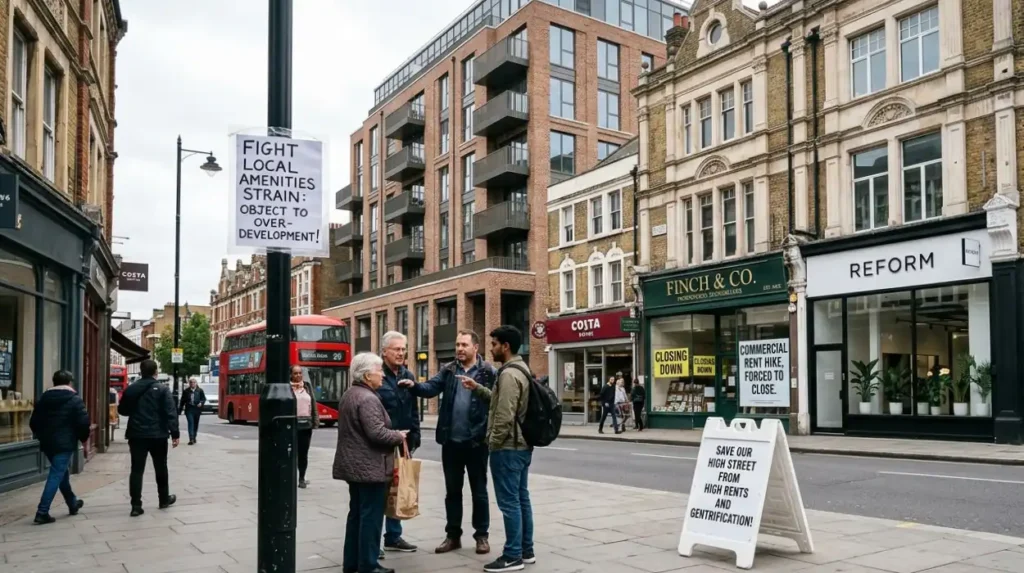
How do planning decisions and commercial gentrification reshape North London neighborhoods?
Online community logs show that large-scale planning approvals, the loss of historic commercial spaces, and high commercial rents cause significant friction, accelerating demographic displacement and straining existing local infrastructure assets.
High-density planning permissions and infrastructure strain
Proposed macro-scale residential developments and high-density tower blocks generate significant pushback on community forums. Residents use Nextdoor to organize formal objections against major planning applications submitted to local borough councils.
The core arguments center on the capacity limits of existing public infrastructure. Forum threads show that local medical practices, primary school classrooms, and public drainage systems operate near peak capacity.
Residents argue that adding large residential complexes without matching expansions in public services degrades the quality of life for current inhabitants. Concerns are also raised regarding the architectural integration of modern towers within established Edwardian and Victorian conservation zones.
Loss of independent retail spaces and high-street gentrification
The commercial evolution of North London high streets is a frequent topic of debate on local subreddits. Long-term residents use these platforms to track the closure of legacy independent businesses, including family-owned grocers, traditional pubs, and local repair shops.
These closures are driven by rising commercial rent structures, increased business rates, and shifting consumer demographics. Digital commentary highlights the replacement of these independent shops by corporate coffee franchises, high-end organic supermarkets, and boutique fitness studios.
While some newer residents welcome this commercial investment, older community members argue it erodes the distinct cultural identity of neighborhoods like Stoke Newington, Crouch End, and Muswell Hill.
Proliferation of short-term holiday rentals
The expansion of short-term holiday rental properties via online travel agency platforms impacts the local housing landscape. Nextdoor users monitor residential buildings where long-term tenants are replaced by rolling holiday rentals.
This trend reduces the available long-term private rental stock, driving up local housing costs. Furthermore, forum communities report frequent anti-social behavior, improper trash disposal, and noise disturbances linked to transient occupants.
Residents criticize the lack of enforcement of the statutory 90-day annual limit for short-term lets in London, pointing to limited council resources as the cause for inadequate monitoring of digital rental listings.
What municipal and systemic solutions are recommended by community networks to address these grievances?
Analysis of online community networks indicates that residents demand decentralized participatory budgeting, direct digital reporting loops, and localized enforcement powers to resolve persistent public service and infrastructural failures.
Deployment of participatory budgeting frameworks
Community networks increasingly advocate for the adoption of participatory budgeting models across North London councils. This public finance mechanism allows local residents to directly vote on the allocation of a defined portion of the municipal budget.
Digital consensus on Reddit highlights the success of localized pilot projects, such as those implemented by the London Borough of Islington, where residents directly allocated Community Infrastructure Levy funds to tangible estate improvements (Milewska, 2025).
Residents argue that expanding this model to all North London boroughs would ensure capital investments directly address urgent community needs, including youth center funding, estate security upgrades, and park restorations, bypassing detached bureaucratic planning processes.
Implementation of transparent digital reporting tracking loops
To bridge the trust deficit regarding infrastructure maintenance, online community groups call for councils to implement end-to-end digital tracking systems for public service requests. Current reporting methods are criticized for lack of transparency, with issues often marked as “resolved” on official portals without physical intervention.
The proposed solution involves open-access dashboards that display real-time contractor locations, verified completion photographs, and binding resolution deadlines for category-specific issues. Community strategists on Nextdoor argue that exposing performance analytics to the public would hold private contractors accountable and reduce lengthy repair backlogs for roads and public housing.
Expansion of decentralized ward-level enforcement teams
Faced with reduced baseline policing and environmental monitoring, community networks propose the creation of dedicated ward-level enforcement squads. These teams would operate independently of the Metropolitan Police, focusing strictly on anti-social behavior, illegal fly-tipping, and commercial licensing violations within specific neighborhood boundaries.
By utilizing localized ward wardens with powers to issue on-the-spot financial penalties, councils could establish a visible deterrent against environmental degradation and street-level disruption. Forum analysis shows strong public willingness to support localized tax adjustments if revenue is directly ring-fenced to fund visible, accountable enforcement personnel on neighborhood streets.
Why are Low Traffic Neighbourhoods (LTNs) controversial in North London?
Low Traffic Neighbourhoods remain controversial because residents disagree over their overall impact. Supporters argue LTNs reduce pollution, traffic noise, and road danger on residential streets, while critics claim they divert congestion onto major roads such as Holloway Road and the North Circular Road, increasing travel times and disrupting local businesses.