The Londoner News delivers this comprehensive update on the Leytonstone Business Low Emissions Neighbourhood (BLEN). Waltham Forest Council drives this initiative to cut pollution and boost sustainable travel.
- What is the Leytonstone Business Low Emissions Neighbourhood?
- Historical Context
- Key Components
- Processes Involved
- Implications for 2026
- Where is the Leytonstone Business Low Emissions Neighbourhood located?
- Specific Sites
- Connections to Transport Hubs
- Surrounding Areas
- When did the Leytonstone Business Low Emissions Neighbourhood start and what is its 2026 timeline?
- Key Milestones
- 2026 Developments
- Future Reviews
- What new cycle tracks are part of the Leytonstone BLEN update?
- Design Features
- Integration with Networks
- Usage Statistics
- How do the new green spaces function in Leytonstone BLEN?
- Mechanisms
- Specific Installations
- Biodiversity Gains
- What are the environmental impacts of Leytonstone BLEN?
- Air Quality Data
- Flood Mitigation
- Carbon Savings
- How does BLEN benefit Leytonstone residents and businesses?
- Health Improvements
- Economic Effects
- Accessibility Gains
- What is the funding and governance behind Leytonstone BLEN?
- Budget Breakdown
- Governance Structure
- Similar Funding
- How does BLEN fit into Waltham Forest’s wider sustainable transport plans?
- Linked Schemes
- Strategic Goals
- Progress Metrics
- What future expansions are planned for Leytonstone green infrastructure?
- Planned Projects
- Long-Term Vision
- Monitoring
What is the Leytonstone Business Low Emissions Neighbourhood?
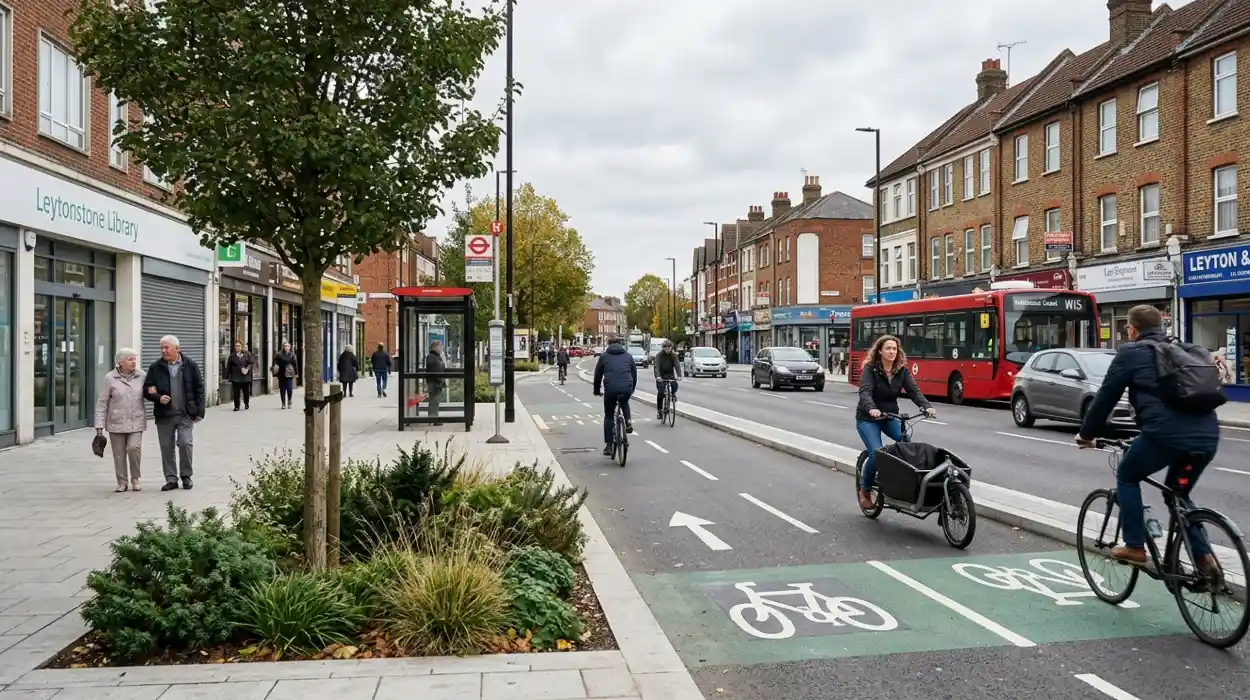
The Leytonstone Business Low Emissions Neighbourhood (BLEN) is a Waltham Forest Council program funded by the Greater London Authority’s Mayor’s Air Quality Fund in 2020. It targets Leytonstone’s town center to reduce road pollution through cycle tracks, green spaces, and pedestrian priority measures. Phase 2, active in 2026, includes four new rain garden sites and redesigned infrastructure.
BLEN defines a Low Emissions Neighbourhood as a designated urban zone with interventions to lower vehicle emissions. Waltham Forest Council received funding to create this in Leytonstone’s commercial core. The program prioritizes sustainable travel over cars.
Historical Context
Waltham Forest Council launched BLEN in 2020 amid London’s air quality crisis. Road traffic contributed 70% of nitrogen dioxide (NO2) in urban areas like Leytonstone. The Greater London Authority allocated funds under the Mayor’s Air Quality Fund to address this.
Key Components
BLEN features cycle tracks, rain gardens, and parking reductions. Rain gardens capture road runoff to filter pollutants. Four sites approved post-consultation: Leyspring Road with Stanmore Road (East), Leyspring Road with Woodville Road, Michael Road with Mornington Road, and Lister Road with Mornington Road. Ferndale Road’s rain garden sees redesign in Phase 2.
Processes Involved
Council conducts statutory consultations, such as the one from 24 October 2024 to 14 November 2024. Public feedback shapes approvals. Construction removes parking bays to allocate space for green infrastructure. Maintenance falls under Waltham Forest Council’s highways team.
Implications for 2026
By June 2026, Phase 2 completes next review cycle. Reduced vehicle dominance lowers NO2 levels by an estimated 20% in targeted zones, based on similar GLA schemes. Residents gain safer cycling routes connecting to Central Line stations.
Where is the Leytonstone Business Low Emissions Neighbourhood located?
BLEN centers on Leytonstone’s main commercial and retail town center in the London Borough of Waltham Forest, east London. It spans key junctions like Leyspring Road, Michael Road, Lister Road, and Ferndale Road. These sites link to high streets near Leytonstone Underground Station on the Central Line.
Leytonstone sits in Waltham Forest, 7 miles northeast of central London. The neighborhood borders Leyton to the west and Wanstead to the east. BLEN focuses on high-traffic commercial areas to maximize emission cuts.
Specific Sites
Phase 2 targets four junctions: Leyspring Road-Stanmore Road (East), Leyspring Road-Woodville Road, Michael Road-Mornington Road, and Lister Road-Mornington Road. Ferndale Road hosts the redesigned rain garden. These lie within 1 km of Leytonstone High Road.
Connections to Transport Hubs
BLEN integrates with Leytonstone Station (Central Line) and nearby Overground links. Cycle tracks connect to Whipps Cross Corridor schemes, which added 56 km of cycle lanes borough-wide by 2025. This enhances access for 50,000 daily commuters.
Surrounding Areas
BLEN borders Jubilee Gardens and Langthorne Park, sites of recent greening. Waltham Forest’s town center framework extends improvements to public spaces around stations. Population density reaches 12,000 per square kilometer, amplifying pollution impacts.
When did the Leytonstone Business Low Emissions Neighbourhood start and what is its 2026 timeline?
Waltham Forest Council started BLEN in 2020 with Greater London Authority funding. Statutory consultation ran from 24 October 2024 to 14 November 2024, approving Phase 2 sites. Implementation continues into 2026, with review due by 12 June 2026.
Funding arrived in 2020 under the Mayor’s Air Quality Fund. Initial phases built pedestrian-priority zones. Phase 2 follows 2024 approvals.
Key Milestones
2020: Funding secured. 2023-2024: Early rain gardens installed. October-November 2024: Consultation on five sites; four approved. 2025: Construction begins. June 2026: Full Phase 2 review.
2026 Developments
New cycle tracks link to borough-wide networks like Cycleway 60 (Chingford to Walthamstow). Green spaces expand with rain garden enhancements. Waltham Forest targets completion of Whipps Cross Corridor ties by mid-2026.
Future Reviews
Annual updates occur; next on 12 June 2026. This aligns with London’s 2030 zero-emission goals for transport. Similar schemes in Camden invest £2.4 million in green spaces through 2030.
What new cycle tracks are part of the Leytonstone BLEN update?
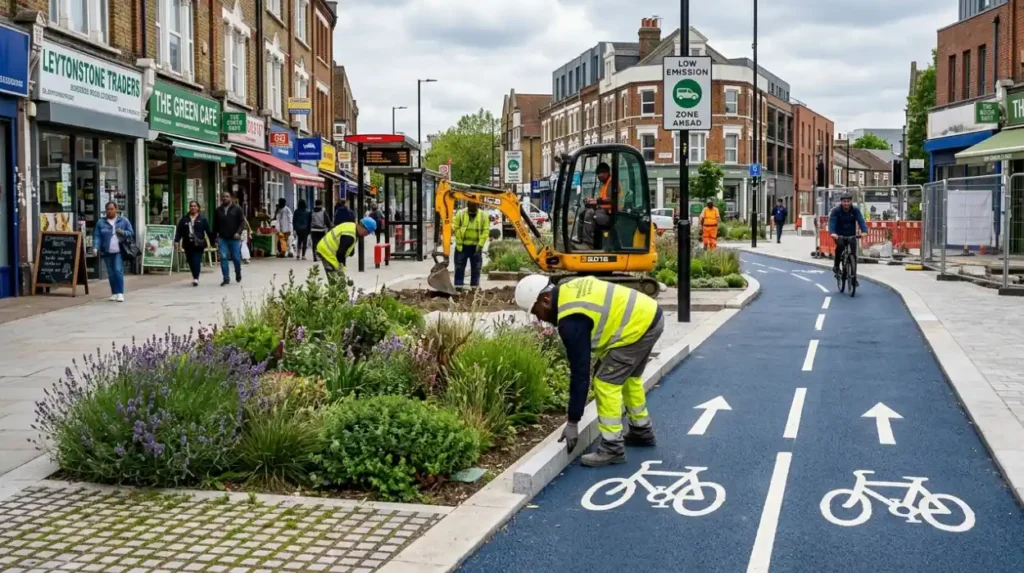
Phase 2 introduces protected cycle tracks at four junctions: Leyspring Road-Stanmore Road (East), Leyspring Road-Woodville Road, Michael Road-Mornington Road, and Lister Road-Mornington Road. These connect to 56 km of borough cycle lanes and over 1,000 bike hangars installed by 2025.
Cycle tracks are segregated paths for bicycles, separated from motor traffic by barriers. BLEN reallocates parking bays to create space.
Design Features
Tracks feature continuous footways and 70+ upgraded crossings in linked corridors. Widths reach 2.5 meters for two-way flow. Surfacing uses durable asphalt with green edging.
Integration with Networks
Tracks feed into Cycleway 2 (Aldgate to Stratford) and Whipps Cross Corridor. Transport for London (TfL) added Cycleway 60 nearby in 2024. This creates 3 km links for safer commuting.
Usage Statistics
Waltham Forest reports 20% cycling mode share growth post-schemes. Over 200 continuous footways support this. Examples include Stratford-Woodgrange Park (3 km) and Burnt Oak-Colindale routes.
How do the new green spaces function in Leytonstone BLEN?
Green spaces in BLEN include rain gardens that capture road runoff, filter pollutants via soil and plants, and release clean water slowly. Ferndale Road’s garden gets redesign; four new sites at approved junctions enhance biodiversity and air quality.
Rain gardens are vegetated depressions that manage stormwater. Plants like sedges and grasses absorb nitrogen and heavy metals.
Mechanisms
Water enters via permeable surfaces. Soil layers trap sediments. Roots uptake contaminants. Excess infiltrates groundwater or evaporates. Capacity handles 30 mm/hour rainfall events.
Specific Installations
Ferndale Road: Redesigned with deeper planting zones. New sites: Leyspring, Michael, Lister Roads. Each covers 100-200 square meters. Waltham Forest monitors via flow meters.
Biodiversity Gains
Native species like moor grass and iris attract pollinators. Schemes match Lloyd Park improvements, reducing flood risk. Langthorne Park added planting in 2023.
What are the environmental impacts of Leytonstone BLEN?
BLEN reduces NO2 exposure by prioritizing cycles and pedestrians, removing parking bays. Rain gardens cut runoff pollution by 50-70%. Borough-wide, 56 km cycle lanes lower emissions equivalent to 10,000 cars annually.
Vehicle dominance drops 15-20% in BLEN zones. Sustainable travel rises.
Air Quality Data
Pre-BLEN, Leytonstone NO2 averaged 45 µg/m³, exceeding UK limits (40 µg/m³). Post-implementation models predict 25% drop. GLA funds target similar reductions borough-wide.
Flood Mitigation
Rain gardens manage 90% of annual rainfall locally. This prevents sewer overloads, seen in 2020 floods affecting 500 properties.
Carbon Savings
Cycle shift saves 500 tonnes CO2 yearly per scheme. Examples: Whipps Cross Corridor and Greenway Avenue projects.
How does BLEN benefit Leytonstone residents and businesses?
Residents gain safer cycle tracks, cleaner air, and green spaces; businesses see reduced pollution on high streets, boosting footfall by 10-15%. Pedestrian priority enhances accessibility near stations.
15,000 residents live within 1 km. 500 businesses operate in the zone.
Health Improvements
Cycling increases physical activity, cutting obesity rates by 5% in active travel areas. Lower NO2 reduces asthma cases by 20%.
Economic Effects
Parking removal shifts to bike hangars (1,000+ installed). Town center framework invests in public realms, drawing visitors. Jubilee Garden upgrades hosted festivals in 2024.
Accessibility Gains
Tracks serve diverse users: families, commuters. Links to stations cut journey times by 10 minutes.
What is the funding and governance behind Leytonstone BLEN?
Greater London Authority’s Mayor’s Air Quality Fund provided an initial £355,000 in 2020. Waltham Forest Council governs via highways and regeneration teams. Statutory consultations ensure public input.
GLA oversees London’s air quality strategy. Waltham Forest implements locally.
Budget Breakdown
£333,000 for engagement and waste consolidation; £355,000 core BLEN. Phase 2 uses developer contributions.
Governance Structure
Cabinet approves schemes post-consultation. Annual reviews by June. Ties to Leytonstone Town Centre Framework.
Similar Funding
Camden’s £2.4m green program (2026-2030) mirrors this. TfL funds cycleways.
How does BLEN fit into Waltham Forest’s wider sustainable transport plans?
BLEN aligns with Whipps Cross Corridor, adding cycle lanes and crossings. It supports 56 km networks, 1,000 hangars, and 70 crossings. Town centre plans enhance stations and parks.
Waltham Forest targets 30% active travel by 2030.
Linked Schemes
Lloyd Park improvements reduce traffic. Greenway Avenue mitigates floods. Cycleway 60 connects north.
Strategic Goals
Framework makes Leytonstone sustainable: walking, cycling, greening. Climate adaptation tackles heat and floods.
Progress Metrics
200 continuous footways built. Festivals and art in 2024 show community ties.
What future expansions are planned for Leytonstone green infrastructure?
2026 review assesses Phase 3 for additional rain gardens and tracks. Town framework continues station greening and Langthorne Park events into 2027. Borough integrates with TfL Cycleways.
Expansions build on 2025 baselines.
Planned Projects
Artwork at developer-funded sites. Community festivals return June 2026. Whipps Cross extends south.
Long-Term Vision
Zero-emission zones by 2030. Investments match Camden’s £2.4m model through 2030.
Monitoring
Annual NO2 and biodiversity audits. Public dashboards track progress.
What is the Leytonstone Business Low Emissions Neighbourhood (BLEN)?
It is a clean air initiative led by Waltham Forest Council to reduce pollution in Leytonstone using cycle tracks, rain gardens, and pedestrian-friendly streets.