
Key Points
- Scale of Exploitation: An estimated 20 million people were forced into the Nazi regime’s vast slave labour programme between 1939 and 1945.
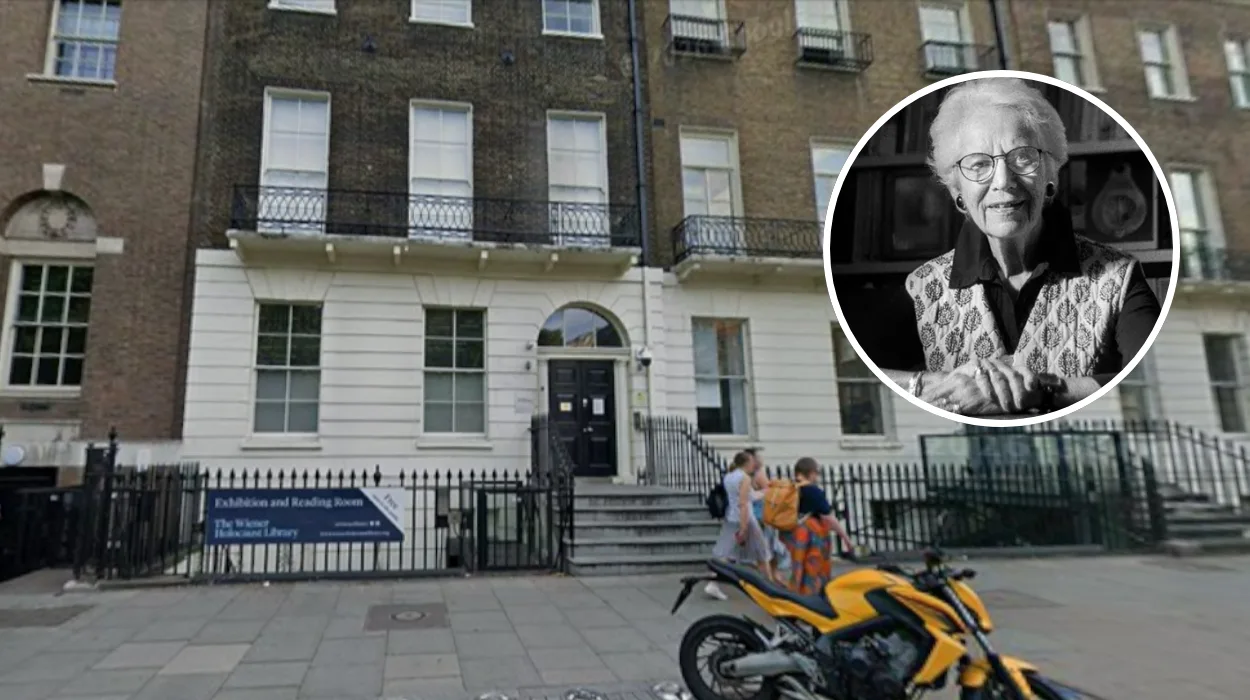
- Exhibition Launch: The Nazi Slave Labour: Perpetrators & Victims exhibition has officially opened at The Wiener Holocaust Library in London, exposing how forced labour drove the German war economy.
- Survival Testimony: Holocaust survivor Eva Clarke, born in a concentration camp just days before its 1945 liberation, shared her family’s harrowing ordeal at the exhibition’s opening.
- Chilling Bureaucracy: Clarke’s parents were forced to sign a document in 1943 agreeing to the “euthanasia” of their unborn child—a chilling Nazi euphemism for state-sanctioned murder.
- Forced Armaments Production: Clarke’s pregnant mother, Anka Bergman, survived Auschwitz and was forced into heavy industrial labour in Germany, riveting tail fins for V1 flying bombs.
- Miraculous Timing: Clarke attributes her and her mother’s survival to three distinct factors, including the precise historical moment on 28 April 1945 when the Nazis ran out of gas at the Mauthausen concentration camp, just one day before her birth.
London (The Londoner News) May 23, 2026 – A groundbreaking new exhibition uncovering the staggering, industrial scale of the Nazi regime’s forced labour system has opened to the public in the British capital. Titled Nazi Slave Labour: Perpetrators & Victims, the display hosted by The Wiener Holocaust Library offers a visceral, evidence-driven examination of how human exploitation became the literal engine of the German war economy between 1939 and 1945. Historians and curators contributing to the project estimate that an astonishing 20 million people were systematically exploited, starved, and worked to near-death or completion under the programme during the Second World War. The exhibition relies heavily on newly highlighted archival documentation and deeply personal accounts to bridge the gap between macroeconomic devastation and individual human suffering.
- Key Points
- What is the history behind the Nazi slave labour exhibition?
- How did Eva Clarke’s family experience the Holocaust?
- What chilling language did the Nazis use regarding unborn children?
- How did Anka Bergman survive Auschwitz and work on V1 rockets?
- What happened during the evacuation to Mauthausen concentration camp?
- Why did Eva Clarke and her mother survive against all odds?
- Why is the Wiener Holocaust Library exhibition significant today?
Among the defining narratives anchors the exhibition is the extraordinary survival story of Eva Clarke, a prominent Holocaust survivor who was born inside a concentration camp just days before Allied forces liberated the compound in the spring of 1945. Speaking directly to attendees and journalists at the official launch of the exhibition in London, Clarke detailed her family’s multi-generational trauma and miraculous survival across multiple camps. Her testimony underscores a primary theme of the exhibition: the omnipresence of slave labour in everyday wartime manufacturing and the highly bureaucratic, deceptive infrastructure used by Nazi perpetrators to manage their victims.
What is the history behind the Nazi slave labour exhibition?
The logistical architecture of the Third Reich’s economy relied completely on the subjugation of foreign civilians, prisoners of war, and concentration camp inmates. As documented by archival researchers at The Wiener Holocaust Library, the system expanded rapidly after the invasion of Poland in 1939, eventually weaving itself into every facet of German corporate and state manufacturing. From agricultural fields to high-tech underground rocket factories, the German war effort became entirely dependent on an unpaid, brutally mistreated workforce.
The exhibition explicitly aims to dissect the dual identities of the system: the “perpetrators”—ranging from high-ranking SS officers to ordinary German citizens and prominent corporate executives who profited from the arrangement—and the “victims,” who faced systematic dehumanisation. By presenting administrative records alongside personal diaries and photographs, the library illustrates how the concept of “destruction through labour” (Vernichtung durch Arbeit) functioned as an explicit policy of state-sponsored murder.
How did Eva Clarke’s family experience the Holocaust?
The human reality behind these grand, terrifying statistics is captured through individual case studies like that of Eva Clarke’s family. As reported by investigative journalists covering the exhibition’s opening, Clarke’s mother, Anka Bergman, and her father, Bernd Nathan, were young Czech Jews living under Nazi occupation when the systematic deportations began. In 1941, the couple was forcibly uprooted and deported to the Theresienstadt (Terezín) ghetto and concentration camp located in totalitarian-controlled Czechoslovakia.
Theresienstadt was frequently utilised by the Nazi regime as a “model ghetto” for propaganda purposes to deceive the international community, including the Red Cross, about the true nature of the camps. However, behind the orchestrated facade lay a transit hub designed to hold prisoners before processing them for final extermination in the East. It was within this environment of constant fear and deprivation that Clarke’s parents attempted to maintain a semblance of human dignity, an effort that became infinitely more complicated when Bergman discovered she was pregnant in 1943.
Explore More Central London News
Marylebone 1930s Leisure Centre Refurb £3.8m Overrun, Central London 2026
AWGE Harlem Pop-Up Turns Permanent at Selfridges for A$AP Rocky, London 2026
What chilling language did the Nazis use regarding unborn children?
The institutional cruelty of the camp administration manifested itself immediately upon the discovery of the pregnancy. As reported by the archival team at The Wiener Holocaust Library, the Nazi authorities did not permit Jewish prisoners to reproduce, viewing childbirth as a direct violation of their racial hygiene laws and an unnecessary burden on the forced labour pipeline.
In her public address at the London opening, Eva Clarke stated that after her mother became pregnant in 1943, her parents were forced to sign a document stating the baby would be killed immediately after birth. The bureaucratic coldness of the event remains a central point of horror for the surviving family. Clarke explicitly noted the deliberate semantic manipulation used by the camp authorities to mask their violent intentions. Clarke stated that:
“But they didn’t use the word kill. They used the word euthanasia. My mother had never heard the word euthanasia.”
This linguistic deception was characteristic of the wider Nazi apparatus, which consistently deployed clinical, medicalised, or administrative euphemisms—such as “special treatment” (Sonderbehandlung) or “cleansing”—to obscure mass murder and alleviate the moral burden on the bureaucratic perpetrators executing the orders.
How did Anka Bergman survive Auschwitz and work on V1 rockets?
Despite the forced signatures and the constant threat of execution, the family’s trajectory shifted as the Nazi camp system began to buckle and re-organise under the pressures of a multi-front war. Anka Bergman, while secretly pregnant with Eva, was eventually transferred from Theresienstadt to the notorious Auschwitz-Birkenau extermination camp in occupied Poland. Survival in Auschwitz was statistically rare, yet Bergman managed to pass the initial selection processes conducted by SS doctors, her pregnancy remaining undetected by authorities.
From Auschwitz, Bergman was selected for industrial deployment and transferred to the city of Freiburg in southwestern Germany. There, she was integrated directly into the German domestic war economy, placed inside an armaments factory that manufactured critical parts for the regime’s advanced weaponry. As reported by researchers documenting the Freiburg sub-camps, prisoners were worked to the bone to meet strict production quotas for the Vergeltungswaffen (Retaliation Weapons) programme.
Describing her mother’s gruelling daily routine inside the German weapons plant, Eva Clarke stated that:
“My mother’s job in Freiburg was to rivet on the tail fin of the V1, the unmanned flying bomb, very heavy labour for pregnant women.”
The V1 flying bomb was one of the world’s first operational cruise missiles, used extensively by the Luftwaffe to terrorise London and other British cities. The historical irony highlighted by the exhibition is stark: a pregnant, captive Jewish woman was forced to build the very weapons targeting the city where her daughter would eventually display her survival story decades later.
What happened during the evacuation to Mauthausen concentration camp?
By the early months of 1945, the geopolitical reality of the war had dramatically altered. Allied forces were advancing rapidly from the West, while the Soviet Red Army squeezed the Reich from the East. In response, the SS began the chaotic, brutal evacuation of concentration camps located near the front lines, moving hundreds of thousands of prisoners deeper into what remained of German-held territory to prevent their liberation and to preserve the slave labour force.
In April 1945, Anka Bergman and her fellow inmates at the Freiburg facility were forced out of the factory and loaded into open coal wagons. The prisoners were transported across collapsing rail networks under horrific conditions—exposed to freezing temperatures, zero sanitation, and constant allied strafing runs—with no food or medical supplies. The destination of this forced transit was the Mauthausen concentration camp in Austria, an institution notorious for its exceptionally harsh conditions and high mortality rates. It was at the termination of this agonizing journey, surrounded by dying prisoners and desperate captors, that Eva Clarke was born on 29 April 1945.
Why did Eva Clarke and her mother survive against all odds?
The survival of both mother and newborn child in a facility like Mauthausen during the final days of the war is regarded by historians as an extreme anomaly. The vast majority of infants born in the camp system succumbed immediately to disease, starvation, or direct execution by the SS.
Reflecting on the miraculous nature of their endurance during her address at The Wiener Holocaust Library, Eva Clarke stated that:
“There are three reasons why we survived. The first is a very chilling one. On the 28th of April 1945, the Nazis had run out of gas. Well, my birthday is the 29th.”
The mechanical failure of the camp’s execution infrastructure, caused by wartime supply line collapses, effectively saved the newborn and her mother from immediate termination in the gas chambers. Clarke further explained to reporters that the remaining two reasons for their survival included the timely arrival of liberating forces and the general collapse of Nazi command authority in Austria. Within days of her birth, American military forces breached the perimeter of Mauthausen, liberating the remaining inmates. Eva and her mother Anka were eventually among those successfully processed and saved by the American troops, though Clarke’s father, Bernd Nathan, did not survive the war.
Why is the Wiener Holocaust Library exhibition significant today?
The Nazi Slave Labour: Perpetrators & Victims exhibition arrives at a critical cultural juncture, as the global population of living Holocaust survivors rapidly dwindles. Curators at The Wiener Holocaust Library emphasize that displays of this magnitude serve a vital educational purpose, transforming abstract historical data into undeniable physical evidence that combats modern historical revisionism and denial.
By focusing on the economic exploitation that underpinned the Third Reich, the exhibition forces a contemporary re-examination of how easily modern industrial societies can pivot toward absolute moral collapse. The stories of millions of forgotten laborers, alongside detailed individual narratives like that of Anka Bergman and Eva Clarke, ensure that the human cost of the Nazi war machine remains visible to public consciousness in the twenty-first century.