The preservation of localized cultural history remains a critical driver of social cohesion and urban identity within evolving metropolitan spaces. In East London, the Bow London Heritage Project serves as a structured framework designed to document working-class histories, preserve industrial milestones, and engage contemporary residents through community-led art installations. Published by The Londoner News, this analytical article provides a comprehensive investigation into the historical framework of Bow, the functional mechanisms of its heritage initiatives, and the measurable socioeconomic impacts of community art integration within the London Borough of Tower Hamlets.
- What Is The Bow London Heritage Project?
- How Did Industrialization and Social Movements Shape the History of Bow?
- What Are the Key Components of the Bow London Heritage Project?
- How Does the Project Co-Create Art with Local Communities?
- What Role Do Specific Historic Sites Play in the Initiative?
- How Does the Project Measure Its Social and Economic Impact?
- What Are the Future Implications for Heritage Preservation in East London?
What Is The Bow London Heritage Project?
The Bow London Heritage Project is a structured cultural preservation initiative operating within East London to document working-class histories, record industrial milestones, and integrate contemporary public art installations. The program establishes accessible public records while fostering localized social cohesion through community-led creative engagement.
The initiative operates as a collaborative framework involving regional archives, academic entities, municipal authorities, and local arts organizations. The primary geographic focus centers on Bow, a district situated within the London Borough of Tower Hamlets. Historically characterized by rapid industrialization, dense immigration waves, and significant socioeconomic shifts, the area requires structured preservation efforts to prevent the erasure of its vernacular histories. The project functions by converting localized historical data into physical and digital public assets, ensuring that subaltern narratives remain accessible to a broad public audience.
Institutionally, the project coordinates with organizations such as the Heritage & Arts Centre (HAC) Bow, located at the former Holy Trinity Church on Lichfield Road (Hodge, 2023). By utilizing repurposed historical structures, the project anchors its operations within the physical artifacts of the past. The methodology relies on participatory action research, meaning local residents actively collect, interpret, and display their own history rather than relying solely on external curatorial curation. This approach addresses common structural gaps in municipal archives, which frequently prioritize municipal governance records over the everyday lived experiences of working-class populations.
The conceptual framework of the project balances academic rigorous historical research with decentralized public art production. This dual structure acknowledges that traditional academic dissemination, such as peer-reviewed monographs or archival finding aids, often fails to engage broader public audiences. By translating archival findings into community murals, textile autobiographies, and public exhibitions, the initiative democratizes access to historical knowledge. It treats the physical landscape of East London as a living archive, where contemporary community members interact with historical legacies during daily transit.
How Did Industrialization and Social Movements Shape the History of Bow?
Industrialization transformed Bow from a rural landscape into a dense manufacturing center, driving pivotal labor movements and global trade connections. The establishment of factories, chemical works, and shipping infrastructures attracted diverse populations, creating a distinct working-class identity defined by collective socio-political activism.
During the eighteenth and nineteenth centuries, the expansion of infrastructure altered the topography of East London. The completion of the Regent’s Canal in 1820 and the subsequent development of the Eastern Counties Railway transformed Bow from an agrarian district into an industrial hub. The geographic proximity to the River Lea and the East India Docks on the Isle of Dogs facilitated the rapid movement of raw materials and finished goods (Baines, 2026). This infrastructure attracted large-scale manufacturing enterprises, including chemical processing plants, distilleries, textile mills, and consumer goods factories.
A primary industrial milestone was the establishment of the Bow Porcelain Factory, founded by artist Thomas Frye and merchant Edward Heylyn via an initial patent filed in 1744 (Burgio et al., 2023). The factory revolutionized domestic ceramic manufacturing by utilizing “virgin earth” (animal bone ash) combined with pipe clay to create soft-paste porcelain that rivaled imported East Asian ceramics (Burgio et al., 2023). This enterprise established Bow as a locus of scientific and artistic innovation, employing hundreds of local artisans and laborers prior to its eventual consolidation with the Derby factory in the late 1770s.
By the mid-nineteenth century, the industrial footprint expanded significantly with the construction of the Bryant & May match factory at Fairfield Works in Bow (Baines, 2026). The factory became one of the largest employers in the area, relying primarily on the labor of women and young girls who worked under hazardous conditions, including exposure to white phosphorus, which caused bone necrosis known colloquially as “phossy jaw.” The severe working conditions culminated in the Match Girls’ Strike of 1888, led by activist Annie Besant and local workers (Baines, 2026). This collective labor action resulted in the formation of the Matchmakers’ Union, establishing a historic precedent for the modern British trade union movement and working-class political representation.
What Are the Key Components of the Bow London Heritage Project?
The core components of the project comprise decentralized oral history archives, community-led public art installations, architectural conservation efforts, and educational outreach programs. These elements combine to preserve localized historical records and make them accessible to diverse contemporary audiences through physical and digital mediums.
The operational architecture of the Bow London Heritage Project relies on a series of interconnected functional modules that transform raw historical data into public cultural assets. The initial component focuses on primary research and oral history documentation. Researchers collect testimonies, personal letters, photograph collections, and ephemeral materials from long-term residents. This process prioritizes narratives that have been omitted from official state histories, such as the experiences of minority ethnic groups, migratory laborers, and displaced communities. These findings are cataloged in open-access digital repositories.
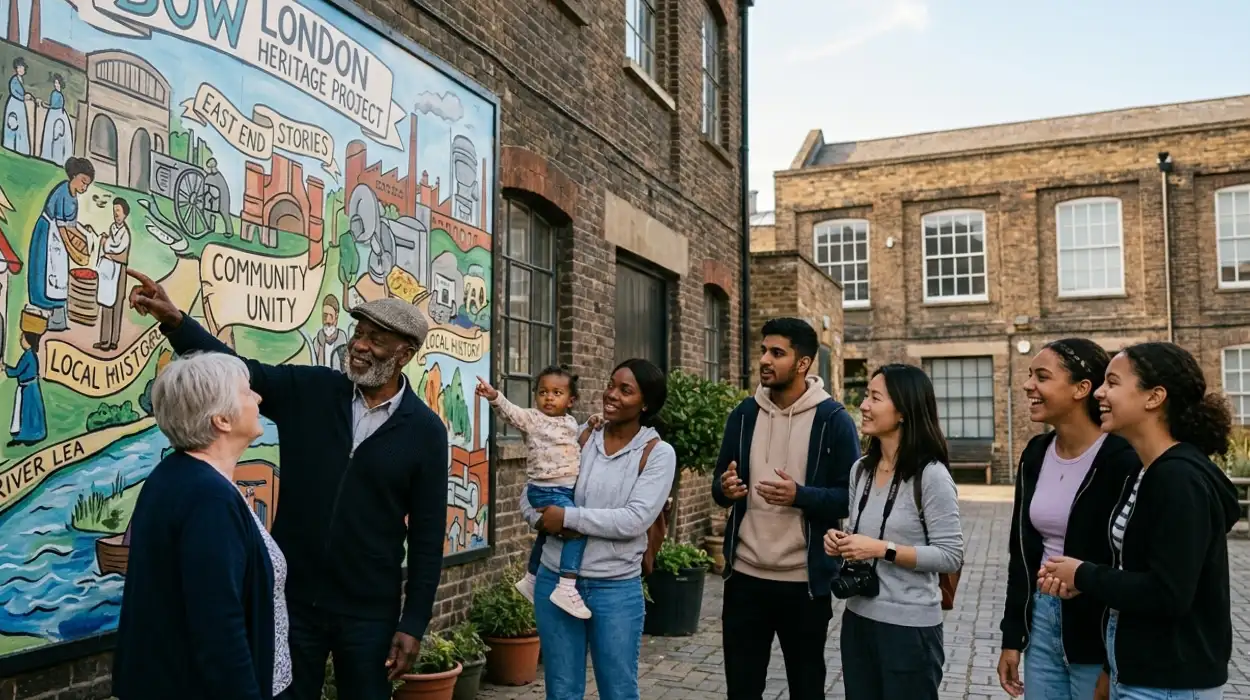
The second component involves the physical transition of this historical material into public spaces through community art initiatives. Rather than commissioning external artists to install static monuments, the project utilizes co-creation workshops where local residents collaborate with creative facilitators. These initiatives manifest as:
- large-scale painted murals on municipal brick walls,
- integrated sculptural markers along historical walking routes,
- textile art installations displayed in community centers, and
- temporary multimedia projection mappings on industrial structures.
The third component centers on architectural conservation and the adaptive reuse of historical spaces. The project operates out of protected structures, ensuring that physical links to the past remain intact within the urban landscape. For example, the partnership with the Heritage & Arts Centre Bow ensures that the Grade II listed Holy Trinity Church serves as a venue for historical exhibitions, creative skill-sharing workshops, and public lectures (Hodge, 2023). This integration prevents historical buildings from falling into disuse or facing demolition due to speculative urban development pressures.
How Does the Project Co-Create Art with Local Communities?
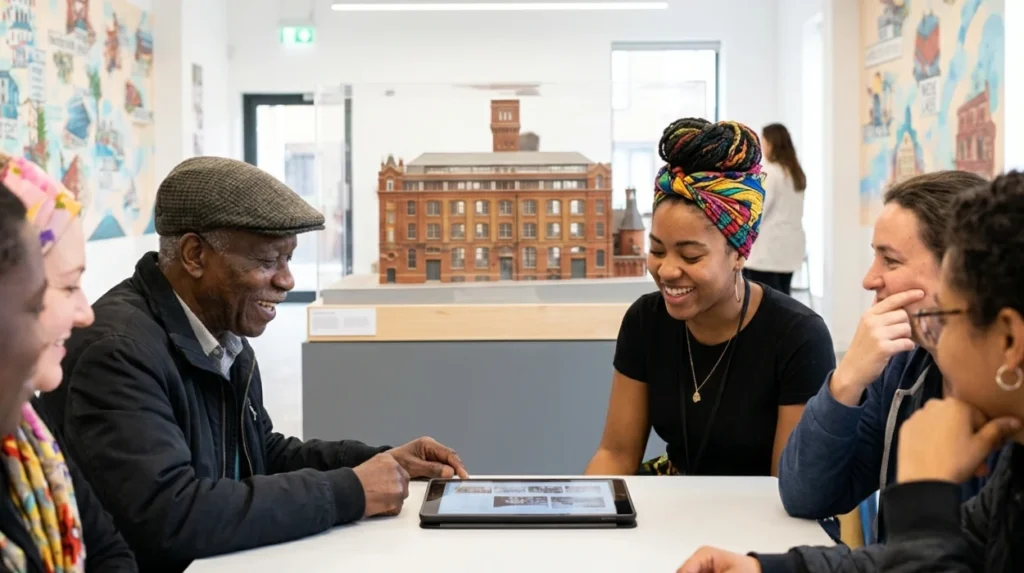
The project co-creates public art by conducting structured collaborative workshops where residents, historians, and professional artists synthesize archival data into creative formats. This methodology ensures that public art directly represents the lived experiences, cultural backgrounds, and historical narratives of the local population.
The process of community co-creation follows a strict participatory action research methodology divided into distinct phases. The initial phase requires establishing partnerships with local community groups, including refugee support organizations, elderly day centers, youth clubs, and tenant management organizations. By utilizing existing social infrastructures, the project ensures that participation represents a cross-section of the demographic profile of Tower Hamlets. This approach bypasses traditional barriers to arts participation that frequently marginalize low-income or non-native English-speaking populations.
The secondary phase involves structured creative workshops where historical data undergoes collective analysis. For instance, participants engage in “Textile Autobiographies” workshops, a method deployed by research practitioners to explore cultural sustainability and community resilience (Mazzarella & Mirza, 2023). During these sessions, participants use traditional textile techniques—such as embroidery, applique, and patchwork quilting—to stitch narratives of migration, labor, and personal identity into collective fabric panels (Mazzarella & Mirza, 2023). This physical practice allows individuals to express complex historical and emotional realities without relying exclusively on written or spoken English.
The final phase translates these workshop outputs into permanent or semi-permanent public installations. Professional artists work alongside participants to scale up designs, ensure structural integrity, and navigate municipal planning permissions. The physical fabrication takes place in communal spaces, allowing passersby to observe and engage with the production process. This open methodology demystifies the artistic process, shifts the ownership of public spaces back to the residents, and ensures that the finished pieces are contextually integrated into the urban fabric of East London.
Explore More Things To Do
New Support Grants Open for Small Independent Businesses: London 2026
Croydon Pride in Place Fund Infrastructure Upgrades: London 2026
What Role Do Specific Historic Sites Play in the Initiative?
Specific historic sites serve as physical anchors, community hubs, and contextual canvases for the project’s initiatives. Repurposed industrial factories, historic religious structures, and public waterways provide the tangible spaces where historical narratives are researched, displayed, and preserved.
Physical structures in Bow provide the necessary spatial context for historical interpretation. The Heritage & Arts Centre (HAC) Bow, situated within the nineteenth-century Holy Trinity Church, represents a primary spatial asset for the project. Completed in 1841 during a period of intense urban expansion, the church historically served as a focal point for Mile End’s middle class and industrial elite (Hodge, 2023). Today, the building houses the project’s physical archives, providing a venue where researchers analyze gravestones, burial records, and memorial plaques to reconstruct the life histories of ordinary working people across varying classes and genders (Hodge, 2023).
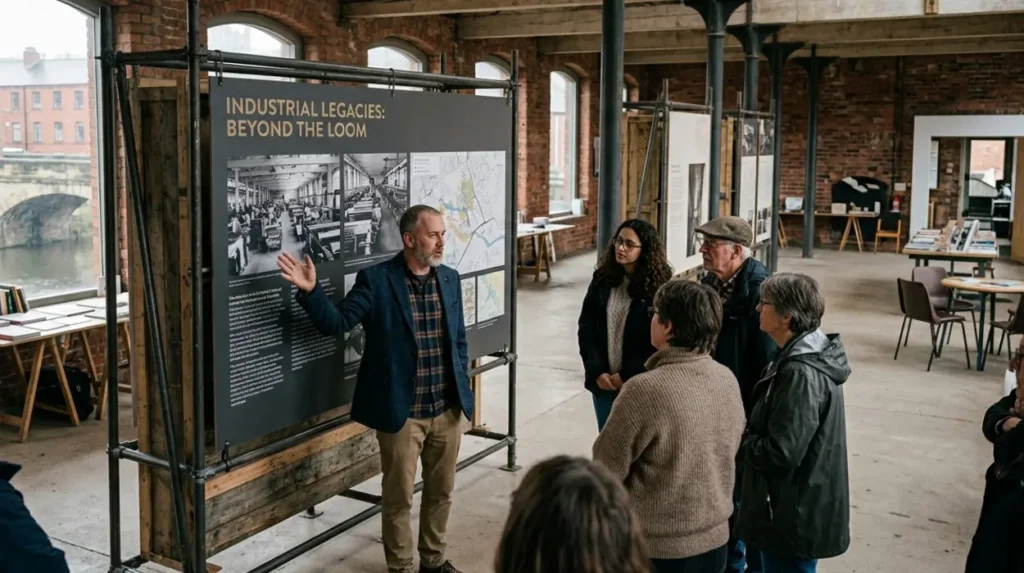
Another critical geographic site is the Fairfield Road district, specifically the surviving elements of the Bryant & May match factory. The preserved Victorian brick facade serves as an open-air educational asset. The Bow London Heritage Project uses this specific site to conduct guided historical walks and on-site educational workshops. By standing before the physical gates where the 1888 strike commenced, contemporary participants gain an immediate spatial understanding of industrial scale and labor history. The architecture functions not merely as a historic monument, but as a teaching tool that connects nineteenth-century exploitation with modern labor discussions.
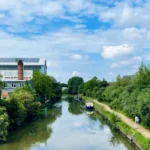
The industrial waterways of Bow, including the Bow Back Rivers and the Hertford Union Canal, function as physical canvases for public art integration. These canals were originally constructed to transport industrial commodities, such as coal, timber, and chemicals. The project utilizes the towpaths and underpasses of these waterways to place localized historical signage and community-painted murals. Transforming these transitional pathways into outdoor galleries exposes recreational users, commuters, and visitors to the industrial heritage of the area, contextualizing how water infrastructure shaped the economic geography of London.
How Does the Project Measure Its Social and Economic Impact?
The project measures impact through quantitative assessments of public engagement and qualitative evaluations of community resilience, civic pride, and creative skill acquisition. Tracking visitor numbers, workshop attendance, and participant well-being metrics provides verification of the socioeconomic benefits delivered to Tower Hamlets.
Socioeconomic evaluation relies on mixed-method frameworks to capture both numerical reach and human impact. Quantitatively, the initiative tracks direct participation metrics across all operational nodes. These metrics include:
- annual visitor footfall at physical exhibition sites,
- the number of unique participants enrolled in co-creation workshops,
- digital access rates for open-source historical archives, and
- the volume of primary source documents successfully digitized and cataloged.
These figures are audited alongside demographic data to ensure compliance with equity, diversity, and inclusion targets established by funding bodies such as the Arts and Humanities Research Council (AHRC).
Qualitatively, the project measures changes in civic engagement, localized identity formulation, and community cohesion. Researchers conduct semi-structured interviews and focus groups with participants following workshop completions. In projects involving transient or marginalized populations, such as refugees and asylum seekers residing in East London, participation has been documented to directly improve self-confidence, build local community resilience, and provide a safe space to process shifting identities during periods of legal or societal upheaval (Mazzarella & Mirza, 2023). The acquisition of transferable craft and research skills also provides participants with pathways toward further education or employment within the cultural heritage sector.
From an economic perspective, the project contributes to the creative economy of Tower Hamlets by providing direct employment and freelance commissions for local artists, historians, and archival specialists. By transforming historic sites into community cultural hubs, the initiative stimulates local footfall, benefitting independent retail and hospitality businesses in the surrounding neighborhood. Furthermore, the focus on cultural heritage tourism attracts external visitors to the district, redistributing tourism expenditures from central London toward the retail corridors of East London.
What Are the Future Implications for Heritage Preservation in East London?
The future implications center on creating scalable models for decentralized urban preservation that counter the displacing effects of gentrification. By embedding working-class histories into physical infrastructure, the project ensures that marginalized narratives remain permanent fixtures within rapidly redeveloping urban landscapes.
The ongoing redevelopment of East London, accelerated by post-2012 Olympic legacy infrastructure projects, has introduced significant gentrification pressures across Tower Hamlets, Newham, and Hackney. Empirical evidence indicates that top-down, legacy-led urban regeneration frequently creates an unequal trade-off, displacing pre-existing minoritised ethnic residents and low-income populations in favor of wealthier demographics (Islam, 2023). This displacement often leads to the erasure of localized cultural heritage and working-class history as old industrial buildings are demolished or converted into luxury residential complexes.
The Bow London Heritage Project establishes a defensive counter-model to this trend. By securing heritage protections, documenting oral histories, and establishing physical public art markers, the initiative anchors working-class narratives within the geographic landscape. This ensures that even as demographic shifts occur, the physical environment continues to communicate its histories of migration, labor resistance, and artistic innovation. Future preservation frameworks are increasingly adopting these participatory action models to ensure that municipal redevelopment plans respect and incorporate existing cultural assets rather than erasing them.
Furthermore, the integration of digital humanities ensures the long-term survivability of these records independent of physical space. The digitalization of oral histories, 3D scans of historic structures, and open-access catalogs allows global researchers to study the social history of East London. This digital infrastructure supports the decolonization of regional history curricula, providing primary source materials for schools and universities. The methodologies developed by the project provide a functional blueprint for global metropolitan areas grappling with the preservation of working-class histories within rapidly changing urban environments.
What is the Bow London Heritage Project?
The Bow London Heritage Project is a community-led cultural preservation initiative in East London focused on documenting working-class history, industrial heritage, migration stories, and local identity through archives, public art, and educational programs.