
The Londoner News presents an authoritative review of the critical infrastructural updates across the South London transport network. A major segment of the arterial network faces prolonged disruptions due to structural engineering interventions.
- What Is The Scope Of The Hampton Court Road Maintenance Project?
- Why Is Planned Maintenance Necessary On The A308 Corridor?
- How Will The Roadworks Disrupt South London Traffic Flows?
- What Are The Approved Diversion Routes For Commuters?
- How Will Local Public Transport Services Be Affected?
- What Is The Expected Timeline For Project Completion?
- What Modern Engineering Techniques Are Being Utilized?
- How Will This Infrastructure Investment Benefit South London?
- What Emergency Protocols Are In Place During The Construction Phase?
What Is The Scope Of The Hampton Court Road Maintenance Project?
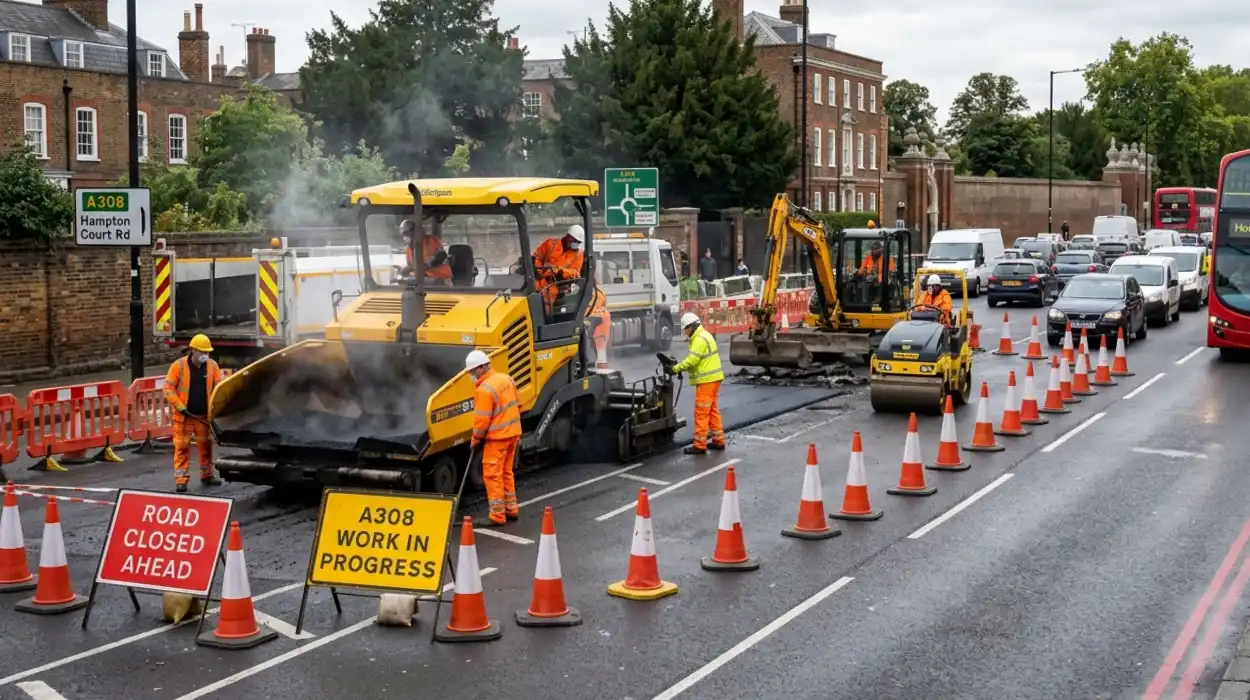
The Hampton Court Road maintenance project encompasses extensive carriageway resurfacing, structural asset reinforcement, and utility upgrades on the A308 corridor. The initiative targets structural degradation across a two-mile segment to guarantee long-term vehicular safety and network reliability.
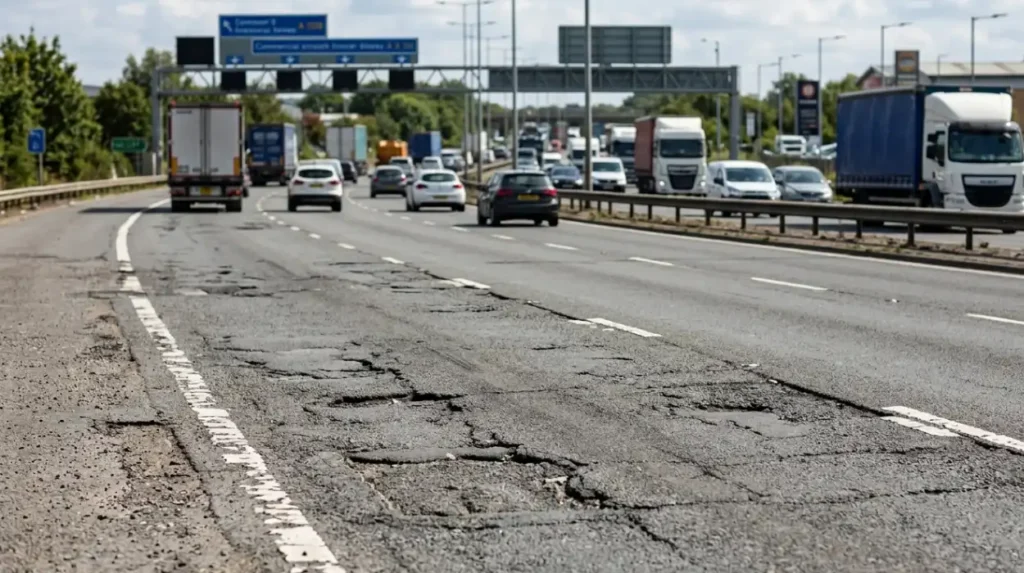
The London Borough of Richmond upon Thames, in coordination with Transport for London (TfL), has finalized a comprehensive engineering layout for the A308 Hampton Court Road. This specific state-maintained arterial route links Southwest London to key residential and commercial zones in Surrey. The surface asset management team identified extensive sub-base deterioration, macro-cracking, and compromised binder courses along the dual and single-carriageway sections. Left unaddressed, this level of degradation hazards structural failure of the highway asset.
The engineering intervention deploys 3 specific phases of physical works:
- Deep-bore structural resurfacing: Excavation of the degraded asphalt layers down to the foundation stone, followed by the installation of a high-durability polymer-modified bitumen base layer.
- Drainage infrastructure modernization: The removal of blocked gullies and the installation of high-capacity attenuation systems designed to mitigate surface water flooding during peak precipitation events.
- Infrastructural utility integration: Targeted access provisions for Thames Water and National Grid assets buried beneath the footway and carriageway environments, preventing the necessity of emergency excavations in the subsequent 5-year cycle.
The local authority schedules these highway works under the statutory provisions of the New Roads and Street Works Act 1991. This legislation mandates that public utilities and highway authorities coordinate asset interventions to minimize public economic loss. The total financial expenditure allocated to this structural refurbishment stands at £1.4 million, sourced from the central borough transport fund.
Why Is Planned Maintenance Necessary On The A308 Corridor?
Planned maintenance on the A308 corridor is necessary because the route sustains heavy daily traffic volumes that exceed its original design parameters. Continuous structural stress combined with historic environmental weathering has caused critical wear to the underlying highway foundation.
The historical context of the A308 Hampton Court Road defines its modern structural vulnerabilities. Constructed originally to facilitate horse-drawn transit and early 20th-century mechanized logistics, the corridor has evolved into a primary trunk road. Transport data from the Department for Transport (DfT) reveals that the daily average weapon-weight traffic count on this sector has increased by 22% over the past two decades. Heavy Goods Vehicles (HGVs), such as 32-tonne multi-axle logistics vehicles and double-decker public transit buses, exert high axle load pressures. This stress accelerates the deformation of the asphalt matrix through a process known as fatigue cracking.
Environmental factors exacerbate this mechanical fatigue. The proximity of the highway to the River Thames introduces a high localized water table. Sub-surface moisture penetrates the lower aggregate foundation layers during seasonal winter freezes. The subsequent freeze-thaw cycle forces the water to expand, displacing the compressed aggregate particles and generating sub-surface voids. When heavy commercial vehicles pass over these hidden voids, the unsupported surface asphalt collapses, forming deep potholes and systemic longitudinal ruts.
The implementation of a planned maintenance program prevents the complete structural failure of the highway asset. Reactive repairs, such as emergency localized pothole patching, do not restore the structural integrity of the pavement foundation. By executing a planned intervention, engineers replace the structural profile entirely, extending the operational lifecycle of the highway asset by an estimated 15 years.
How Will The Roadworks Disrupt South London Traffic Flows?
The roadworks will disrupt South London traffic flows by reducing local lane capacity, imposing mandatory lower speed limits, and introducing temporary signal control systems. These operational restrictions will alter local arterial network performance, increasing driver journey delays across peak travel hours.
The introduction of engineering assets onto a live highway forces immediate adjustments to traffic management configurations. Transport for London models indicate that closing one lane of a dual-carriageway segment reduces the saturation flow rate of that junction by more than 50%. The physical presence of highway personnel and heavy machinery requires the establishment of safety buffer zones, mandated under Chapter 8 of the Traffic Signs Manual.
The traffic management plan enforces 3 specific operational constraints:
- Temporary multi-way traffic signals: Replacing standard fixed-time signals with sensor-driven temporary installations at the intersections of the A308 with local secondary roads.
- Carriageway width restrictions: Narrowing the operational lanes to 3.0 meters, which forces larger commercial logistics vehicles to reduce transit speeds to less than 20 miles per hour.
- Overnight total closures: Executing complete linear closures between 21:00 and 05:00 hours on targeted dates to facilitate heavy material delivery and large-scale planing machinery operations.
These constraints alter the local Volume-over-Capacity (V/C) ratios significantly. During peak morning commuter periods (07:00 to 09:30) and evening return periods (16:30 to 19:00), the V/C ratio along the A308 is projected to rise to 1.15, signaling that traffic demand will exceed the available physical capacity of the road network. This imbalance leads directly to queue propagation, where stationary vehicle lines extend backward into surrounding residential road networks.
What Are The Approved Diversion Routes For Commuters?
The approved diversion routes for commuters utilize major parallel strategic roads including the A309, the A307, and the A3 traffic corridors. Transport for London signed these specific routes to safely redirect heavy vehicular volumes away from the active construction zones.
To mitigate severe gridlock within the immediate vicinity of Hampton Court Palace and the Kingston bridge network, traffic engineers have designed a strategic regional diversion map. The primary objective of this mapping is to separate local residential traffic from long-distance transit traffic. Signs deployed across the highway network instruct heavy logistics vehicles and non-local motorists to bypass the A308 entirely by utilizing higher-capacity strategic trunk roads.
The strategic diversion path diverts westbound traffic at the Kingston roundabout, redirecting drivers via the A307 southbound toward Esher. From this node, vehicles interface with the A309 northbound link road to re-establish connection with the A308 west of the maintenance zone. Conversely, eastbound traffic originating from the Sunbury and Staines sectors is diverted southward via the A308 junction toward the M3 motorway and the A3 trunk road.
Drivers must account for 3 specific operational impacts when utilizing these diversion lines:
- Extended geographic mileage: The strategic diversion path adds an additional 4.2 miles to a standard cross-borough journey.
- Increased junction transit times: Secondary roundabouts along the A307 suffer from elevated entry-demand pressures, increasing localized delays at non-signalized merge points.
- Enforced weight restrictions: Strategic heavy vehicles must remain strictly on the designated A-road diversions, as local alternative residential paths enforce a 7.5-tonne maximum weight limit, monitored via automatic number plate recognition (ANPR) systems.
Explore More Things To Do
New School And Community Hub Timelines: Purfleet Waterfront
New Cycleway 9 and Pedestrian Zone Updates: West London 2026
How Will Local Public Transport Services Be Affected?
Local public transport services will be affected through mandatory route diversions, temporary bus stop suspensions, and increased timetable volatility for regional operators. Bus networks operating through the A308 corridor must adjust scheduled journey times to maintain connection consistency.
The bus network across Southwest London relies on the unimpeded operation of key arterial corridors. The planned maintenance works directly impact several high-frequency routes managed by Transport for London and regional Surrey operators. Because buses cannot navigate past asphalt planing equipment within single-lane restrictions, certain service sectors require immediate operational modification.
The public transit mitigation plan includes 3 specific operational adjustments:
- Route truncation and short-turning: Terminating specific services short of their standard destinations to prevent vehicles from becoming trapped within stagnant queues on Hampton Court Road.
- Temporary stop placement: Deactivating fixed roadside shelters within the active construction zone and erecting temporary boarding flags 200 meters outside the safety perimeters.
- Inter-operator ticket acceptance: Allowing passengers holding specific TfL Oyster or contactless media to utilize regional rail connections without incurring additional fare penalties.
Timetable reliability data forecasts a reduction in Excess Wait Time (EWT) metrics across local routes if commuters do not transition to rail alternatives. The local train services operating from Hampton Court station and Kingston station remain unaffected by the surface roadworks, providing a consistent transit alternative into central London terminals. London Bus route 411 and regional route 461 face the highest probability of operational delays, with peak-period schedules extended by up to 25 minutes per single journey loop.
What Is The Expected Timeline For Project Completion?
The expected timeline for project completion spans a total duration of six consecutive weeks, commencing in early June and concluding by mid-July. The engineering team operates on a 24-hour shifting pattern to compress the structural construction schedule.
The project management office has established a strict linear timeline to ensure the highway asset is fully restored prior to the late-summer tourism surge. The delivery schedule utilizes critical path method (CPM) planning to ensure that material delivery, excavation, curing, and road-marking application proceed without operational gaps. Any delay in the initial excavation phases will cascade into subsequent resurfacing milestones.
The chronological execution plan follows 3 distinct structural milestones:
- Phase 1 (Weeks 1-2): Initial site mobilization, setting up temporary traffic control assets, and executing deep drainage asset clearing alongside targeted sub-base stabilizing injections.
- Phase 2 (Weeks 3-4): High-speed macro-planing of the existing worn top layers, followed by immediate base-course layer installation and utility cover adjustments.
- Phase 3 (Weeks 5-6): Laying the high-friction surface wearing course, executing thermoplastic reflective line installations, and conducting final safety audits prior to total site demobilization.
Weather dependencies present the primary risk to this project timeline. The application of high-friction surfacing materials and polymer-modified binders requires a dry substrate and ambient temperatures above 10 degrees Celsius. In the event of persistent heavy precipitation, surface laying operations must pause to prevent moisture entrapment, which causes premature blistering and rapid delamination of the modern asphalt material. The local authority maintains a contingency window of four additional nights to absorb minor environmental disruptions without delaying the final reopening date.
What Modern Engineering Techniques Are Being Utilized?
The modern engineering techniques being utilized include cold mechanical planing, the application of polymer-modified stone mastic asphalt, and sensor-based traffic signal optimization. These advanced industrial processes maximize the physical longevity of the road surface while lowering the carbon footprint.
The execution of modern highway maintenance requires techniques that surpass traditional hot-mix asphalt applications. To ensure maximum asset durability under heavy urban transit loads, the contracting civil engineering firm has specified the use of Stone Mastic Asphalt (SMA) infused with elastomeric polymer modifiers. This specific chemical formulation enhances the structural flexibility of the surface, allowing it to resist rutting during extreme summer temperatures and preventing brittle cracking during winter sub-zero cycles.
The physical rehabilitation process deploys 3 specific engineering mechanisms:
- Micro-milling and cold planing: Utilizing precision drum cutters to remove exactly 50 millimeters of worn surface asphalt, creating a highly textured substrate that improves the mechanical bond with the new layer.
- In-situ base stabilization: Injecting structural polyurethane resins into soft sub-grade soil profiles beneath the highway foundation to arrest structural sinking without requiring full-depth excavation.
- Smart signal attenuation: Deploying temporary radar-controlled traffic signals that dynamically adjust green-light phases based on real-time vehicle queue lengths, minimizing unnecessary idling times.
The utilization of these techniques reduces the overall material mass required for the project. By using precision planing, the contractor recycles 100% of the excavated asphalt road base, transferring the material to a local processing plant where it is converted into recycled aggregate for future infrastructure projects. This closed-loop resource system aligns with the environmental sustainability mandates enacted across Greater London borough development frameworks.

How Will This Infrastructure Investment Benefit South London?
This infrastructure investment will benefit South London by establishing superior surface ride quality, lowering localized vehicular emissions, and reducing structural vehicle maintenance costs for road users. The finished project secures long-term asset protection for a critical economic transit corridor.
The long-term socio-economic returns of the £1.4 million capital deployment extend beyond basic surface smoothness. Civil infrastructure research demonstrates that poor road surfaces increase vehicular rolling resistance, which forces internal combustion engines and electric vehicle powertrains to expend more energy per mile. By eliminating surface irregularities, potholes, and longitudinal ruts, the average fuel efficiency of vehicles traversing the A308 corridor is projected to improve, leading to a measurable reduction in localized carbon dioxide and particulate matter emissions.
The structural upgrade yields 3 specific regional benefits:
- Decreased road traffic accident risk: The installation of high-friction surfacing across critical braking zones reduces vehicle stopping distances by up to 30% under wet conditions.
- Mitigated vehicle wear and tear: Eliminating sudden impacts from deep potholes reduces mechanical damage to consumer suspension systems, steering linkages, and tire sidewalls.
- Enhanced asset value: Preserving the integrity of the highway foundation prevents the necessity of a total asset reconstruction, saving taxpayers an estimated £4 million in emergency intervention costs over the coming decade.
Furthermore, improved drainage attenuation structures protect adjacent commercial properties and historical residential structures from the destructive impacts of road splash and localized flash flooding. By securing the operational continuity of the A308 Hampton Court Road, the borough maintains robust logistics connectivity, supporting local commerce, historical tourism institutions, and emergency services deployment routes across the entire South London geography.
What Emergency Protocols Are In Place During The Construction Phase?
What emergency protocols are in place during the construction phase? Emergency protocols include the enforcement of continuous blue-light priority access, the positioning of dedicated vehicle recovery assets, and real-time communication links between site managers and London emergency centers.
The maintenance of emergency service transit through an active construction zone is a statutory requirement under UK blue-light operational frameworks. Because the A308 serves as a vital pathway for London Ambulance Service vehicles, London Fire Brigade pumps, and Metropolitan Police Service units navigating toward regional incidents, the construction layout must adapt instantly to emergency transits. The site operations team maintains direct radio contact with regional dispatchers to ensure advance warning of approaching emergency assets.
The emergency management layout operates through 3 specific field protocols:
- Instant gate-opening procedures: Constructing specialized removable safety barriers that allow highway workers to clear a continuous 3.5-meter path through the center of the work zone within 60 seconds of hearing an emergency siren.
- On-site heavy recovery assets: Deploying a dedicated heavy-duty tow vehicle at the perimeter of the roadworks zone to immediately remove any civilian vehicle that suffers a mechanical breakdown within the single-lane restriction.
- Dynamic diversion overrides: Granting emergency vehicles total exemption from standard diversion routing, allowing blue-light assets to utilize restricted-access corporate access lanes when necessary.
These protocols ensure that response time metrics for critical life-safety events do not deteriorate during the six-week engineering cycle. Regular monitoring via CCTV feeds linked directly to the Transport for London Network Management Control Centre allows traffic operators to adjust surrounding fixed signals, clearing downstream congestion before an emergency vehicle arrives at the construction perimeter.
The Londoner News will continue to provide structural transport updates as this major infrastructure investment progresses toward its summer completion milestone. Drivers are advised to consult real-time digital transit indicators prior to initializing journeys across the Southwest London network.
What is happening on Hampton Court Road?
The A308 Hampton Court Road is undergoing major maintenance works, including road resurfacing, drainage improvements, and utility-related infrastructure upgrades designed to improve safety and extend the lifespan of the road.