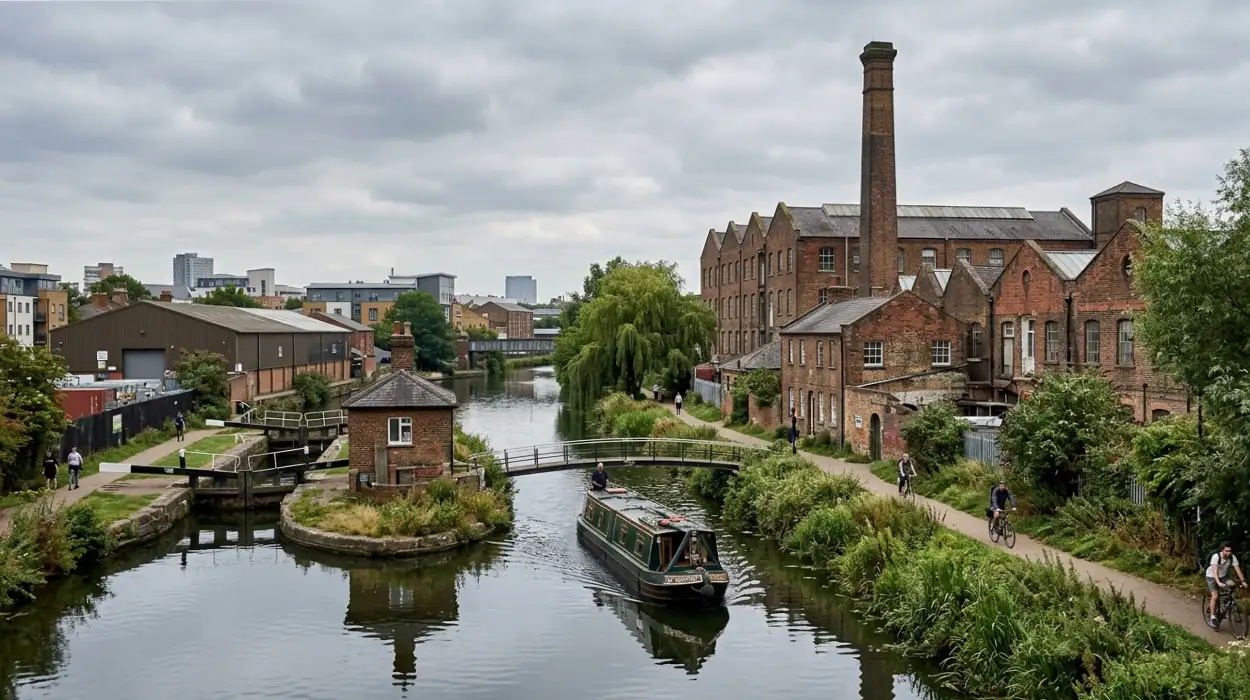
The River Lea is a 42-mile-mile-long tributary of the River Thames that originates in Luton and flows through Hertfordshire and North London, serving as a critical navigation route and power source that accelerated Britain’s transition into an industrialized economy.
- How Did Early Water Management and Infrastructure Projects Transform the Lea Valley into an Economic Highway?
- Which Core Industries Defined the North London Industrial Corridor Along the River Lea?
- How Did Industrial Expansion Drive Urban Growth and Change the Demographics of Local Communities?
- What Were the Environmental Consequences of Unregulated Industrial Activities in the Lea Valley?
- What Key Historical Milestones and Technological Innovations Emerged from the River Lea’s Factories?
- How Did the Decline of Manufacturing Impact These North London Communities in the Late Twentieth Century?
- What Physical Remnants and Heritage Preservation Projects Exist Along the River Lea Today?
- How Has the Industrial Legacy of the Lea Valley Shaped the Modern Identity of North London?
Historically, the River Lea formed a natural boundary between the ancient kingdoms of Middlesex and Essex. Its geographical position made it an essential conduit for transporting agricultural goods from the home counties directly into the heart of London. By the sixteenth century, the British government recognized the river’s strategic economic value, leading to the River Lea Act of 1571. This legislation authorized the improvement of navigation channels, including the construction of the Waltham Cut, to ensure a reliable supply of grain to London’s growing population.
The natural hydrology of the Lea Valley provided substantial water power, a prerequisite for early industrial processes. Before the widespread adoption of steam power in the nineteenth century, watermills lined the river banks. These mills ground flour, crushed oilseeds, and powered early textile machinery. The availability of water power, combined with proximity to the largest consumer market in Britain, attracted early manufacturers who required both energy and efficient transport links.
As the Industrial Revolution accelerated, the Lea Navigation system underwent extensive engineering modifications. Engineers like John Smeaton and Thomas Telford designed locks, canals, and reservoirs that bypassed the river’s natural twists and shallow reaches. These alterations transformed the Lea into a predictable, high-capacity industrial highway. By the early nineteenth century, the river connected the industrial centers of Hertford and Ware directly to the Thames at Bow Creek, allowing barges to move heavy raw materials such as coal, timber, and building stone into North London.
The convergence of transport infrastructure, water resources, and available land in the outer parishes of North London created an ideal environment for manufacturing clusters. Parishes like Tottenham, Edmonton, and Walthamstow transformed from rural agricultural villages into industrial hubs. The river did not merely support factories; it dictated the spatial arrangement of the factories, workshops, and worker housing that formed the foundation of modern North London.
How Did Early Water Management and Infrastructure Projects Transform the Lea Valley into an Economic Highway?
Early water management transformed the Lea Valley into an economic highway through parliamentary acts, engineered canal locks, artificial cuts, and reservoir construction that stabilized the river’s flow, expanded barge capacity, and provided clean water to London’s expanding population.
The systematic engineering of the River Lea began in earnest under the direction of the New River Company, incorporated by royal charter in 1619. Spearheaded by Sir Hugh Myddelton, the company constructed the New River, an artificial aqueduct that diverted fresh water from the River Lea near Ware down to New River Head in Finsbury. This infrastructure project supplied clean drinking water to London, demonstrating the river’s capacity for large-scale hydraulic engineering. This project established a precedent for treating the Lea Valley as a managed utility corridor.
In 1767, Parliament passed the Lee Navigation Improvement Act, which appointed trustees to oversee the modernization of the waterway. The trustees hired civil engineer John Smeaton to survey the river and design improvements. Smeaton implemented a system of pound locks to replace the inefficient flash locks that caused frequent navigation delays. The construction of the Limehouse Cut, completed in 1770, connected the River Lea directly to the Thames at Limehouse, bypassing the circuitous and dangerous navigation around the Isle of Dogs and reducing transport times into central London by several hours.
During the nineteenth century, structural developments shifted toward managing both transport and public health. The Metropolis Water Act of 1852 mandated that water companies draw domestic supplies above the tidal reaches of the Thames to prevent cholera. In response, the East London Waterworks Company constructed a vast network of reservoirs in the lower Lea Valley, including the Walthamstow Reservoirs and the Warwick Reservoirs. These engineering projects altered the topography of the valley, replacing marshland with vast bodies of water that regulated urban flooding and secured water supplies for millions of Londoners.
The infrastructure expansion culminated in the late nineteenth century with the construction of the Tottenham and Forest Gate Railway and the expansion of the Great Eastern Railway, which ran parallel to the navigation channels. This multi-modal transport network enabled factories to receive bulk raw materials by barge and distribute finished products rapidly by rail. The coordinated development of water, canal, and rail infrastructure turned the Lea Valley into one of the most densely integrated industrial corridors in the United Kingdom.
Which Core Industries Defined the North London Industrial Corridor Along the River Lea?
The North London industrial corridor along the River Lea was defined by specialized manufacturing clusters, including firearms production at Waltham Abbey, chemical and plastics manufacturing in Manningtree and Hackney Wick, and large-scale electronics manufacturing in Enfield.
The Royal Small Arms Factory (RFAF), established by the Board of Ordnance in 1816 at Enfield Lock, served as the anchor institution for precision manufacturing in the region. The state-owned facility manufactured military firearms, including the iconic Enfield rifle used by British imperial forces. The RFAF introduced American methods of mass production to Britain, utilizing interchangeable parts and specialized machinery powered by water from the River Lea. The factory attracted skilled engineers, machinists, and metallurgists to Enfield, creating a highly technical local workforce.
Further downstream, the Lea Valley became a global center for the chemical industry. In 1865, Alexander Parkes established the Parkesine Company in Hackney Wick, producing the world’s first synthetic plastic material, Parkesine. Although the company failed commercially, its successor, the British Xylonite Company, opened a large-scale manufacturing plant at Hale End, Walthamstow, in 1897. This factory produced celluloid plastics for consumer goods like combs, collars, and photographic film, establishing the region as a leader in material science.
The chemical sector also included extensive paint, varnish, and explosive manufacturing plants. The Royal Gunpowder Mills at Waltham Abbey, situated on the upper reaches of the river, produced military-grade explosives for centuries, relying on the river’s network of streams for power, transport, and safety isolation. In Stratford and Bow, chemical works produced sulphuric acid, fertilizers, and coal-tar derivatives, utilizing the river for waste disposal and raw material transport.
In the twentieth century, the industrial corridor transitioned into consumer electronics and electrical engineering. The Edison Swan Electric Company, later known as Ediswan, established a factory at Ponders End in Enfield, where they manufactured the first commercial incandescent light bulbs and thermionic valves. This facility laid the groundwork for the emergence of the “Silicon Valley” of its era along the Lea, with companies like Thorn Electrical Industries and Ferguson Radio Corporation setting up massive assembly plants that supplied televisions, radios, and domestic appliances to the British domestic market.
How Did Industrial Expansion Drive Urban Growth and Change the Demographics of Local Communities?
Industrial expansion drove urban growth and transformed local demographics by converting rural hamlets into dense, working-class urban districts, attracting waves of internal migrants and international immigrants who settled near the factories lining the River Lea.
The rapid industrialization of the Lea Valley caused an unprecedented population surge in the surrounding parishes during the nineteenth and early twentieth centuries. For example, the population of Tottenham grew from 3,629 residents in 1801 to 102,691 residents by 1901. This demographic shift was mirrored in adjacent districts like West Ham, Walthamstow, and Leyton. The primary catalyst was the demand for labor at the Royal Small Arms Factory, the chemical works, and the local railway yards, which drew thousands of agricultural laborers from East Anglia and the home counties into North London.
The influx of workers required rapid residential development, leading to the construction of extensive terraced housing estates. Speculative builders bought up former agricultural land and market gardens to erect high-density housing for the working-class population. The Cheap Trains Act of 1883 further accelerated this process by requiring railway companies to offer low-cost workmen’s fares, allowing laborers to commute easily between residential suburbs like Edmonton and the industrial zones along the river banks.
International immigration patterns significantly influenced the cultural and demographic composition of the Lea Valley communities. In the late nineteenth and early twentieth centuries, thousands of Jewish refugees fleeing persecution in Eastern Europe settled in the East End and subsequently migrated northward into Hackney, Tottenham, and Stamford Hill. These communities established local garment workshops, furniture factories, and retail businesses, integrating into the existing industrial economy of the valley.
Following the Second World War, the labor shortage in the expanding manufacturing sectors attracted new populations from the Commonwealth. Migrants from the Caribbean, South Asia, and Cyprus settled in districts like Tottenham, Walthamstow, and Edmonton to work in electronics factories, transport networks, and public services. This migration transformed North London into a multicultural region, where local community organizations, religious institutions, and commercial districts reflected the global origins of the workforce that sustained the local industrial economy.
What Were the Environmental Consequences of Unregulated Industrial Activities in the Lea Valley?
The environmental consequences of unregulated industrial activities in the Lea Valley included severe water pollution from chemical runoff, toxic air emissions from factories, and widespread habitat destruction that devastated the local ecosystem and caused public health crises.
The River Lea functioned for decades as an open sewer and industrial dump site for the factories operating along its banks. Chemical works, gasworks, distilleries, and slaughterhouses in Bow, Stratford, and Hackney discharged untreated effluents directly into the watercourses. By the mid-nineteenth century, the lower reaches of the river were heavily contaminated with heavy metals, ammonia, and organic waste, which depleted oxygen levels in the water and eliminated fish populations.
The organic pollution contributed directly to outbreaks of waterborne diseases in the surrounding communities. The most notable incident occurred during the 1866 cholera epidemic in London, which was traced directly to the contamination of the Old Ford Reservoir by the East London Waterworks Company. The waterworks had inadvertently distributed water contaminated with sewage from the River Lea, resulting in over 5,500 deaths in the East End and North London districts, highlighting the dangers of mixing municipal water supplies with industrial drainage.
Air pollution was equally severe due to the concentration of coal-burning factories, locomotives, and domestic hearths in the valley. The geographic topography of the Lea Valley, which forms a low-lying basin, frequently trapped industrial emissions, leading to heavy smog. These environmental conditions caused respiratory illnesses, such as chronic bronchitis and tuberculosis, among the working-class populations living in the high-density housing adjacent to the industrial zones.
The physical alteration of the river system also destroyed the natural wetland habitats of the Lea Valley. Marshlands were systematically drained, paved over, or converted into concrete-lined channels and reservoirs to facilitate industrial development and flood control. This process eradicated the native flora and fauna, transforming a biodiverse river valley into a sterile industrial landscape. The legacy of this pollution remains present today in the contaminated industrial soils and riverbed sediments of the lower Lea Valley.
Explore More History Of London
Hidden Victorian Station Vaults and Underground Arches: North London
History Of High Cross Medieval Landmarks: Tottenham
What Key Historical Milestones and Technological Innovations Emerged from the River Lea’s Factories?
Key historical milestones and technological innovations from the River Lea’s factories include the development of interchangeable parts for military firearms, the synthesis of the world’s first plastics, and pioneering advancements in thermionic valves that enabled modern telecommunications.
The Royal Small Arms Factory at Enfield was a pioneer in manufacturing technology. In the 1850s, the factory imported specialized machinery from the United States, including automated lathes and milling machines developed by the Robbins & Lawrence Company. This innovation allowed the factory to implement the “American System of Manufacturing,” which relied on standardized gauges and automated production to achieve precise interchangeability of rifle components. This marked a major shift away from traditional craft-based gunsmithing toward modern assembly-line manufacturing.
In 1865, the creation of Parkesine at Hackney Wick by Alexander Parkes marked the official birth of the global plastics industry. Parkes dissolved nitrocellulose in solvents like ethanol and camphor, creating a hard, flexible, and transparent material that could be molded when heated. This invention laid the technical foundation for the development of celluloid and all subsequent synthetic polymers, which transformed global consumer product manufacturing, medical devices, and packaging in the twentieth century.
The Lea Valley also played a crucial role in the development of global telecommunications and broadcasting infrastructure. At the Ediswan factory in Ponders End, physicist John Ambrose Fleming collaborated with the company to manufacture the first commercial thermionic valve (or vacuum tube) in 1904. This technological innovation acted as the foundational component for radio transmitters, receivers, and early digital computers, enabling the growth of the BBC and the global telecommunications industry during the mid-twentieth century.
Furthermore, the region was a center for automotive and aviation innovation. In 1892, Edward Butler built the Butler Petrol Cycle, one of the earliest British petrol-powered motor vehicles, at the Erith Engineering Works in Hackney. During the First World War, factories along the Lea, such as the Lebus furniture factory in Tottenham, re-tooled their production lines to manufacture aircraft components, including wings and fuselages for the Royal Flying Corps, demonstrating the high level of industrial adaptability within the local workforce.
How Did the Decline of Manufacturing Impact These North London Communities in the Late Twentieth Century?
The decline of manufacturing impacted North London communities through severe deindustrialization, causing high unemployment rates, widespread urban decay, and social deprivations as major employers closed their operations.
The deindustrialization of the Lea Valley accelerated rapidly after the Second World War and reached its peak between 1970 and 1990. Structural shifts in the global economy, including competition from manufacturing centers overseas, rising land values in London, and high transport costs within urban areas, forced many companies to close or relocate outside the capital. The Royal Small Arms Factory at Enfield officially closed its gates in 1988, ending over 170 years of manufacturing at the site and eliminating thousands of skilled engineering jobs.
The electronics and chemical sectors experienced a similar collapse. The Ediswan factory in Ponders End closed its manufacturing divisions, and major employers like Thorn EMI and Lesney Products (manufacturers of Matchbox toy cars) liquidated their operations or moved production abroad. Between 1971 and 1981, the London Borough of Haringey, which includes Tottenham, lost over 40% of its manufacturing employment, leaving a workforce without immediate alternative employment opportunities.
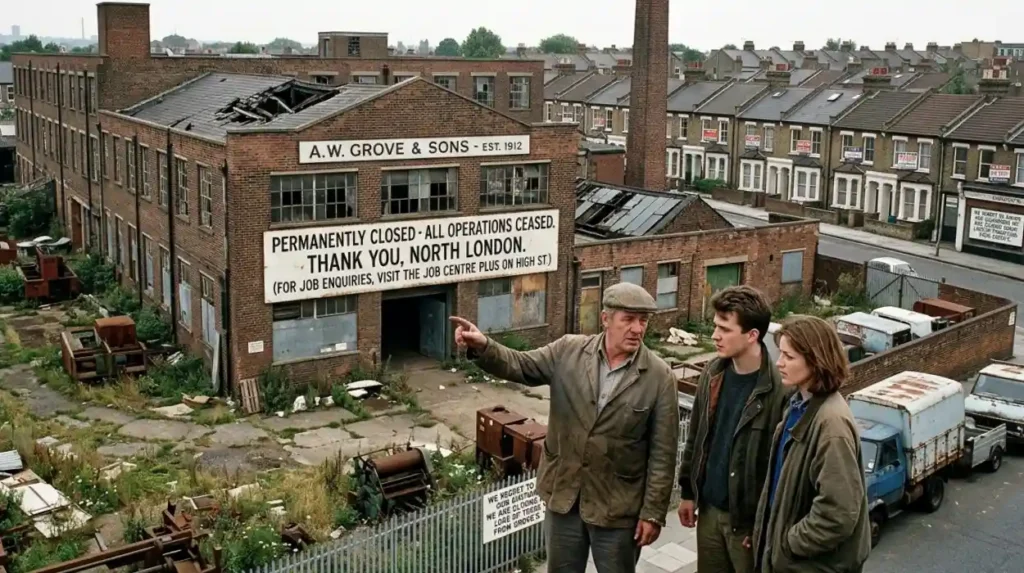
The sudden loss of industrial employment had severe socio-economic consequences for local communities. Districts adjacent to the river became centers of generational unemployment and poverty. The rapid economic decline contributed to social tensions, culminating in major urban civil disturbances, such as the Broadwater Farm riot in Tottenham in 1985. The empty factory buildings fell into disrepair, creating vast brownfield sites that came to characterize the landscape of the Lea Valley during the late twentieth century.
Municipal authorities struggled to manage the fiscal and social impact of this economic transition. The loss of industrial business rates reduced local government revenues just as the demand for social services and housing support escalated. The local infrastructure, once designed to support an integrated industrial economy, became obsolete, requiring comprehensive state intervention and urban regeneration strategies to transition the Lea Valley into a post-industrial service and residential economy.
What Physical Remnants and Heritage Preservation Projects Exist Along the River Lea Today?
Physical remnants and heritage preservation projects along the River Lea today include converted Victorian industrial buildings, designated heritage sites like the Waltham Abbey Royal Gunpowder Mills, and transformed ecological parks that integrate industrial archaeology into modern public spaces.
The built heritage of the Lea Valley has undergone extensive adaptive reuse over the past three decades. Many former Victorian factories and warehouses have been converted into creative workspaces, artist studios, and residential lofts. In Hackney Wick and Fish Island, the concentration of industrial buildings—such as the former peanut factory and the old printworks—now houses one of the densest populations of artists and creative practitioners in Europe, preserving the architectural character of the industrial era while accommodating new economic activities.
The Waltham Abbey Royal Gunpowder Mills stands as one of the most significant preservation sites in the valley. Operating as an interactive museum and nature reserve, the 170-acre site contains over 20px historic buildings and scheduled ancient monuments that chart the evolution of explosive manufacturing from the eighteenth century onward. Visitors can examine incorporating mills, press houses, and the narrow-gauge railway systems used to transport hazardous materials, all preserved within an environment that supports rare wildlife.
In Enfield, the former site of the Royal Small Arms Factory was redeveloped into Enfield Island Village, a master-planned residential community. The development preserves key architectural elements of the original factory, including the Grade II-listed machine shop superstructure, the clock tower, and the original canal basins. This project serves as a prime model of how industrial archaeology can be integrated into modern urban housing developments, keeping the memory of the local engineering heritage intact.
The most visible modern transformation is the Walthamstow Wetlands, opened to the public in 2017 in partnership with Thames Water and the London Wildlife Trust. This 211-hectare site remains an operational reservoir network while functioning as the largest urban wetland nature reserve in Europe. The site preserves the Victorian industrial pumping stations, including the Coppermill and the Marine Engine House, which have been restored to house educational centers and viewing platforms, demonstrating a successful co-existence of industrial utility, heritage conservation, and ecological restoration.
To experience this historic landmark in person today, consult our comprehensive [London Canal and River Walks Guide] for itineraries and visiting parameters.
How Has the Industrial Legacy of the Lea Valley Shaped the Modern Identity of North London?
The industrial legacy of the Lea Valley has shaped the modern identity of North London by establishing its diverse, working-class demographics, driving community-led conservation movements, and providing the physical infrastructure for major redevelopment initiatives.
The historical demand for factory labor created a resilient, multicultural working-class identity that defines North London boroughs like Haringey, Enfield, and Waltham Forest. The community organizations, mutual aid societies, and trade union traditions that emerged during the industrial era provided a framework for successive waves of immigrant communities to establish social roots and campaign for civil rights and economic equity. This historical continuity has made North London a center for progressive politics and grassroots community activism.
The physical imprint of industrialization has also fueled the growth of the modern environmental and conservation movements in London. The campaign to protect the Lea Valley from further industrial exploitation led to the creation of the Lee Valley Regional Park Authority in 1966. This statutory body manages a 26-mile-long, 10,000-acre linear park that stretches from the River Thames to Hertfordshire, ensuring that the former industrial corridor remains a permanent green space for recreation, nature conservation, and sport for millions of Londoners.
Furthermore, the industrial infrastructure provided the spatial foundation for the regeneration projects of the twenty-first century, most notably the London 2012 Olympic Games. The Queen Elizabeth Olympic Park in Stratford was constructed entirely on heavily contaminated industrial brownfield land in the lower Lea Valley. The remediation of the soil, the restoration of the river channels, and the construction of new transport links built directly upon the historical infrastructure networks established during the Industrial Revolution.
Ultimately, the River Lea has transitioned from a natural border into an industrial engine, and finally into an ecological and cultural corridor. The modern identity of North London is defined by this continuous adaptation. The historic watermills, gun factories, and chemical works no longer drive the local economy, but their architectural remains, environmental consequences, and demographic legacies continue to dictate the social, cultural, and physical geography of the region today.
What is the River Lea?
The River Lea is a major tributary of the River Thames that flows through Hertfordshire and East/North London. Historically, it served as a vital transport route, water supply source, and industrial corridor.