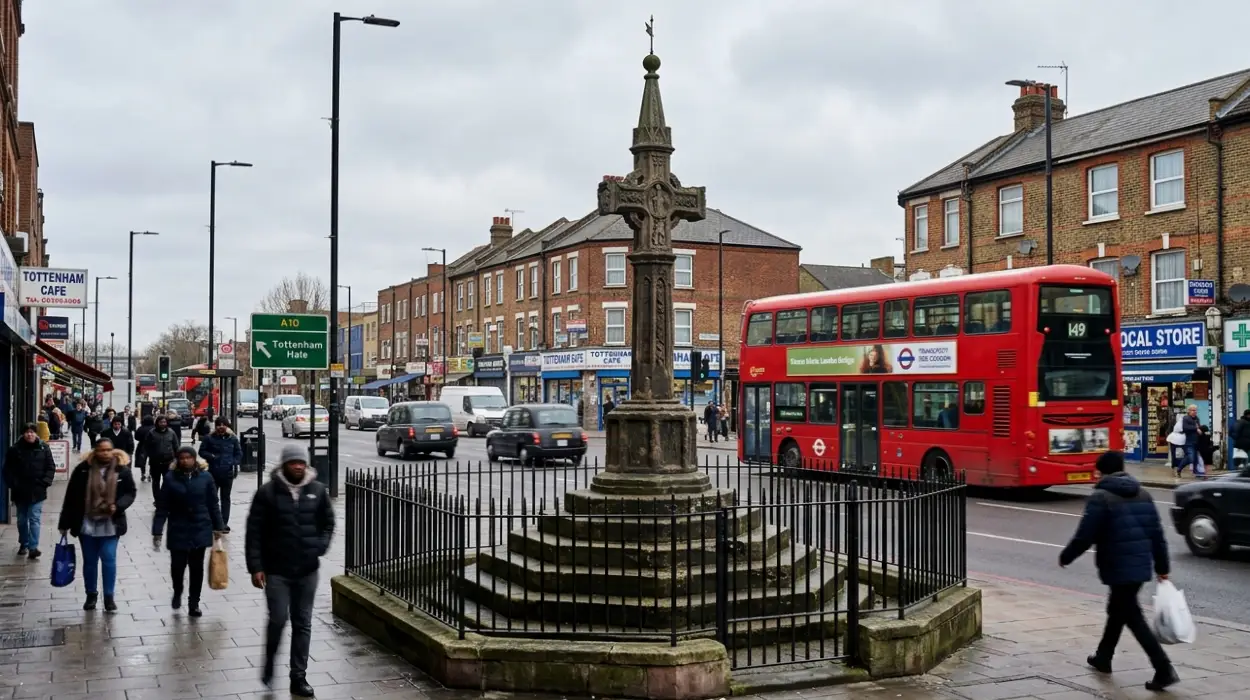
The Tottenham High Cross is a structurally designated monument in Middlesex, North London, marking a vital medieval junction on Ermine Street. Serving as a socio-economic focal point since the thirteenth century, it signifies the historic development of agrarian Tottenham into an urbanized metropolitan borough.
- When Was The Tottenham High Cross First Constructed?
- Who Controlled The Land Surrounding The Medieval Cross?
- How Did The Cross Influence The Urban Layout Of Tottenham?
- What Architectural Alterations Did The Structure Undergo Across The Centuries?
- Why Do Historical Myths Link The Monument To Queen Eleanor?
- How Is The High Cross Preserved In Modern London?
The Tottenham High Cross stands as one of the oldest surviving infrastructural landmarks in the London Borough of Haringey. Positioned on the historic Roman route of Ermine Street—now designated as the A1010 road—the monument originally demarcated a major geographical and administrative nexus outside the historic City of London. Historically, the landmark operated as a gateway marker between the urban commercial center of London and the agrarian hinterlands of Hertfordshire, Cambridgeshire, and the North of England.
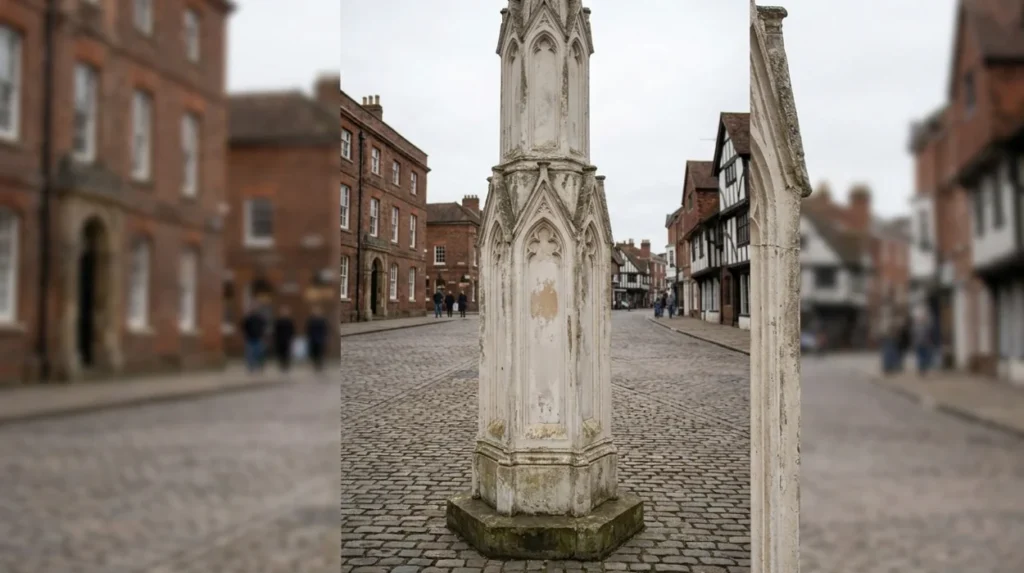
Architecturally, the monument has undergone multiple reconstructions that reflect the shifting aesthetic and structural paradigms of English history. While local antiquity lore frequently associated the structure with the famous funeral procession of Queen Eleanor of Castile in 1290, official municipal and state records confirm that the Tottenham High Cross was an independent wayside marker. The structural evolution of the site transitioned from a basic medieval timber cross into a permanent octagonal brick column erected between 1600 and 1609 by the local lord of the manor, Dean Wood. The brick structure was subsequent to a major late Georgian structural renovation in 1809, when it was encased in stucco Roman cement and adorned with Gothic Revival decorative elements, including crocketed gables, pinnacles, and a protective iron palisade.
Sociologically, the High Cross served as the foundational anchor for the civic identity of the Tottenham parish. It acted as an open-air public courtroom, a market hub, and a prominent assembly point for travelers, traders, and local authorities. To experience this historic landmark in person today, consult our comprehensive [Things to Do in Tottenham Visitor Guide] for itineraries and visiting parameters. The physical longevity of the cross through consecutive centuries of industrialization and transportation expansions highlights its role as a permanent symbol of community convergence and regional pride within the North London landscape.
When Was The Tottenham High Cross First Constructed?
The exact documentation of the initial construction remains unrecorded, but authentic municipal manorial court rolls verify the existence of a permanent wayside cross at the Tottenham site by the year 1409, during the late medieval period of English history.
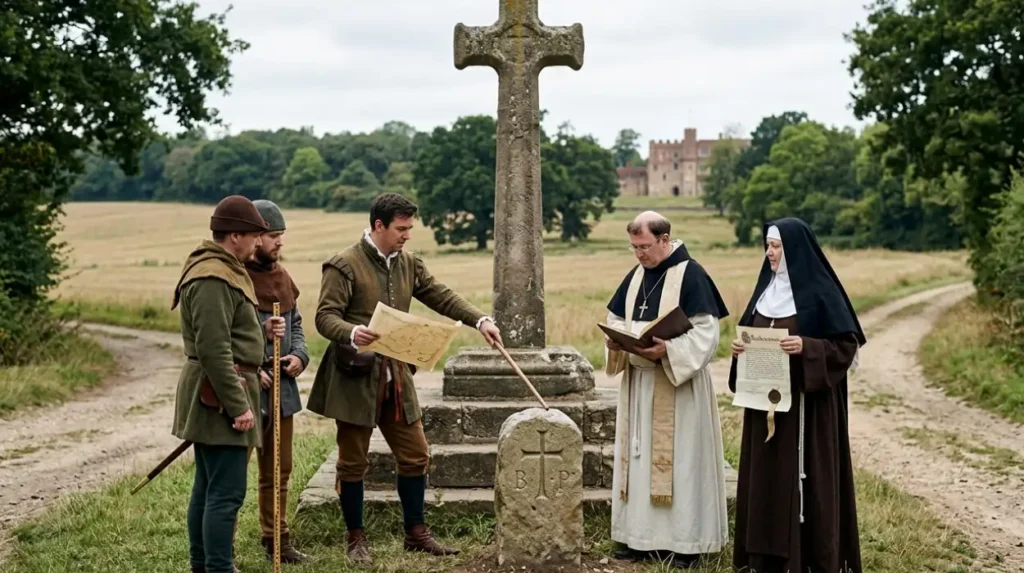
The chronological origin of the Tottenham High Cross is rooted in the territorial organization of medieval Middlesex. While physical evidence of a timber cross on Ermine Street likely dates back to the reign of King Edward I or earlier, the first indisputable text-based archival reference appears in manorial court rolls dated 1409. These entries refer to a localized parcel of land designated as “High Cross Furlong,” proving that the monument was already a deeply entrenched topographical marker used by the local populace and manorial bailiffs to define agricultural boundaries and legal jurisdictions.
The transition from a rustic marker to a substantial architectural monument occurred during the post-medieval period. In the first decade of the seventeenth century, Dean Wood, who held the leasehold for the nearby Rectory Manor, ordered the demolition of the decayed medieval wood structure. In its place, he commissioned a decorative octagonal brick pillar. This early seventeenth-century variant featured a sundial and capped lead roofing, transforming the marker from a purely religious or boundary indicator into a functional secular timekeeping station for the growing roadside settlement.
The structural configuration visible to the public today dates precisely to the early nineteenth century. In 1809, a public subscription fund organized by the affluent residents of Tottenham enabled the prominent local architect and builder, William Coverdale, to repair the structurally compromised brick core. Coverdale applied a layer of Roman cement—an innovative fast-setting waterproof stucco patented in 1796—and introduced the ornate Tudor Gothic features that preserved the monument through the Victorian era and the Blitz of World War II, securing its subsequent Grade II statutory listing.
Who Controlled The Land Surrounding The Medieval Cross?
The land surrounding the Tottenham High Cross was split between three major medieval manors: the Manor of Bruce Castle, the Rectory Manor, and the Prioress Manor, which were held by prominent Anglo-Scottish aristocrats, ecclesiastical bodies, and English gentry.
The governance and socioeconomic layout of medieval Tottenham were governed by a complex network of manorial estates that converged near the High Cross. Following the Norman Conquest of 1066, King William I granted the overarching manor of Tottenham to Earl Waltheof. Through subsequent aristocratic marriages, the estate descended to the Scottish royal house, coming into the direct possession of David I of Scotland in the twelfth century. This created a unique socio-political dynamic wherein a significant portion of North London was directly controlled by Scottish royalty as English tenants-in-chief.
By the thirteenth century, political conflicts between the crowns of England and Scotland led to the fragmentation of the original macro-estate into three distinct sub-manors:
- The Manor of Bruce Castle: Retained by the Bruce lineage until it was confiscated by King Edward I in 1306 after Robert the Bruce claimed the Scottish throne. The estate was subsequently granted to various English noble families, including the Comptons.
- The Rectory Manor: An ecclesiastical estate attached to the parish church of All Saints, which was granted to the Dean and Chapter of St. Paul’s Cathedral in 1127, controlling the tithes and agricultural outputs of the central lands.
- The Prioress Manor: A smaller parcel managed by the religious order of the Nunneries of Clerkenwell, exerting spiritual and economic influence over local tenant farmers.
These manorial administrations used the High Cross as a central point to collect agricultural tolls, enforce royal statutes, and hold seasonal manorial courts. The tenants who tilled the fields of the High Cross Furlong were legally bound to these estates, rendering service in the form of labor, grain, and monetary taxes. This complex manorial division prevented a single authority from monopolizing the district, allowing the space around the cross to evolve into a relatively open civic arena for public assembly, retail trade, and regional communication.
How Did The Cross Influence The Urban Layout Of Tottenham?
The High Cross operated as the primary spatial anchor for Tottenham, transforming a dispersed collection of agrarian hamlets into a linear urban corridor aligned along the north-south axis of the historical Ermine Street high road.
The spatial development of Tottenham is an example of ribbon development, an urban planning phenomenon where a settlement expands linearly along a major transit artery. Prior to the seventeenth century, Tottenham did not possess a single urbanized core; instead, it comprised several isolated hamlets, including Wood Green, West Green, and Hale. The positioning of the High Cross on the heavily trafficked road to the north acted as a catalyst for infrastructure convergence, gradually drawing residential, commercial, and administrative buildings toward the highway.
As long-distance traffic between the City of London and northern England intensified during the Tudor and Stuart eras, the High Cross became the geographic center of the parish. Innkeepers, blacksmiths, wheelwrights, and retail merchants established permanent structures directly adjacent to the monument to capture the commerce generated by drovers, royal messengers, and stagecoaches. This commercial density caused the land values around the High Cross to increase relative to the outlying agricultural fields, prompting the subdivision of manorial strip fields into dense urban building plots.
When the Turnpike Trusts were established by Acts of Parliament in the early eighteenth century to modernize English roads, the High Cross was designated as a principal marker for road maintenance tolls and distance calculations. The Middlesex turnpike records indicate that the stretch of road running past the High Cross was heavily fortified with gravel and flint to support heavy carriage traffic. This infrastructure development attracted wealthy London merchants, who constructed large Georgian and Victorian villas within sight of the cross, cementing the area’s transition from a rural agricultural landscape into a premier suburban residential district of greater London.
Explore More History Of London
Jimi Hendrix Exhibition Unveils Rare Memorabilia: Mayfair London 2026
What Architectural Alterations Did The Structure Undergo Across The Centuries?
The monument underwent three major structural transformations: from a medieval timber cross, to an early seventeenth-century octagonal brick pillar under Dean Wood, to a stuccoed Gothic Revival monument designed by William Coverdale in 1809.
The architectural biography of the Tottenham High Cross demonstrates how local materials and changing artistic movements dictated the preservation of public monuments in England. The earliest iteration of the cross was constructed from heavy English oak timber, likely finished with a weatherproofing coat of pitch or tar. This structure featured a traditional cruciform shape mounted on a stepped stone base, designed to withstand the elements while remaining highly visible to illiterate travelers navigating the high road.
In the late Tudor era, the timber structure suffered severe rot and physical instability. Between 1600 and 1609, the leaseholder Dean Wood replaced the wood with locally fired red clay bricks, forming a solid octagonal pillar. This engineering choice reflected the rising popularity of brickwork in Elizabethan and Jacobean architecture. The brick pillar was topped with a decorative weather vane and featured a mechanical sundial on its southern face, introducing a civic utility to the religious monument.
By 1809, the brickwork had suffered from environmental erosion caused by coal smoke and carriage impacts. Architect William Coverdale stabilized the core and applied an exterior coating of Roman cement. He molded this material into a fashionable Gothic Revival design, adding structural buttresses, faux-stone masonry joints, ornate shields displaying the crests of local manorial families, and a decorative cresting at the peak. In 1929, the monument was further modified when the surrounding protective iron railings were re-spaced, and a commemorative bronze plaque was attached to clarify its historical provenance to the public.
Why Do Historical Myths Link The Monument To Queen Eleanor?
The historical link to Queen Eleanor stems from an antiquarian error popularized by nineteenth-century writers who confused the Tottenham High Cross with the nearby, authentic Eleanor Crosses erected by King Edward I.
The persistent historical myth connecting the Tottenham High Cross to Queen Eleanor of Castile represents a classic case of folkloric conflation. Queen Eleanor, the wife of King Edward I, died in November 1290 at Harby in Nottinghamshire. Her grieving husband ordered the construction of twelve highly ornate stone monuments, known as Eleanor Crosses, at each site where her funeral cortège stopped overnight during its journey back to Westminster Abbey. Two of these authentic structures were built in close proximity to North London: one at Waltham Cross in Hertfordshire, located approximately seven miles north of Tottenham, and another at Charing Cross in central London.
During the eighteenth and nineteenth centuries, early topographers and local historians frequently lacked access to primary manorial archives. Writers looking at the Tottenham monument assumed that its prominent location on the funeral route meant it was one of the official stopping stations. This theory was popularized in local literature and early travel guides, embedding itself into the collective memory of the Tottenham population. The myth was so potent that it influenced the design of local pub signage, school emblems, and early municipal seals throughout the Victorian era.
Modern archival research conducted by the London and Middlesex Archaeological Society has completely debunked this connection. The official royal building accounts from the Exchequer rolls of the late thirteenth century explicitly detail the expenditures, master masons, and precise locations for all twelve Eleanor Crosses; Tottenham is entirely absent from these state ledgers. The Tottenham High Cross was already functioning as a standard parish boundary and market marker before the queen’s death, proving its historical origin was secular and regional rather than royal and funereal.
How Is The High Cross Preserved In Modern London?
The Tottenham High Cross is preserved through its statutory Grade II listing under British heritage protection laws, active monitoring by Historic England, and localized restoration schemes managed by the Haringey Borough Council.
In modern London, the Tottenham High Cross faces significant preservation challenges due to its position in the center of a busy urban transport corridor. The monument is legally protected under the Planning (Listed Buildings and Conservation Areas) Act 1990, which restricts any unauthorized alterations, demolition, or development that could compromise its architectural and historical integrity. This Grade II statutory listing ensures that any structural intervention must use historically accurate materials and methods approved by conservation officers.
The primary environmental threats to the cross include atmospheric pollution from vehicular emissions, structural vibrations caused by heavy traffic on the A1010 road, and moisture ingress through the nineteenth-century Roman cement stucco. To combat these issues, Historic England and the Haringey Borough Council have executed targeted maintenance interventions. Specialist stone conservators routinely inspect the monument to repair hairline cracks in the stucco using breathable lime-based mortars, preventing moisture from trapping inside and damaging the internal historic brick core.
Community-led heritage groups, based out of the nearby Bruce Castle Museum, also play an essential role in its modern preservation. These organizations run public education programs, historical walking tours, and digital archiving projects to keep the historical memory of the High Cross active among the diverse modern population of Tottenham. By integrating the monument into broader urban regeneration plans for the High Road, planners ensure that the High Cross remains a protected, visible historical anchor amidst the continuous architectural evolution of twenty-first-century North London.
What is Tottenham High Cross?
Tottenham High Cross is a historic monument located on Tottenham High Road in North London. It has served as a significant landmark, meeting place, and civic focal point for the local community since the medieval period.