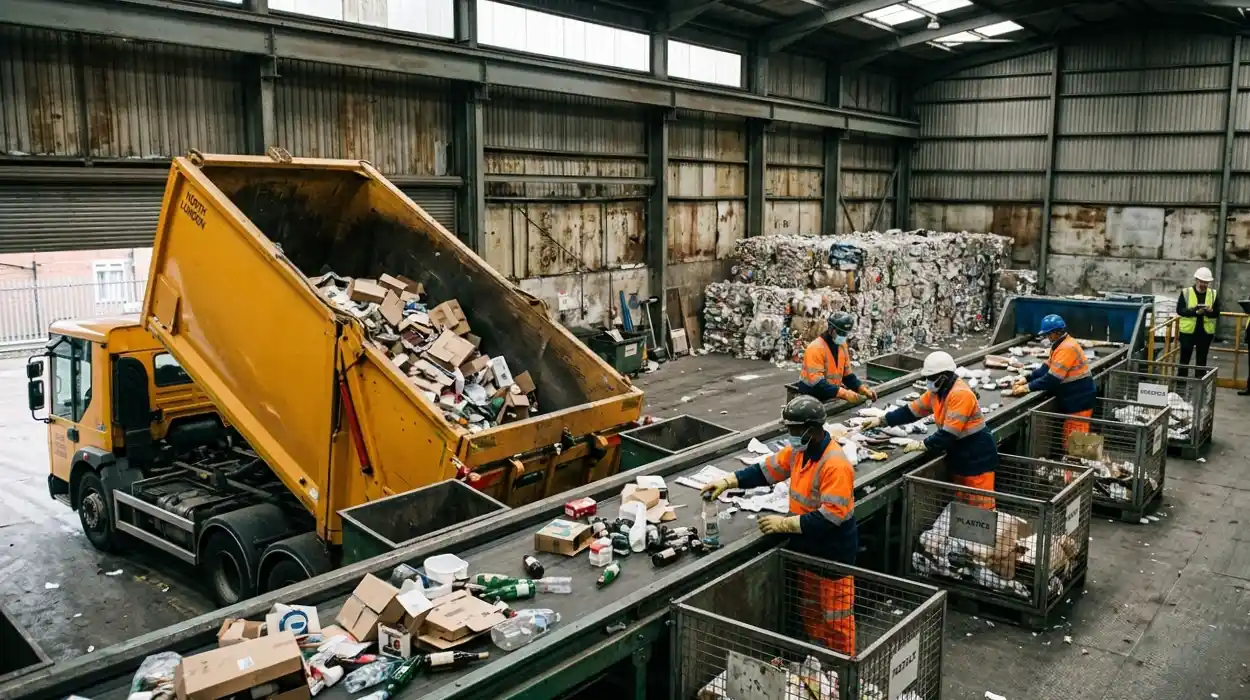
The request for a larger recycling bin from a contemporary North London municipal authority links directly to the structural evolution of metropolitan sanitation laws, public health legislation, and urban infrastructure development. The historical trajectory of waste management in North London spans from primitive, decentralized parish systems to highly integrated, modern statutory frameworks. Understanding this evolution requires an examination of the legislative milestones, demographic pressures, and administrative transformations that formed the basis of contemporary civic services in London.
- How Did Early North London Parishes Regulate Domestic Waste Collection Before Modern Councils Existed?
- What Legislation Created the Modern North London Borough Boundaries and Waste Authorities?
- How Did the Victorian Dust-Yard System Lay the Foundation for Modern Domestic Recycling?
- What Historical Public Health Crises Forced the Development of Standardized Public Bins?
- How Have North London Housing Archetypes Influenced Waste and Recycling Storage Across Different Eras?
- What Technical Mechanisms and Financial Penalties Govern Contemporary Recycling Allocations?
- How Does Modern North London Infrastructure Rank Against Historic Recycling Targets?
How Did Early North London Parishes Regulate Domestic Waste Collection Before Modern Councils Existed?
Early North London parishes regulated domestic waste collection through decentralized, localized systems managed by vestries, relying on the Public Health Act 1848 and Nuisances Removal Acts to appoint scavengers, penalize open dumping, and clear dangerous accumulations from expanding residential neighborhoods.
The Parish and Vestry Framework
Before the creation of centralized municipal authorities, local administration in North London operated through ecclesiastical units known as parishes (such as St. Mary Islingon, St. Pancras, and Hornsey). The governing body of these units, the parish vestry, held the legal responsibility for local highway maintenance, poor relief, and basic environmental maintenance.
During the early nineteenth century, these vestries faced unprecedented demographic expansion. The population of Islington, for example, grew from 10,212 residents in 1801 to over 95,322 residents by 1851. This rapid urbanization overwhelmed the traditional, informal methods of agrarian waste disposal, where domestic refuse was simply dumped into open spaces or nearby fields.
The System of Contract Scavengering
To manage the increasing volumes of household waste, parish vestries implemented the system of contract scavengering. The vestries auctioned off annual licenses to private contractors, who were known as scavengers. These contractors received the exclusive statutory right to collect household ash, dust, and organic detritus within specific parish boundaries.
The contractors generated their profits by processing and selling this refuse to industrial markets. Brickmakers purchased the fine coal ash to mix with clay, while agricultural operations bought organic waste for fertilizer. The vestries enforced these contracts using local manorial courts and early police statutes, which allowed them to fine residents who failed to present their waste or who obstructed the scavengers.
Legislative Interventions and Penalties
The structural shift toward formal regulation accelerated with the passage of the Nuisances Removal and Diseases Prevention Act 1848. This legislation granted parish vestries explicit legal powers to order the clearance of accumulated filth, unemptied privies, and stagnant pools of water.
The vestries appointed inspectors of nuisances to systematically log violations across North London neighborhoods. Property owners who ignored official removal orders faced prosecution before local magistrates, resulting in daily financial penalties. This system established the legal precedent that domestic waste management constitutes a mandatory public health service rather than an optional personal responsibility.
What Legislation Created the Modern North London Borough Boundaries and Waste Authorities?
The London Government Act 1963 created the modern North London borough boundaries and waste authorities by abolishing older metropolitan boroughs and establishing thirty-two new administrative units alongside the overarching Greater London Council to coordinate large-scale refuse disposal.
The London Government Act 1963
The administrative geography of modern North London was established by the London Government Act 1963, which came into full legal effect on 1 April 1965. This radical piece of legislation completely restructured the governance of the metropolis. It abolished the historic administrative counties of London and Middlesex, while simultaneously dissolving dozens of ancient metropolitan boroughs, urban districts, and municipal boroughs.
In their place, the Act created thirty-two distinct administrative units known as London Boroughs. In North London, this consolidation merged several smaller authorities to form larger modern entities:
- The London Borough of Camden was formed by amalgamating the metropolitan boroughs of Hampstead, Holborn, and St Pancras.
- The London Borough of Islington was created by combining the metropolitan boroughs of Islington and Finsbury.
- The London Borough of Haringey united the municipal boroughs of Hornsey and Tottenham.
- The London Borough of Barnet consolidated the municipal boroughs of Hendon and Finchley alongside the urban districts of Barnet, East Barnet, and Friern Barnet.
Division of Waste Responsibilities
The London Government Act 1963 introduced a two-tiered statutory framework for managing metropolitan waste. The newly established individual London Boroughs were designated as Waste Collection Authorities (WCAs). Under this legal mandate, the boroughs retained direct responsibility for the localized collection of household refuse, the provision of domestic bins, and the management of local street sweeping.
Conversely, the overarching regional body created by the Act, the Greater London Council (GLC), was designated as the central Waste Disposal Authority (WDA). The GLC took over the strategic management of large-scale regional infrastructure, including major rail-linked transfer stations, mass incineration facilities, and extensive landfill sites located outside the boundaries of Greater London.
The Evolution of Waste Disposal Authorities
Following the abolition of the Greater London Council by the Local Government Act 1985, the statutory framework for waste disposal required immediate reorganization to prevent systemic failure. The modern statutory body known as the North London Waste Authority (NLWA) was established in 1986 under the Waste Regulation and Disposal (Authorities) Order 1985.
The NLWA was formed as a statutory joint committee to handle disposal duties for seven distinct North London boroughs: Barnet, Camden, Enfield, Hackney, Haringey, Islington, and Waltham Forest. Today, while individual residents interface directly with their local collection authority to request upgraded or larger receptacles, the NLWA manages the processing, recycling, and disposal of the collected materials. To experience this historic area and its architectural progression in person today, consult our comprehensive [North London historic neighborhood walking itineraries and cultural guide] for itineraries and visiting parameters.

How Did the Victorian Dust-Yard System Lay the Foundation for Modern Domestic Recycling?
The Victorian dust-yard system laid the foundation for modern domestic recycling by organizing the systematic collection of household refuse and utilizing mechanized sorting yards to separate ash, bones, rags, and metals for industrial reuse and manufacturing.
The Economics of the Dust-Yard System
During the nineteenth century, London developed a highly organized, private-sector recycling economy known as the dust-yard system. As coal combustion served as the primary source of domestic heating and cooking, household waste consisted largely of coal ash and cinders, which were collectively referred to as “dust.” Private contractors capitalized on the industrial demand for these materials, transforming waste collection into a highly lucrative commercial enterprise.
The dust contractors established specialized industrial sites called dust-yards, which were located primarily along North London canal networks and railway hubs, such as the major facilities in Paddington, King’s Cross, and Islington. The contractors employed large teams of low-wage laborers, including specialized sorters known as “dustmen” and “hill-men,” to manually process the incoming material.
Material Separation and Industrial Reuse
The operations within the Victorian dust-yards directly mirrored the material separation protocols executed by modern materials recovery facilities (MRFs). The workers separated the household waste into distinct, economically valuable subcategories:
- Soil and Fine Ash: Sifted and sold to brickmakers in Kent and Essex to be incorporated into building materials, or sold to farmers for agricultural soil conditioning.
- Brings and Cinders: Sold back to industrial factories and foundries to fuel low-temperature manufacturing processes.
- Bones: Sent to boiling houses and chemical plants to extract fat for soap manufacturing, or processed into bone meal for agricultural fertilizer.
- Rags and Paper: Dispatched to paper mills located across Hertfordshire to be pulped and converted into industrial paper products.
- Metals: Collected and sent to scrap foundries for metallurgical smelting and reuse.
The Collapse of the Commercial Dust Market
The classic dust-yard system flourished until the mid-nineteenth century, when changing economic conditions and technological shifts undermined its profitability. The introduction of newer brickmaking techniques reduced the industrial demand for coal ash, while the importation of cheaper foreign guano disrupted the domestic market for organic bone fertilizers.
As the commercial value of the dust declined, private contractors began demanding financial subsidies from parish vestries to continue their collection routes. This economic collapse forced local government boards to step in, shifting the responsibility of waste collection from a profitable private trade to a tax-funded public service, laying the groundwork for modern municipal utility departments.
What Historical Public Health Crises Forced the Development of Standardized Public Bins?
Historical public health crises, including the cholera epidemics of 1848 and 1854 alongside the Great Stink of 1858, forced parliament to pass the Public Health Act 1875, mandating that local authorities provide standardized, covered waste receptacles.
The Cholera Epidemics and Miasma Theory
The mid-nineteenth century in London was marked by catastrophic outbreaks of epidemic cholera, with major crises occurring in 1832, 1848, 1853, and 1866. During these events, the scientific community operated primarily under the miasma theory of disease, which asserted that dangerous infections were transmitted through noxious gases, or “bad air,” rising from decaying organic matter.
Because of this widespread scientific belief, the extensive accumulations of uncollected domestic waste, decomposing animal matter, and overflowing cesspools throughout North London were viewed as direct causes of epidemic disease. This urgent public health threat forced the government to grant local authorities unprecedented statutory powers to intervene in private property management.
The Great Stink of 1858
The public health crisis peaked during the summer of 1858 during an event known as the Great Stink. Unusually high temperatures caused the heavily polluted River Thames, which received raw sewage and industrial effluent from across the capital, to ferment. The resulting odor disrupted the operations of the Houses of Parliament and brought the city to a standstill.
The event demonstrated that London’s decentralized, parish-level sanitation systems were completely inadequate for a massive industrial metropolis. Parliament responded by passing legislation that funded the construction of the London sewerage system by Sir Joseph Bazalgette, while simultaneously tightening the statutory sanitation requirements for local boroughs.
The Public Health Act 1875 and Standardized Receptacles
The decisive legislative turning point arrived with the passage of the Public Health Act 1875. This comprehensive statute established a mandatory nationwide framework for sanitary regulation. The Act required all local urban authorities to ensure the systematic, weekly collection of household refuse.
Crucially, the 1875 Act gave local authorities the legal power to compel homeowners to use standardized, moveable ashpits or covered cylindrical dustbins made of galvanized iron. This measure prevented rainwater from mixing with household refuse, which reduced dangerous decomposition and limited the breeding grounds of disease-carrying flies and rodents. The iron dustbin became the direct technological predecessor to the modern wheeled plastic recycling bin.
Explore More Public Services
When Will 2026 Council Tax Bands Take Effect in London?
How to Challenge a Private Parking Fine in London
How Have North London Housing Archetypes Influenced Waste and Recycling Storage Across Different Eras?
North London housing archetypes have influenced waste storage through architectural transitions from Victorian coal-cellar grates and mid-century chuted high-rise estates to contemporary multi-bin configurations that require specific spatial management along narrow terraced streets.
Victorian and Edwardian Terraced Housing
The residential architecture of North London is heavily defined by Victorian and Edwardian terraced streets, built extensively across areas like Finsbury Park, Highbury, and Muswell Hill between 1860 and 1910. These properties were originally designed around coal-based economies. They featured small front gardens with subterranean coal cellars, accessible via metal plates set directly into the pavement.
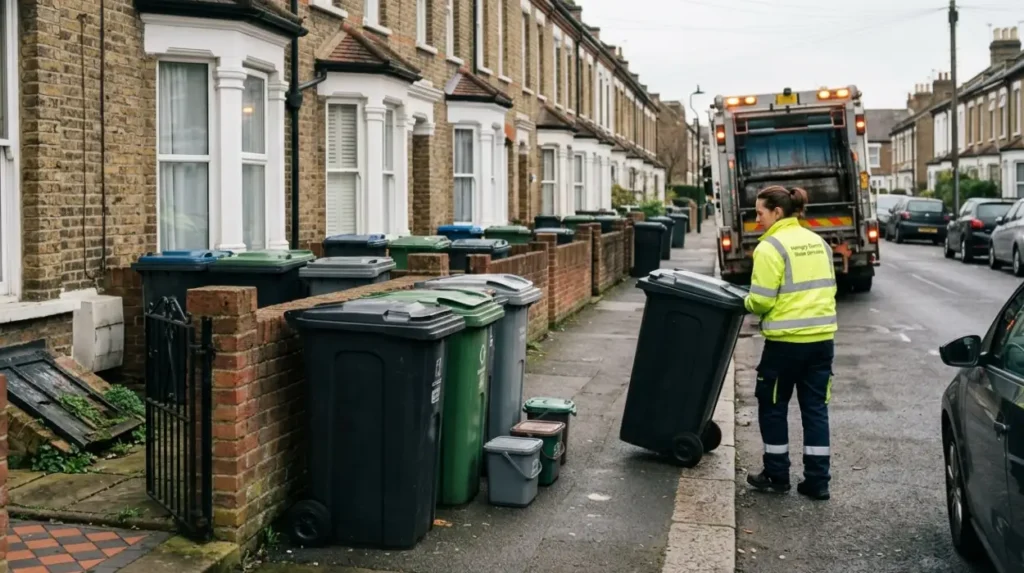
These properties lacked any built-in external space for large, multi-categorical waste separation. As a result, modern North London councils managing these terraced zones face persistent logistical challenges. The narrow pavements must accommodate multiple modern bins per household, frequently creating storage problems and blocking pedestrian access along historic streets.
Interwar Suburban Expansion
The expansion of the London Underground network during the 1920s and 1930s sparked rapid suburban growth across outer North London boroughs like Barnet and Enfield. This era was characterized by the construction of semi-detached and detached suburban homes, designed in accordance with the garden city ideals of the period.
These interwar properties featured wide side alleys, dedicated garages, and expansive rear gardens. This spatial layout accommodates modern municipal waste infrastructure with ease. These properties provide sufficient space to store multiple large wheeled bins out of public view, allowing residents to separate garden waste, dry recyclables, and residual refuse without disrupting local streetscapes.
Post-War High-Density Estates
Following the destruction of World War II, North London councils addressed housing shortages by constructing high-density modernist housing estates, such as the Brunswick Centre in Camden or the Andover Estate in Islington. These architectural projects utilized centralized, vertical waste disposal systems known as refuse chutes.
Residents on upper floors dropped their mixed household waste into wall openings that led directly to large ground-floor bin stores. While highly efficient for general refuse disposal, these chuted systems became obsolete with the introduction of modern recycling mandates. The narrow vertical chutes cannot handle large cardboard boxes or separate recyclables into distinct streams, forcing modern councils to retrofit these estates with large communal recycling points located across the grounds.
What Technical Mechanisms and Financial Penalties Govern Contemporary Recycling Allocations?
Technical mechanisms and financial penalties govern contemporary recycling allocations through specific container capacities, rigorous purity inspections, and statutory financial penalties levied under the Environmental Protection Act 1990 against non-compliant households.
Container Capacities and Spatial Restrictions
Modern North London local authorities use strict container capacities to encourage recycling and limit the generation of residual waste. The standard issue container for general household refuse is a 140-litre or 240-litre wheeled plastic bin. Councils operate under a strict policy that restricts households to a single general waste bin unless they meet specific criteria, such as having a large family or documented medical needs.
Conversely, requests for larger or additional recycling bins are generally supported and provided free of charge, as long as the property has sufficient external storage space. This approach aims to maximize the household’s volumetric capacity for recyclable materials while restricting the space available for general, non-recyclable waste.
Purity Inspections and Contamination Controls
Waste collection crews carry out regular visual inspections of domestic recycling bins before emptying them into collection vehicles. This process protects the purity of the recycling stream. Commingled recycling bins containing non-recyclable items—such as food waste, diapers, or plastic bags—are flagged as contaminated.
When collection crews identify a contaminated bin, they leave it uncollected and attach a warning notice to the handle. This notice informs the resident of the specific contaminating items, which must be removed before the bin can be cleared on the next scheduled collection date.
Statutory Enforcement and Financial Penalties
The primary legal framework governing municipal waste collection is the Environmental Protection Act 1990. Under Section 46 of this Act, local authorities hold the explicit legal power to dictate the type, size, and number of waste receptacles used by households, as well as the specific locations where bins must be placed for collection.
The Climate Change Act 2008 amended these provisions, allowing councils to issue civil financial penalties to persistent offenders. If a resident repeatedly violates bin regulations or contaminates recycling streams, the council can issue a statutory warning notice. Continued non-compliance results in a formal Fixed Penalty Notice (FPN), which carries a financial penalty ranging from £60 to £200, protecting the municipal recycling system from systemic contamination.
How Does Modern North London Infrastructure Rank Against Historic Recycling Targets?
Modern North London infrastructure ranks highly against historic recycling targets through sophisticated automated recovery facilities and thermal energy-from-waste plants designed to meet strict statutory targets set by national environmental laws.
The Edmonton EcoPark Facility
The center of North London’s modern waste infrastructure is the Edmonton EcoPark, a 43-hectare industrial facility located in the London Borough of Enfield. Operated on behalf of the North London Waste Authority, this site has managed the region’s waste since its initial opening in 1971.
The facility features an advanced materials recovery facility (MRF) that uses automated sorting technologies, including optical sorters, magnetic separators, and eddy-current systems, to isolate plastics, paper, and metals. The EcoPark is currently undergoing a major redevelopment known as the North London Heat and Power Project (NLHPP). This project replaces the original incineration plant with a highly efficient Energy Recovery Facility (ERF), which converts residual waste into electricity for up to 127,000 homes and provides low-carbon heating for local district networks.
Long-Term Environmental Implications
Modern North London waste policy is governed by the target of achieving a 50% recycling rate across the capital, alongside broader national net-zero carbon emissions targets. Achieving these goals depends heavily on public participation and household sorting efficiency.
By providing residents with larger recycling receptacles and implementing strict enforcement regimes, municipal authorities aim to capture high-quality, uncontaminated recyclable materials directly at the source. This modern approach marks a return to the high material recovery rates seen during the Victorian era, updating the process with automated technology to meet contemporary environmental standards.
What is an extreme heat warning?
An extreme heat warning is an official alert issued when temperatures and humidity reach levels that pose significant risks to human health, infrastructure, and public services.