Mayfair became one of London’s most prestigious luxury neighbourhoods through a combination of aristocratic landownership, carefully planned eighteenth-century development, proximity to the royal court, exceptional architecture, and long-term estate management. Its transformation from open land into an elite urban district established a pattern of wealth and exclusivity that continues today.
- What was Mayfair before it became London’s luxury neighbourhood?
- Why did Mayfair develop so rapidly during the eighteenth century?
- How did aristocratic society make Mayfair prestigious?
- How did Mayfair’s architecture create its luxury identity?
- What role did the May Fair itself play in creating the district’s identity?
- How did estate planning make Mayfair different from other London neighbourhoods?
- How did Mayfair change during the Victorian and Edwardian periods?
- How did the twentieth century transform Mayfair?
- Why did Mayfair remain prestigious after aristocratic society changed?
- What historic landmarks still show Mayfair’s aristocratic past?
- How has historic preservation protected Mayfair’s character?
- What is the lasting historical significance of Mayfair?
- How did Mayfair become London’s enduring symbol of luxury?
- Frequently Asked Question
The history of Mayfair explains why a relatively compact area in the West End became internationally associated with aristocracy, wealth, luxury property, private clubs, fine shopping, and diplomatic importance. Its status did not emerge from a single building, family, or commercial development. It resulted from more than three centuries of controlled urban development.
The district developed at a decisive moment in London’s expansion. After the Restoration of the monarchy in 1660 and the rebuilding of London following the Great Fire of 1666, wealthy landowners increasingly developed estates west of the historic City of London. The West End offered cleaner air, more open space, and direct access to Westminster, St James’s Palace, and the royal parks.
Mayfair occupied an advantageous position within this expanding metropolitan geography. Landownership, planning, architecture, and social hierarchy combined to create a district designed for wealthy residents from its earliest urban development.
What was Mayfair before it became London’s luxury neighbourhood?
Before its eighteenth-century development, Mayfair consisted largely of open countryside, fields, pasture, gardens, and scattered buildings west of London. The area’s transformation began when aristocratic landowners converted rural estates into planned streets, squares, and high-status residential property near Westminster and the royal court.
The name Mayfair originated from the annual May Fair, a public fair associated with the celebration of spring. The fair had origins in the sixteenth century and later operated in the area that became Mayfair.
The district was therefore named after an event rather than an aristocratic family or architectural landmark. This distinction remains important because Mayfair’s later identity became almost entirely associated with wealth and exclusivity.
During the seventeenth century, much of the land west of the established urban area remained relatively undeveloped. London was growing rapidly, but the City of London and Westminster remained distinct centres surrounded by expanding settlements, estates, fields, and rural land.
A major change occurred in 1677 when Sir Thomas Grosvenor married Mary Davies, the heiress to substantial landholdings associated with the Manor of Ebury. Through this marriage, land that would later form major parts of Mayfair, Belgravia, and other central London districts entered the Grosvenor family’s ownership.
This transfer of land created one of the most important foundations of Mayfair’s future. Unlike districts developed through fragmented ownership, large sections of Mayfair could be planned and managed through a major landed estate.
How did landownership shape Mayfair’s future?
Long-term aristocratic ownership allowed developers to control streets, building standards, leases, and the overall appearance of the neighbourhood. The Grosvenor Estate therefore treated Mayfair as a coordinated urban development rather than an uncontrolled collection of individual properties.
Estate ownership created continuity. The landowner retained an interest in the long-term quality of the district because the value of future leases depended upon the reputation and condition of the estate.
This system encouraged planned streets, formal squares, architectural consistency, and restrictions that protected the social status of the neighbourhood.
By the beginning of the eighteenth century, London’s wealthy population was increasingly moving westward. Mayfair stood directly within the path of this expansion.
Why did Mayfair develop so rapidly during the eighteenth century?
Mayfair developed rapidly during the eighteenth century because London expanded westward, aristocrats wanted residences near the royal court, and major landowners created planned estates with spacious streets and prestigious garden squares designed specifically for wealthy households and long-term residential value.
The eighteenth century marked a major period of urban expansion in London. Political stability, imperial commerce, growing national wealth, and population growth increased demand for high-quality housing.
The West End became particularly attractive to aristocratic and wealthy households.
Proximity to St James’s was essential. St James’s Palace and the surrounding royal court made the area a centre of political and social activity. Members of the aristocracy wanted London residences that allowed convenient access to Parliament, government, court functions, and elite social institutions.
Mayfair provided this access while remaining outside the older and more densely built parts of the City.
The Grosvenor Estate began major development during the 1720s. Grosvenor’s historical records state that development began in 1720 and created a grid of wide, straight streets that largely survives in the modern district.
Historic England records that Sir Richard Grosvenor, the fourth Baronet, commissioned estate surveyor Thomas Barlow in 1720 to prepare the family’s Hundred Acre estate for development.
Barlow planned spacious streets arranged around a major garden square.
Why was Grosvenor Square so important to Mayfair?
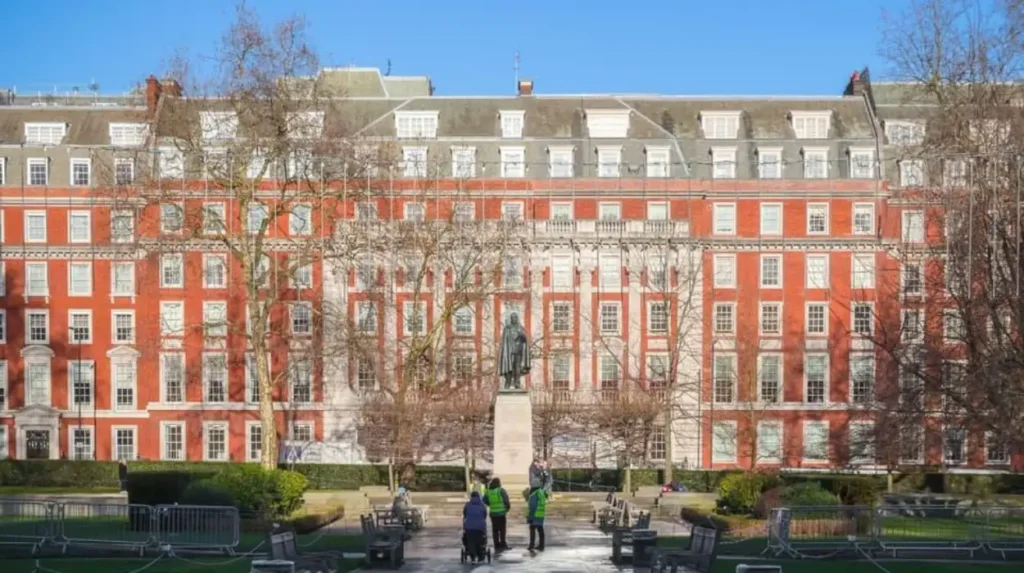
Grosvenor Square became the central organising feature of the new estate. It represented a major innovation in elite residential planning.
The square created valuable frontage for large townhouses while providing a landscaped central space for residents.
Historic England describes Grosvenor Square as part of an early eighteenth-century development for the Grosvenor Estate and identifies its garden square as a central feature of the planned neighbourhood.
The use of squares became a defining feature of prestigious London urban development.
A garden square performed several functions. It provided open space, increased property values, separated wealthy residents from crowded commercial districts, and created a recognisable architectural identity.
Grosvenor Square therefore established a physical model that supported Mayfair’s social hierarchy.
The neighbourhood was not designed for industrial workers or mass housing. Its streets and properties were structured around large residences for wealthy households with servants and substantial domestic operations.
How did aristocratic society make Mayfair prestigious?
Mayfair became prestigious because Britain’s aristocracy, political elite, wealthy landowners, and influential families established London residences there. Their presence attracted further elite residents, reinforcing property values, social status, exclusive institutions, and the district’s reputation as a leading address.
Prestige in eighteenth-century London was closely connected to location.
The British aristocracy maintained country estates but also required townhouses in London. These residences supported political activity, parliamentary attendance, court participation, entertainment, and social networks.
Mayfair became one of the principal locations for these London houses.
A townhouse was not simply a private residence. It was an urban base for an aristocratic household.
Large properties accommodated family members, servants, kitchens, stables, storage, reception rooms, and formal spaces for political and social gatherings.
The concentration of wealthy households produced a powerful economic effect. High-status residents required specialist services, luxury goods, skilled craftspeople, tailors, furniture makers, and other businesses.
The district therefore developed a social and commercial ecosystem built around affluent consumers.
How did Mayfair’s social geography reinforce exclusivity?
The district’s geography helped preserve its elite identity.
Mayfair stood close to St James’s, Piccadilly, Green Park, and Hyde Park. These locations connected residents to royal institutions, major parks, fashionable streets, and the political centre of Westminster.
The neighbourhood was also organised around controlled residential streets and squares rather than large industrial infrastructure.
This physical structure helped maintain a separation between elite residential areas and the commercial or manufacturing districts that characterised other parts of London.
The result was a concentration of wealth that reinforced itself over generations.
How did Mayfair’s architecture create its luxury identity?
Mayfair’s luxury identity was built through high-quality Georgian architecture, formal terraces, large townhouses, garden squares, and later Victorian and Edwardian buildings. Architectural consistency created a recognisable environment associated with wealth, craftsmanship, aristocratic residence, and long-term urban prestige.
Architecture became one of Mayfair’s most durable historical assets.
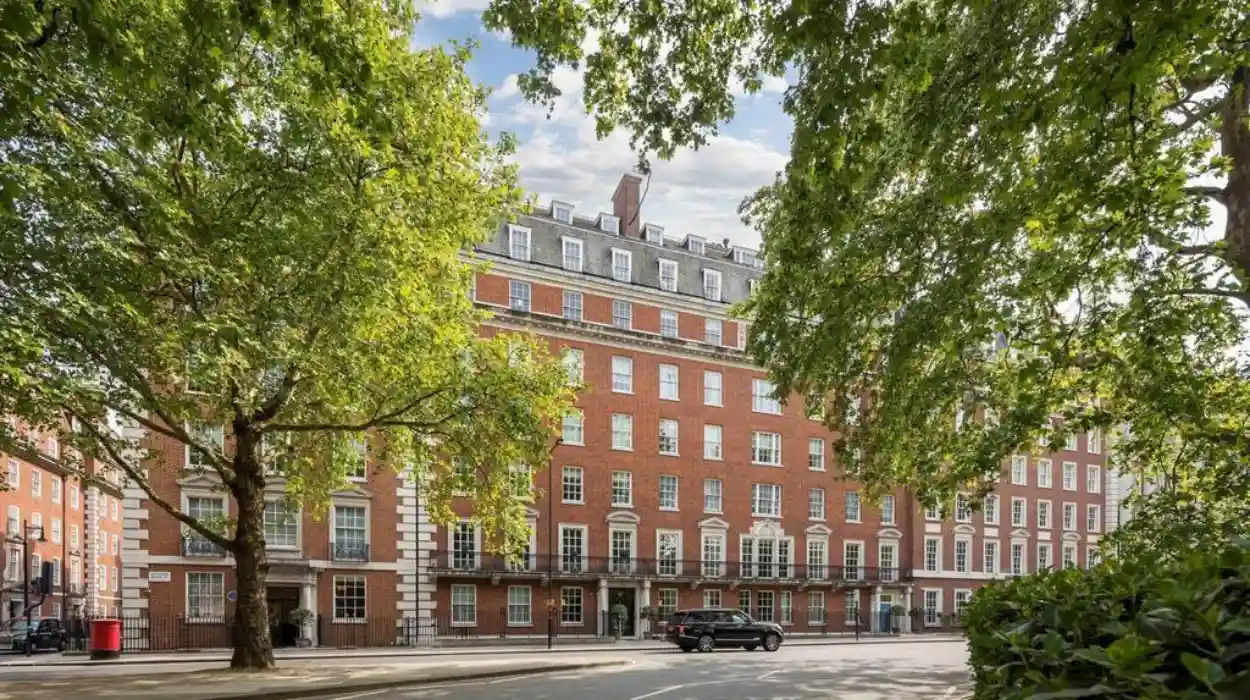
The eighteenth-century development produced streets lined with brick townhouses built according to Georgian principles of proportion, symmetry, and formal street composition.
Individual buildings differed in size and decoration, but the wider urban landscape retained a consistent architectural language.
Berkeley Square became one of the most important examples.
Historic England records that Berkeley Square was laid out in the 1740s and that its present garden layout dates substantially from the late 1760s. The west side was developed in 1745 by developers including Edward Cock and Francis Hillyard.
The square developed through connections between several major aristocratic estates.
Land north of Piccadilly had been associated with Berkeley House, later Devonshire House. A seventeenth-century agreement protecting views from the property influenced the pattern of later development around Berkeley Square.
Why did Berkeley Square become a symbol of elite Mayfair?
Berkeley Square combined aristocratic landownership, Georgian housing, formal landscaping, and a highly valuable central location.
Its architecture demonstrates how Mayfair developed through coordinated estate planning rather than random urban growth.
Historic England identifies surviving eighteenth-century buildings around the square and records the long history of changes to its houses and gardens.
The square also contains London plane trees planted in 1789, preserving a direct physical connection with the late eighteenth-century landscape.
Such surviving features make Mayfair historically significant beyond its modern luxury economy.
The district contains a layered urban record in which streets, squares, listed buildings, gardens, and estate boundaries preserve evidence of centuries of development.
What role did the May Fair itself play in creating the district’s identity?
The May Fair gave the neighbourhood its name and represented the area’s earlier public character before aristocratic development transformed it. As planned housing expanded during the eighteenth century, the fair disappeared and the name survived as the permanent identity of Mayfair.
The May Fair reflected a very different stage in the history of the area.
A fair was a temporary public gathering involving entertainment, trade, food, and other commercial activities. Such events were common in early modern England and often operated outside dense urban centres.
The fair associated with Mayfair took place in the area before the district became fully developed as an elite residential neighbourhood.
As the Grosvenor Estate and neighbouring landowners developed streets and houses, the land became too valuable for the continuation of a large public fair.
This transformation demonstrates a fundamental change in land use.
Open land used for temporary public activity was converted into permanent high-value property.
By the middle of the eighteenth century, the built environment had replaced much of the earlier landscape.
Westminster conservation records show that development accelerated rapidly during the early eighteenth century and that by the time of John Rocque’s 1745 map, much of the Grosvenor Estate had been built over.
The disappearance of the fair did not erase its historical importance.
Its name became attached permanently to one of London’s most internationally recognised districts.
How did estate planning make Mayfair different from other London neighbourhoods?
Estate planning distinguished Mayfair by giving large landowners control over streets, leases, architecture, maintenance, and redevelopment. This long-term system protected the district’s physical character and allowed prestigious property to be renewed without abandoning its established urban identity.
The estate system was central to Mayfair’s development.
Much London property was historically held under leasehold arrangements. Landowners retained the freehold while granting long leases to builders and occupants.
When leases expired, estates could influence redevelopment.
This system created long-term control over the urban environment.
The Grosvenor Estate developed extensive experience in managing London property. Its association with London land began through the 1677 marriage of Sir Thomas Grosvenor and Mary Davies, and Mayfair became one of the earliest major examples of its urban development strategy.
How did leasehold development affect architecture?
Leasehold development encouraged builders to construct properties suitable for wealthy tenants.
Estate planning also supported consistent street patterns and coordinated building lines.
Over time, individual houses were altered, rebuilt, or converted to new uses. The broader street network and estate structure remained.
This explains why modern Mayfair contains buildings from several historical periods while retaining a strong overall identity.
The district includes Georgian architecture alongside Victorian, Edwardian, twentieth-century, and contemporary structures.
The historical continuity comes from the survival of streets, squares, estate patterns, and protected buildings.
How did Mayfair change during the Victorian and Edwardian periods?
During the Victorian and Edwardian periods, Mayfair retained its elite status while adapting to changing wealth, architecture, transport, and social structures. Older Georgian properties were altered, new buildings appeared, and luxury commerce increasingly became part of the neighbourhood’s identity.
The nineteenth century brought major changes to London.
The population expanded dramatically. Railways transformed transport. Industrial wealth created new fortunes. Traditional aristocratic society increasingly interacted with bankers, merchants, industrialists, and international visitors.
Mayfair remained an elite district because it adapted rather than disappearing.
Some Georgian houses continued as private residences. Others were rebuilt or altered to meet modern expectations.
The architectural landscape became more varied.
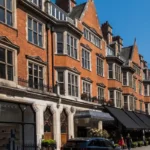
Late nineteenth-century development introduced new styles, including red-brick and terracotta buildings associated with Victorian and Edwardian architecture.
This period also strengthened Mayfair’s connection with luxury commerce.
Why did shopping become important to Mayfair’s prestige?
Wealthy residents created demand for specialised goods and services.
The streets surrounding Mayfair became associated with fashion, jewellery, art, antiques, and other luxury industries.
Bond Street became particularly important within London’s wider luxury geography.
Commercial development did not remove Mayfair’s prestige. It reinforced it.
The combination of expensive residences and high-value retail created a district where wealth was expressed through both property and consumption.
This relationship continues in the modern neighbourhood.
How did the twentieth century transform Mayfair?
The twentieth century changed Mayfair from a predominantly aristocratic residential district into a mixed centre of luxury homes, offices, hotels, diplomacy, private institutions, and international business while preserving many historic streets, squares, and architecturally significant buildings.
The social structure of Britain changed significantly during the twentieth century.
Large aristocratic households became less common. Domestic service declined. Many families no longer maintained extensive London townhouses.
As a result, numerous large properties changed use.
Some became offices. Others became embassies, clubs, hotels, commercial premises, or subdivided residences.
Berkeley Square demonstrates this process.
Historic England records twentieth-century redevelopment on several sides of the square, including office and commercial buildings, while substantial elements of the earlier historic environment survived.
This pattern occurred throughout Mayfair.
How did international connections reshape the district?
Mayfair became increasingly international.
Its central location, prestigious address, hotels, private institutions, luxury businesses, and proximity to government made it attractive to foreign residents and organisations.
Grosvenor Square developed particular significance in Anglo-American relations.
Historic England identifies the square’s twentieth-century redesign and its commemorative role in the relationship between Britain and the United States, including memorial associations connected with the Second World War and later events.
The neighbourhood therefore acquired historical meanings beyond British aristocratic life.
Its public spaces became connected with diplomacy, international politics, and commemoration.
Why did Mayfair remain prestigious after aristocratic society changed?
Mayfair remained prestigious because its location, historic architecture, controlled estate management, limited supply of property, luxury businesses, and international reputation preserved high demand even after traditional aristocratic residential patterns declined during the twentieth century.
Prestige survived because the underlying advantages of the district remained.
Mayfair continued to occupy one of the most strategically valuable locations in central London.
It remained close to major parks, government institutions, luxury shopping streets, hotels, and transport connections.
Its historic buildings also created scarcity.
New development could not simply reproduce centuries of established urban identity.
The survival of Georgian streets and squares gave Mayfair a physical character that newer luxury districts lacked.
Why is scarcity important to Mayfair’s property history?
Land in central London is limited.
Historic planning controls and the presence of protected buildings further constrain redevelopment.
Mayfair therefore combines a highly desirable location with a limited supply of property.
This economic condition has supported long-term high property values.
The district’s reputation also became self-reinforcing.
A prestigious address attracts wealthy residents and businesses. Their presence strengthens the reputation of the address. Increased demand supports property values and luxury investment.
This cycle has operated in different forms since the eighteenth century.
What historic landmarks still show Mayfair’s aristocratic past?
Mayfair’s historic character remains visible through Grosvenor Square, Berkeley Square, Georgian terraces, listed townhouses, historic streets, garden spaces, churches, and surviving estate patterns. These places preserve physical evidence of the eighteenth-century planning that established the neighbourhood’s elite identity.
The most important surviving evidence is often found in the urban layout itself.
Grosvenor Square remains a central feature of the historic estate plan. It is listed at Grade II on the Register of Historic Parks and Gardens.
Berkeley Square is also listed at Grade II and preserves its historic garden structure and mature trees associated with the eighteenth-century landscape.
Individual townhouses provide further evidence.
Historic England records numerous listed buildings throughout Mayfair, documenting their architectural and historical importance.
Number 42 Berkeley Square, for example, contains fabric associated with the mid-eighteenth-century development of the square and later architectural alterations.
These places demonstrate that Mayfair’s history is not confined to museums.
The district itself functions as an urban historical record.
To experience this historic neighbourhood in person today, consult our comprehensive [Best Independent Shops in Marylebone Every Visitor Should Explore During Their Stay] for itineraries and visiting parameters.
How has historic preservation protected Mayfair’s character?
Historic preservation protects Mayfair through listed-building legislation, conservation planning, heritage assessment, and estate management. These systems preserve significant architecture and landscapes while allowing carefully controlled adaptation, ensuring the neighbourhood remains historically recognisable despite continuing economic and commercial change.
Preservation is essential because Mayfair remains economically valuable.
Without planning controls, historic buildings and streets could face extensive redevelopment pressure.
The listing system identifies buildings and landscapes of special architectural or historic interest.
Historic England’s records for Berkeley Square and Grosvenor Square demonstrate the formal recognition of Mayfair’s historic environment.
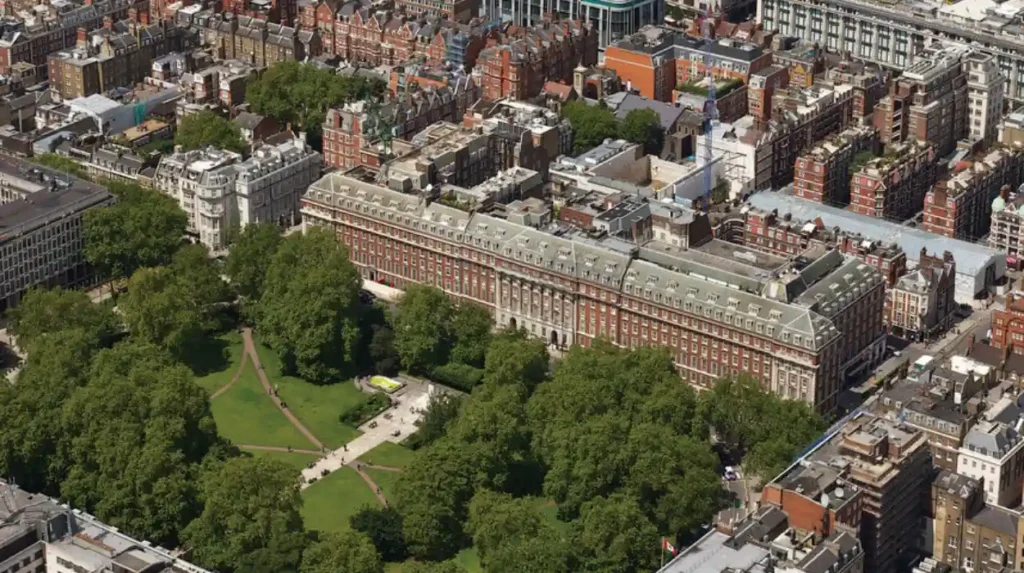
What does preservation mean in a living luxury district?
Preservation does not mean freezing a neighbourhood in one historical year.
Mayfair has changed continuously since the eighteenth century.
Buildings have been repaired, altered, extended, converted, and occasionally replaced.
Preservation focuses on protecting significant features while managing change.
This approach allows historic streets to remain economically active.
Modern offices, hotels, residences, restaurants, galleries, and retailers operate within an environment shaped by earlier centuries.
The coexistence of historic fabric and modern wealth is one of Mayfair’s defining characteristics.
What is the lasting historical significance of Mayfair?
Mayfair is historically significant because it demonstrates how aristocratic landownership, eighteenth-century urban planning, Georgian architecture, social hierarchy, estate management, and modern global wealth combined to create and preserve one of the world’s most recognisable luxury urban neighbourhoods.
Mayfair provides an important case study in London’s urban history.
Its development demonstrates how private landownership shaped the growth of the capital.
The Grosvenor Estate converted formerly rural land into a planned urban district during the eighteenth century. Garden squares, formal streets, and expensive townhouses established a model of elite development.
Its history also documents changes in British society.
The district moved from countryside and fairground activity to aristocratic residence.
It then adapted to Victorian commercial growth, twentieth-century social change, international diplomacy, and the modern global luxury economy.
The physical landscape preserved evidence from these periods.
Georgian squares remain. Historic trees survive. Listed townhouses continue to define streets. Estate boundaries and planned routes remain visible in the modern city.
Mayfair’s prestige therefore has a precise historical foundation.
It was created through location, planning, ownership, architecture, and social concentration. It survived because those foundations remained valuable even as the people and institutions using the district changed.
How did Mayfair become London’s enduring symbol of luxury?
Mayfair became London’s enduring symbol of luxury through more than three centuries of planned development, aristocratic residence, architectural quality, controlled landownership, commercial adaptation, and international investment. Its historical infrastructure of prestige continues to shape its identity, economy, and global reputation today.
The district’s history began with open land and a seasonal fair.
Its decisive transformation occurred during London’s eighteenth-century westward expansion.
Aristocratic landowners recognised the value of developing property close to the royal and political centres of Britain. The Grosvenor Estate created a structured neighbourhood centred on Grosvenor Square and connected by an organised network of streets.
The resulting environment attracted wealthy households.
Architecture reinforced social status. Garden squares provided space and exclusivity. Proximity to St James’s and Westminster connected residents with political and royal institutions.
Later generations adapted the neighbourhood without completely removing its historical structure.
Victorian and Edwardian buildings expanded the architectural record. Twentieth-century conversions introduced offices, hotels, diplomatic functions, and international institutions. Preservation systems protected important historic features.
Modern Mayfair therefore represents both continuity and change.
It remains associated with luxury because its historical development created conditions that continue to produce prestige: limited land, exceptional location, architectural distinction, internationally recognised addresses, and a long-established culture of high-value property and commerce.
The history of Mayfair is ultimately the history of how urban planning can create lasting social and economic identity.
From the May Fair that gave the district its name to the planned streets of the Grosvenor Estate and the surviving squares of Berkeley Square and Grosvenor Square, the neighbourhood preserves a record of London’s transformation into a global capital.
That historical structure remains visible today.
Mayfair did not simply become prestigious because wealthy people moved there. Wealthy residents were drawn to a district deliberately created for elite occupation, and their presence strengthened a system of prestige that has continued for more than 300 years.
For historians, visitors, educators, preservationists, and researchers, Mayfair remains one of the clearest examples of how landownership, architecture, political geography, and social status shaped the modern landscape of London.
Frequently Asked Question
Why is Mayfair still associated with luxury today?
Mayfair remains associated with luxury because its historical reputation, prestigious addresses, high-value property, luxury retail, fine dining, private institutions, and international connections continue to attract wealthy residents and businesses.