The global hospitality sector has transformed into a highly localized, digital-first marketplace. When consumers execute a search for proximity-based dining options, they engage with an interconnected system of geographic coordinates, real-time commercial data, and algorithmic sorting mechanisms. In the United Kingdom, the full-service restaurant market reached a valuation of USD 33.49 billion in 2025, with projections estimating growth to USD 35.78 billion in 2026. This expanding financial footprint highlights the critical importance of spatial discovery engines. For audiences of The Londoner News, understanding the underlying structures of proximity search tools converts an everyday digital interaction into a strategic method for discovering high-quality culinary establishments.
- What Does Restaurants Near Me Mean in Modern Search Engineering?
- How Do Proximity Search Algorithms Determine Local Dining Options?
- Why Has Proximity Searching Reshaped Consumer Behavior in the Hospitality Industry?
- What Key Components Must a Restaurant Optimize to Rank Near Me?
- How Do Consumer Preferences and Economic Trends Guide Proximity Searches?
- What Future Technologies Will Change How We Find Restaurants Near Me?
- How Can Consumers Critically Evaluate Local Search Engine Results?
What Does Restaurants Near Me Mean in Modern Search Engineering?
The phrase “restaurants near me” represents an intent-driven search query that instructs search engines to utilize geographical telemetry, localized indexing, and user constraints to display food service establishments within an immediately accessible radius of the user’s current location.
This mechanism operates by matching the Global Positioning System (GPS) coordinates of a mobile device or the Internet Protocol (IP) address of a desktop computer against a localized database of verified commercial entities. In the field of search engine optimization, this type of lookup is classified as an explicit local intent query. The algorithmic calculation prioritizes proximity, relevance, and prominence above broad global ranking signals. Consequently, the user is presented with a curated list of operational venues that can be filtered by opening hours, user ratings, and culinary styles.
Historically, finding a dining venue relied on physical directories, printed guidebooks, or word-of-mouth recommendations. The introduction of localized search functions in the mid-2000s shifted consumer habits from premeditated planning to spontaneous, real-time discovery. Today, search algorithms analyze dozens of distinct data points simultaneously. These variables include traffic conditions, walking velocities, and real-time seating availability to calculate the actual accessibility of an establishment. The modern execution of proximity search functions as an immediate bridge between digital intent and physical commerce.
How Do Proximity Search Algorithms Determine Local Dining Options?
Proximity search algorithms determine local dining options by cross-referencing user location data with business listing information across three core metrics: distance from the coordinate point, structural relevance to the search terms, and the digital prominence of the establishment.
The first variable, distance, calculates the radial distance or driving time between the user and the commercial point of interest. Search platforms apply geofencing, which creates a virtual geographic boundary around a specific point, to restrict or expand results based on population density. In dense urban centers like Central London, the boundary may be restricted to a radius of 500 meters, whereas in rural environments, it may expand to 15 kilometers.
The second metric, relevance, involves a deep semantic analysis of the digital content associated with a restaurant. The system parses the business name, categorized attributes, online reviews, and digital menus to confirm that the venue matches the specific intent of the user. If a consumer searches for a specific dish, the algorithm scans unstructured data fields across third-party indexers to confirm the item is actively served at that venue.
The third metric, prominence, measures the authority and reputational credit of a business across the internet. This calculation evaluates the volume of inbound links, the consistency of local citations, and user sentiment metrics across platforms. The integration of these three systems creates the finalized output known as the local map pack.
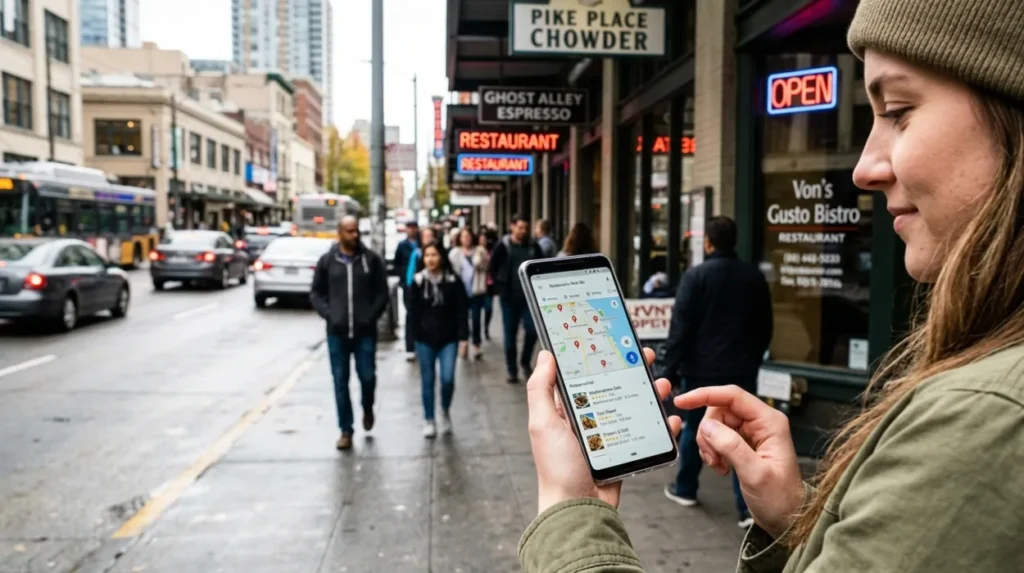
Why Has Proximity Searching Reshaped Consumer Behavior in the Hospitality Industry?
Proximity searching has reshaped consumer behavior by reducing the time required to make a purchasing decision, shifting dining choices toward convenience, and transferring market visibility from legacy brands to highly optimized independent venues.
Data from market intelligence firms shows that immediate geographic availability is now a primary driver of restaurant selection. In 2026, over 50% of consumers in the United Kingdom dine out or order delivery food at least once per week. This high transaction frequency is heavily supported by mobile discovery engines. The availability of real-time operational status, average check prices, and crowd density indicators allows consumers to bypass historical research steps.
This structural shift has created a dual pattern in consumer spending across urban populations:
- Spontaneous Micro-Occasions: Consumers rely on immediate radial searches to fulfill instant needs, prioritizing walking distances under ten minutes.
- Experience-Led Destination Dining: Consumers use wider geographic filters to locate unique, highly rated independent venues for planned social gatherings.
As a result, traditional high-street visibility is no longer the sole requirement for commercial success. Restaurants situated in secondary commercial spaces or subterranean alleys can compete effectively with primary storefronts, provided their local digital profiles maintain high algorithmic relevance.
What Key Components Must a Restaurant Optimize to Rank Near Me?
A restaurant must optimize four primary foundational components to secure local rankings: a verified Google Business Profile, structured schema markup on its website, consistent citation directory profiles, and a continuous stream of user reviews.
The Google Business Profile serves as the primary data point for local search indexing. This platform stores core business attributes, coordinates, operational hours, and health compliance disclosures. If a profile contains incomplete operational hours or unverified location updates, the core algorithm lowers its visibility score to prevent providing inaccurate information to users.
Structured data, specifically Restaurant Schema Markup, uses a standardized code format implemented on a venue’s website. This code allows search spiders to extract menus, price tiers, and reservation options without human interpretation.
Citation alignment requires total consistency across all public directories regarding Name, Address, and Phone number (NAP). Discrepancies in punctuation, postal codes, or telephone extensions introduce data conflicts, reducing trust in the listing’s accuracy. Finally, the review processing engine evaluates the velocity, diversity, and keyword context of user reviews, using them as a real-time signal of continuous commercial operation and consumer validation.
How Do Consumer Preferences and Economic Trends Guide Proximity Searches?
Consumer preferences and macroeconomic trends guide proximity searches by shifting search queries toward specific nutritional profiles, value-driven dining formats, and sustainable sourcing methods.
Data from the Vegan Society confirms that the vegan population in Great Britain expanded significantly, with plant-based diners increasingly using specialized dietary filters during local searches. In response, major corporate entities have modified their menus; for example, Wagamama introduced collaborative plant-based dishes, and Pizza Express deployed specialized vegan alternatives across all national sites. These modifications ensure these brands remain visible when consumers apply health-focused search parameters.
Concurrently, economic inflation has altered how value is parsed via proximity tools. In Q1 2026, the average spend per eating-out occasion in the United Kingdom reached £18.35, driven by menu price adjustments. This environment has accelerated the use of value-based queries, such as “set menus near me” or “best value lunch deals”.
Furthermore, over 80% of UK restaurant operators have prioritized localized, ethical sourcing strategies in 2026 to capture the growing number of consumers willing to pay a sustainability premium. Consequently, phrases highlighting environmental attributes, such as “locally sourced restaurants” or “zero-waste kitchens,” have become significant thematic components within search architectures.

What Future Technologies Will Change How We Find Restaurants Near Me?
Future technologies will change proximity searches by replacing keyword-based maps with natural language AI interfaces, predictive dining engines, and augmented reality overlays.
The transition from keyword matching to neural search processing allows consumers to execute highly detailed, multi-variable prompts, such as:
“Find an open, quiet Italian restaurant within a ten-minute walk that offers gluten-free pasta options and outdoor seating.”
AI search engines handle these queries by instantly synthesizing unstructured data from menus, critical food reviews, and real-time transit databases.
Predictive discovery represents another major evolutionary step. By evaluating historical location history, biometric data from wearable devices, and calendar entries, mobile devices can proactively recommend dining venues before the user initiates a search.
Furthermore, augmented reality (AR) interfaces change real-world navigation by projecting business ratings, live menu items, and seating charts directly onto a user’s field of vision as they look at a physical storefront. These technical advancements move the industry away from manual indexing systems, transforming proximity discovery into an ambient, continuous, and intelligent digital assistant layer.
How Can Consumers Critically Evaluate Local Search Engine Results?
Consumers can critically evaluate local search results by verifying review patterns, cross-checking real-time booking availability, and inspecting direct food menus to bypass paid ad spots and artificial ranking signals.
While search engines provide great convenience, the displayed results are frequently influenced by paid advertising programs, search optimization techniques, and review manipulation efforts. Paid placements often occupy the top spots in the local map pack, meaning the most prominent result is not necessarily the highest-rated or closest venue.
To find authentic local spots, consumers should look for specific indicators of genuine quality:
- Review Text Detail: Authentic feedback often references specific dishes, staff names, or unique physical layouts, whereas artificial reviews tend to rely on generic praise.
- Temporal Review Distribution: A sudden surge in positive ratings within a short period can signal a review manipulation campaign, whereas a steady stream of reviews suggests regular, ongoing operations.
- Direct Menu Verification: Checking a venue’s official digital menu prevents issues with outdated pricing or discontinued items often found on third-party aggregators.
By understanding these algorithmic factors and evaluating listings carefully, consumers can confidently navigate digital search tools to find high-quality dining experiences that match their exact needs.
What does “restaurants near me” mean?
“Restaurants near me” is a location-based search query that uses your device’s GPS, IP address, or Wi-Fi location to display nearby restaurants that match your search intent based on proximity, relevance, and popularity.