
The structural evolution of urban areas within the London Borough of Merton requires systematic documentation to inform residents, business entities, and stakeholders of localized socioeconomic shifts. This community report for The Londoner News provides an authoritative, data-backed assessment of the 2026 local marketplace scheduling, civic infrastructure initiatives, and environmental regeneration projects across the district of Colliers Wood.
- What Is the Background of Urban Infrastructure and Commerce in Colliers Wood?
- What Are the Scheduled Local Market Dates in Colliers Wood for 2026?
- What Neighborhood Improvement Projects Are Underway for 2026?
- How Are Environmental and Green Space Initiatives Being Implemented in 2026?
- What Are the Socioeconomic Impacts of These 2026 Developments on The Londoner News Readers?
What Is the Background of Urban Infrastructure and Commerce in Colliers Wood?
Colliers Wood is a South London district located within the London Borough of Merton, defined by its retail corridors, residential areas, and historical transport links. The area sits along the historic path of Stane Street, a major Roman road connecting London to Chichester.
Historically, the geographic identity of Colliers Wood has been shaped by the Wandle Valley, an ecosystem that powered industrial production from the Anglo-Saxon period through the Industrial Revolution (Adkins, 2026). The River Wandle facilitated the establishment of mills, textile works, and print works, notably the Liberty Print Works, which operated extensively throughout the 19th and 20th centuries.
The transition from an industrial manufacturing hub to a contemporary commercial and residential center accelerated significantly in the late 20th century. A critical catalyst for this shift was the construction of the Colliers Wood Underground Station, designed by architect Charles Holden and opened in 1926 as part of the City and South London Railway extension to Morden. This infrastructure integrated the district into the wider London Passenger Transport Board network, driving suburban development and population dense expansion.
In the contemporary urban landscape, Colliers Wood operates as an essential district center within the London Borough of Merton’s retail and commercial hierarchy (Street, 2008). The economic structure relies on a dual-retail model, comprising traditional high street businesses along the A24 corridor and large-scale retail agglomerations, specifically the tandem commercial environments of the Merton Abbey Mills, the Sainsbury’s and Marks & Spencer flagship complex, and the Priory Retail Park.
Planning frameworks managed by Merton Council ensure that these commercial spaces adapt to shifting consumer patterns while maintaining historical continuity with the surrounding conservation areas.
What Are the Scheduled Local Market Dates in Colliers Wood for 2026?
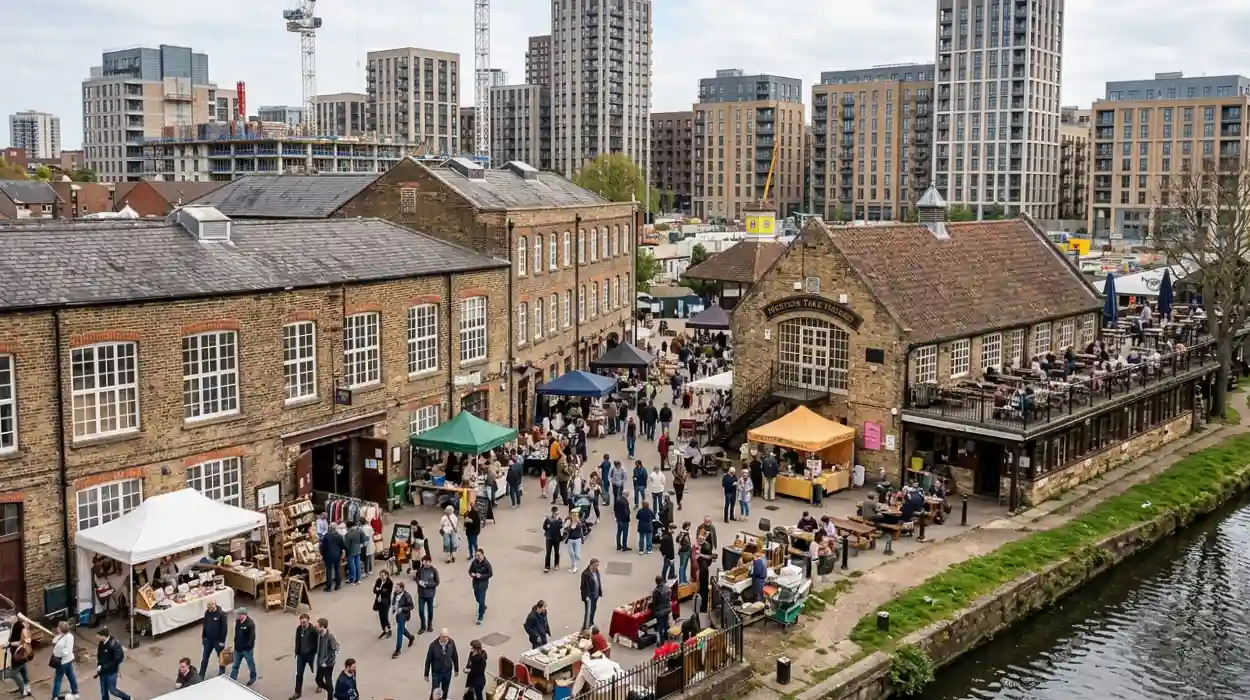
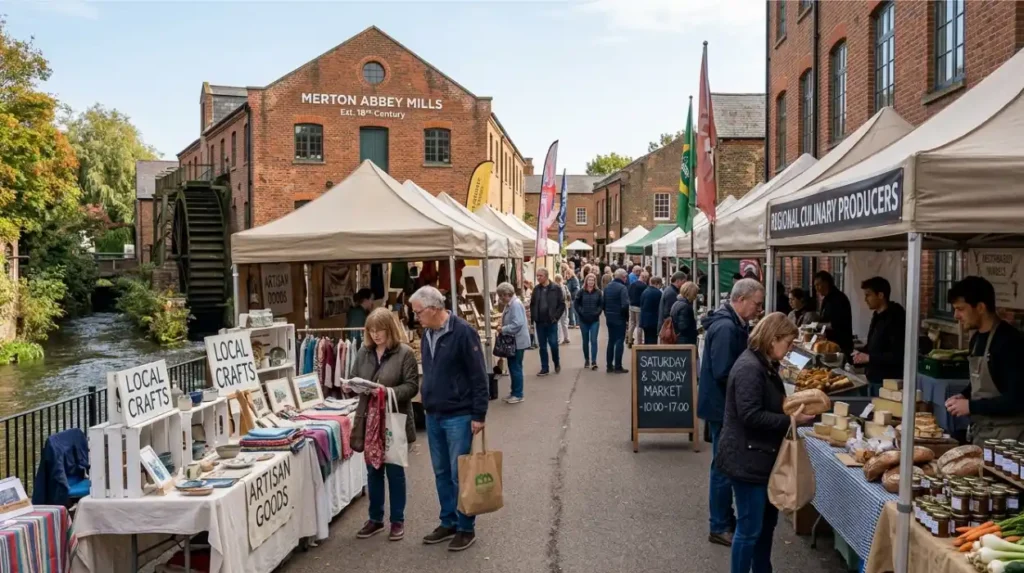
The scheduled local market dates in Colliers Wood for 2026 follow a structured, recurring weekly and seasonal calendar centered around the historic Merton Abbey Mills site. Regular weekend trading occurs every Saturday and Sunday from 10:00 to 17:00 throughout the entire year.
Weekly Trading Infrastructures
The commercial core of the local market sector resides at Merton Abbey Mills, situated off Merantun Way. The weekend craft and food market provides consistent infrastructure for independent traders, micro-enterprises, and regional agricultural producers. In 2026, standard trading operations occur on 52 distinct weekends, representing 104 individual standard market days. These operations are structured around two categories of vendors: permanent retail units housed within the historic wheelhouse and pottery buildings, and temporary stallholders utilizing standardized external gazebos.
Seasonal and Artisan Event Schedules
In addition to the standard weekly scheduling, the calendar for 2026 incorporates specialized seasonal markets designed to accommodate specific categories of consumer demand. The 3 types of specialized markets scheduled for the 2026 calendar year include:
- The Spring Artisan Fair: Scheduled for the final weekend of April 2026 (April 25–26, 2026), focusing on local visual arts, ceramics, and hand-woven textiles.
- The Summer Food and Craft Festival: Scheduled across a three-day bank holiday period in August 2026 (August 29–31, 2026), highlighting regional culinary producers and live interactive craft demonstrations.
- The Winter Solstice Markets: Running continuously from late November through December 2026, operating every Friday evening from 16:00 to 21:00 in addition to standard weekend operating hours.
Logistical management of these dates is coordinated in conjunction with Merton Council’s licensing divisions to ensure compliance with the London Local Authorities Act 1990. This regulatory framework governs street trading, waste management protocols, and crowd control measures during high-density operational periods.
What Neighborhood Improvement Projects Are Underway for 2026?
The neighborhood improvement projects underway in Colliers Wood for 2026 consist of strategic infrastructure modernizations, public realm enhancements, and urban safety installations managed by Merton Council. These developments are funded via the Community Infrastructure Levy and Section 106 planning obligations.
Transport and Highway Modernization
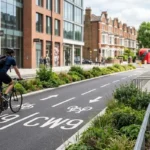
A primary component of the 2026 civic improvements involves the reconfiguration of traffic movement and pedestrian accessibility along the A24 Christchurch Road and the Merantun Way intersection. Merton Council’s structural engineering divisions have initiated a public realm and transport initiative designed to reduce vehicular congestion while minimizing pedestrian conflict points (Council, 2014b). The project introduces active travel corridors, which incorporate segregated cycling lanes, raised continuous pavements at side junctions, and upgraded intelligent traffic signaling systems utilizing Split Cycle Offset Optimisation Technique technology.
Public Realm and Civic Space Revitalization
Civic space improvements in 2026 are specifically targeted at the pedestrianized zones surrounding the Colliers Wood Underground Station and the adjacent library facilities. The structural scope of these works involves the removal of obsolete street furniture, installation of energy-efficient LED public lighting matrices, and the deployment of sustainable urban drainage systems.
These urban systems utilize permeable paving stones and integrated rain gardens to capture surface water runoff, thereby reducing hydro-load stress on the local subterranean sewer network during heavy precipitation events.
Security and Accessibility Upgrades
To support the increased footfall generated by local markets and new residential developments, targeted security installations are being deployed across major public walkways. The 3 types of safety installations expanding across the district in 2026 include:
- Closed-Circuit Television Integration: The installation of high-definition, low-light cameras linked directly to the Merton Council centralized monitoring facility.
- Hostile Vehicle Mitigation Barriers: The strategic placement of structural planters and reinforced bollards at the entry points of pedestrianized commercial zones.
- Accessible Pedestrian Crossings: The implementation of tactile paving surfaces and audible crossing indicators at all primary intersections along Baltic Close and High Street Colliers Wood.
Explore More Things To Do
BBC Weather Data Systems and Climate Metrics: London 2026
Morrisons Installs Male Sanitary Bins in Customer Toilets: London
How Are Environmental and Green Space Initiatives Being Implemented in 2026?
Environmental and green space initiatives in 2026 are implemented through targeted habitat restoration, biodiversity action plans, and park facility modernizations across the Wandle Valley corridor. These projects are executed via partnerships between Merton Council and localized volunteer conservation groups.
The Wandle Valley Regional Park Framework
The environmental strategy for Colliers Wood is integrated into the broader objectives of the Wandle Valley Regional Park Trust. In 2026, specific focus is directed toward the ecological preservation of the River Wandle fluvial corridor running through Wandle Park and the adjacent National Trust property at Morden Hall Park.
The structural mechanics of this environmental project require the extraction of invasive non-native riparian plant species, specifically Himalayan Balsam (Impatiens glandulifera) and Japanese Knotweed (Fallopia japonica), alongside the stabilization of riverbanks using natural willow spilling techniques.
Local Park Facility Enhancements
Urban parklands within the immediate vicinity of Colliers Wood, including Wandle Park and the nearby John Innes Park, are undergoing structured upgrades to fulfill the criteria established by the Green Flag Award scheme (Merton, 2023). The 2026 management plans emphasize sustainable resource usage and the conservation of heritage features.
The technical components of the park improvement schedule for 2026 are detailed chronologically below to illustrate the specific seasonal execution of environmental engineering works.
Riparian Habitat Engineering and Silt Reduction
Q1 2026 (January – March)
Execution of riverbed desilting maneuvers within the Colliers Wood sections of the River Wandle. Workers install coir rolls embedded with native aquatic vegetation to reinforce natural bank topographies and minimize erosion during early spring melt and rainfall.
Arboricultural Management and Canopy Expansion
Q2 2026 (April – June)
Implementation of the Merton Urban Tree Strategy across Wandle Park. This phase comprises the planting of native broadleaf tree species, including English Oak (Quercus robur) and Common Alder (Alnus glutinosa), to improve the urban canopy index and mitigate the local heat island effect.
Biodiversity Monitoring and Meadow Seeding
Q3 2026 (July – September)
Establishment of perennial wildflower meadows within designated low-mowing zones of local green spaces. Ecological surveyors execute formal counts of pollinator populations, focusing on wild bee and lepidoptera distributions to assess the efficacy of the biodiversity action plan.
Pedestrian Footpath Reconstruction and Permeability Works
Q4 2026 (October – December)
Replacement of damaged, impermeable asphalt footpaths with porous aggregate pathways. This engineering adjustment ensures optimal groundwater filtration while maintaining complete accessibility for wheeled mobility apparatus during winter weather conditions.

What Are the Socioeconomic Impacts of These 2026 Developments on The Londoner News Readers?
The socioeconomic impacts of the 2026 developments on the local population manifest as shifts in commercial real estate valuation, localized retail spending retention, and public health metrics derived from enhanced active travel infrastructure. These shifts alter the microeconomic profile of the Merton borough.
Commercial and Residential Property Dynamics
The execution of public realm improvements and infrastructure upgrades directly influences the local property market. Systematic evidence indicates that targeted investments in public infrastructure and pedestrian accessibility correlate with long-term variations in residential asset valuation and commercial rental premiums (Caplin, 2003).
As Colliers Wood improves its physical connection to major transport hubs and updates its public spaces, the district experiences a repositioning within the South London housing market. This shift impacts both private renters and owner-occupiers by altering the underlying land value values across the SW19 postal district.
Retail Retention and Localized Economic Multipliers
The optimization of the market calendars at Merton Abbey Mills serves a specific economic function: the retention of consumer expenditure within the borough boundaries. Historical economic assessments indicate that residents of Merton frequently divert comparison goods expenditure to adjacent retail centers outside the borough, such as those located in Wandsworth, Kingston, or central London destination points (Street, 2008).
By expanding specialized market events and improving the physical presentation of district shopping zones in 2026, the local economy increases its internal multiplier effect. This process ensures that capital generated by residents remains within local supply chains, supporting independent commercial tenants and micro-enterprises.
Public Health and Active Travel Implications
The modifications made to the A24 highway infrastructure carry measurable health implications for the local population. By segregating cycling corridors and widening pedestrian pathways, the infrastructure reduces the statistical probability of vehicular collisions involving vulnerable road users.
Furthermore, the provision of high-quality active travel pathways encourages modal shifts from private combustion-engine vehicles to walking and cycling. This behavioral shift reduces localized nitrogen dioxide emissions and particulate matter concentration levels, contributing directly to the atmospheric targets outlined in the Merton Climate Strategy.
Where is Colliers Wood located?
Colliers Wood is a district in South London located within the London Borough of Merton. The area lies along the historic Roman road known as Stane Street and is connected directly to central London via the Northern line.