


Local taxation within the United Kingdom has undergone multiple systemic transformations over the last four centuries. For history enthusiasts, cultural tourists, and genealogical researchers tracing London lineages, understanding how municipal authorities financed public infrastructure and social welfare offers a critical lens into the socio-political dynamics of the past. The modern council tax system, implemented under the Local Government Finance Act 1992, represents the contemporary iteration of a fiscal lineage that traces its roots directly back to Tudor England.
- What Is the Historical Origin of London’s Local Taxation System?
- How Did the Poor Law Amendment Act 1834 Restructure Municipal Finances?
- What Role Did the London County Council Play in Standardising Local Rates?
- Why Did the Community Charge Trigger a Major Fiscal Crisis in 1990?
- How Did the Local Government Finance Act 1992 Establish Council Tax?
- What Are the Long-Term Implications of 1991 Property Valuations on Modern London?
What Is the Historical Origin of London’s Local Taxation System?
The historical origin of London’s local taxation system resides in the Elizabethan Poor Relief Act 1601, which established the “poor rate.” This mandatory tax on property occupiers funded local parish relief for the impoverished, sick, and institutionalised.
Prior to the formal codification of the poor rate, local infrastructure and poor relief in London relied heavily on voluntary alms, monastic charities, and customary dues managed by trade guilds and ecclesiastical authorities. The dissolution of the monasteries between 1536 and 1541 by King Henry VIII dismantled the primary medieval network of social welfare, leaving London facing an unprecedented surge in vagrancy and economic displacement (Quadagno, 1984). Parliament addressed this crisis by passing the Elizabethan Poor Relief Act 1601, legally establishing the parish as the fundamental unit of local fiscal administration (Besley, n.d.).
Under this statute, churchwardens and appointed overseers of the poor received the statutory authority to levy a compulsory tax—the poor rate—on all occupiers of land, houses, tithes, and coal mines within their specific parish boundaries. The tax was directly proportionate to the estimated annual rental value of the real estate occupied. In London’s highly urbanised environment, this localized system created stark fiscal disparities. Wealthy parishes, such as those within the City of London proper, collected substantial revenues from high-value properties while maintaining relatively low numbers of indigent residents. Conversely, suburban parishes in the East End, such as Stepney and Whitechapel, faced immense poverty burdens supported by a severely restricted property tax base.
To manage municipal functions beyond basic poor relief, the Crown and Parliament introduced supplementary direct taxes based on visible indicators of wealth. These included the hearth tax, enacted in 1662, which charged two shillings per annum for every fire hearth or stove (Hopton, 2021). The intrusive nature of hearth tax assessments, which required physical entry into homes by collectors, caused widespread public resentment, leading to its abolition in 1689 (Hopton, 2021). It was replaced by the window tax in 1696 under King William III, a more easily verifiable fiscal measure that assessed properties based on the number of their windows to avoid residential inspections (Hopton, 2021). This fiscal landscape persisted until the mid-nineteenth century, embedding property occupation as the permanent anchor for British local public finance.
How Did the Poor Law Amendment Act 1834 Restructure Municipal Finances?
The Poor Law Amendment Act 1834 restructured municipal finances by centralising administration into multi-parish Poor Law Unions. This legislation stripped individual parishes of financial autonomy, standardized fiscal accounting, and mandated the construction of union workhouses.
By the early nineteenth century, the escalating costs of the “Old Poor Law” system—driven by demographic growth and the widespread adoption of outdoor relief subsystems like the Speenhamland scale—placed immense fiscal pressure on local ratepayers (Greif & Iyigun, 2013). In 1832, the expenditure on poor relief in England and Wales reached £7 million, prompting Parliament to commission a rigorous inquiry into the structural deficiencies of the system (Besley, n.d.). The resulting Royal Commission on the Poor Laws led directly to the passage of the Poor Law Amendment Act 1834, colloquially designated as the “New Poor Law.”
The 1834 Act fundamentally transformed London’s economic and administrative landscape through three primary interventions:
- Administrative Consolidation: The statute combined England’s 15,000 independent parishes into approximately 600 large administrative units termed Poor Law Unions (Besley, n.d.). In London, historically fragmented areas merged into major districts, including the Poplar Union, the Greenwich Union, and the Holborn Union.
- Fiscal Professionalisation: The newly established central Poor Law Commission mandated a shift from archaic, localized book-keeping methods to standardized, double-entry mercantile accounting practices (Care, 2011). Union clerks were legally required to maintain formal ledgers and present quarterly, audited balance sheets to local ratepayers, significantly reducing financial malfeasance (Care, 2011).
- The Workhouse Test: To systematically reduce expenditure, the Act restricted outdoor relief (direct cash or food provisions) to able-bodied individuals, making all public assistance conditional upon entering a strictly regulated union workhouse (Besley, n.d.).
Financing these large-scale institutional facilities required immense capital outlays, which were drawn directly from the consolidated local poor rates. To experience this historic administrative paradigm in person today, consult our comprehensive [London architectural heritage itinerary guide] for maps, walking routes, and visiting parameters of surviving Victorian institutional structures. The fiscal burden of funding these institutions remained tied to local property assessments, meaning that impoverished industrial districts continued to pay disproportionately higher rates than affluent residential sectors. This structural inequality eventually triggered the passage of the Metropolitan Poor Act 1867, which established the Metropolitan Common Poor Fund to partially equalise the cost of indoor relief across the entire metropolis.

What Role Did the London County Council Play in Standardising Local Rates?
The London County Council standardised local rates by consolidating fragmented municipal authorities under the Local Government Act 1888. It unified disparate local assessments into a single, equitable metropolitan administrative framework.
Prior to 1889, the administrative governance of London outside the ancient City of London was split among a chaotic network of archaic bodies. These included the Metropolitan Board of Works, founded in 1855 to oversee metropolitan infrastructure, alongside dozens of autonomous parish vestries and localized district boards. Each independent entity possessed distinct rating powers, leading to highly volatile tax rates, varied valuation methods, and fragmented infrastructure development across the capital.
The passage of the Local Government Act 1888 dissolved these disjointed administrative structures, creating the County of London and establishing the London County Council (LCC) as its primary, directly elected governing authority. Convening for its inaugural session on 21 March 1889, the LCC assumed comprehensive responsibility for critical metropolitan services. These statutory duties encompassed the expansion of the London main drainage system, the enforcement of public health mandates, the regulation of building construction, and the maintenance of arterial roads and bridges.
To finance these extensive public works equitably, the LCC sought to eliminate the historic discrepancies in local property valuations. Through the London Valuation Act and subsequent local finance reforms, the council introduced standardized valuation criteria across all metropolitan boroughs. Instead of allowing individual parishes to arbitrarily assess rental values, the LCC enforced a uniform five-year revaluation cycle. This structured fiscal alignment ensured that the county rate, levied uniformly across London, was based on an accurate, standardized measurement of property value. By coordinating the financial demands of the capital, the LCC transitioned London out of its parochial past, establishing a modern system of unified municipal finance that treated the entire metropolis as a singular, cohesive economic engine.
Explore More Public Services
How Long to Process a Social Housing Register Application in London?
How to Report Potholes and Broken Streetlights on TfL Red Routes: London
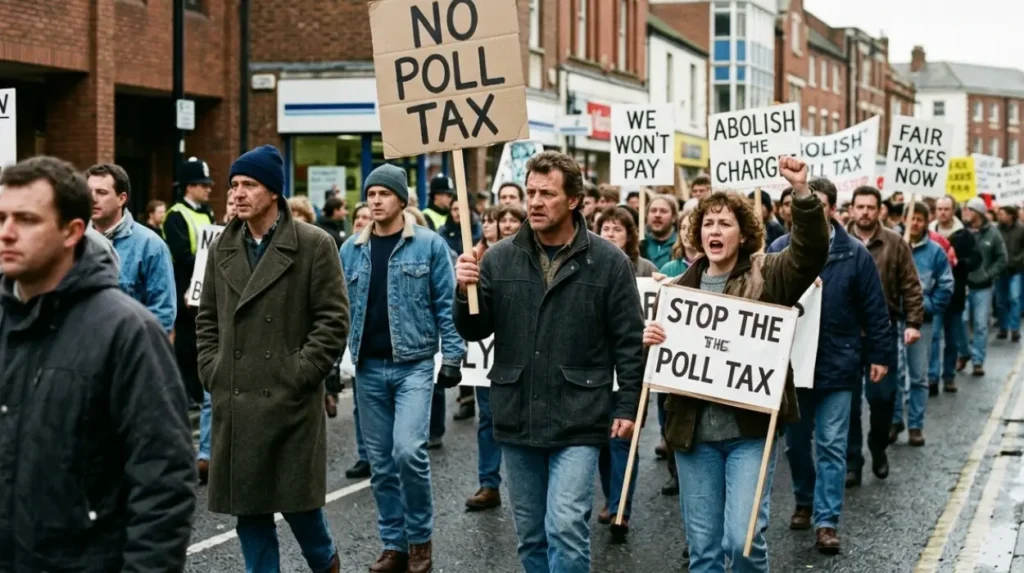
Why Did the Community Charge Trigger a Major Fiscal Crisis in 1990?
The Community Charge triggered a major fiscal crisis in 1990 by replacing property-value assessments with a flat-rate personal tax. This uniform charge ignored individual income, provoking mass non-payment campaigns, widespread civil unrest, and its swift abolition.
In 1986, the government of Prime Minister Margaret Thatcher published a green paper titled Paying for Local Government, which proposed the complete eradication of the domestic rating system. The administration argued that domestic rates were inherently unfair because they were paid by only a minority of local residents—specifically property owners—while all local citizens utilized municipal services. The proposed replacement was the Community Charge, universally dubbed the “poll tax.” This fiscal measure levied a single, flat-rate tax on every adult resident over the age of 18, completely independent of their income, property value, or socio-economic status.
Implemented first in Scotland in 1989 and subsequently across England and Wales on 1 April 1990, the Community Charge immediately encountered intense, systemic resistance. Because the charge required the same payment from a low-wage industrial worker as it did from a wealthy property owner, it was widely perceived as a regressive tax that violated the foundational principles of progressive taxation. In London, where the cost of living was high and local authority expenditures varied dramatically, the poll tax rates set by many inner-city boroughs significantly exceeded initial central government estimates.
The introduction of the tax precipitated an unprecedented fiscal emergency characterized by three main developments:
- Mass Non-Payment: Millions of citizens joined coordinated non-payment movements. In several London boroughs, including Lambeth, Haringey, and Hackney, local authorities failed to collect the tax from over 30% of their registered populations, severely disrupting municipal budgets.
- Administrative Gridlock: Magistrates’ courts were overwhelmed by millions of liability order applications submitted by local councils attempting to enforce debt collection through bailiffs and earnings attachments.
- Civil Unrest: The crisis culminated on 31 March 1990 in the infamous Poll Tax Riot in central London. An estimated 200,000 demonstrators marched to Trafalgar Square, resulting in severe clashes with the Metropolitan Police, over 300 arrests, and widespread property damage.
The profound political unpopularity of the Community Charge, combined with the sheer administrative impossibility of collecting a flat tax from a highly mobile urban population, caused deep divisions within the ruling Conservative Party. This domestic fiscal crisis served as a primary catalyst for the internal leadership challenge that resulted in Margaret Thatcher’s resignation in November 1990. Her successor, John Major, immediately announced a comprehensive review of local government finance, leading to the rapid drafting of replacement legislation.
How Did the Local Government Finance Act 1992 Establish Council Tax?
The Local Government Finance Act 1992 established council tax by blending a property-value levy with a personal element. This system categorised residential properties into eight distinct bands based on their market value.
To restore stability to local public finance after the collapse of the poll tax, Parliament enacted the Local Government Finance Act 1992. Implemented on 1 April 1993 across England, Scotland, and Wales, this legislation created the council tax system that remains active today. The new tax structural design represented a conscious political compromise, carefully combining a property-based valuation with a personal residency component to avoid the regressive pitfalls of the poll tax while preserving a broad tax base.
The core mechanism of the council tax relies on property banding. The Valuation Office Agency (VOA) assessed every domestic property in England based on its open-market capital value as of 1 April 1991. Properties were allocated into one of eight distinct statutory categories, ranging from Band A to Band H. Local authorities calculate their annual revenue requirements and set a specific tax rate for Band D properties; the rates for all other bands are then determined as fixed mathematical proportions of that baseline.
To prevent the total return to a pure property tax, the 1992 Act integrated specific personal discounts and exemptions. The baseline bill assumes a residential property is occupied by at least two adults. If a property is occupied by a single adult, the bill is legally reduced by a statutory 25% single-person discount. Furthermore, specific classes of residents, including full-time students, individuals with severe mental impairments, and specific live-in care workers, are entirely disregarded for council tax purposes. The local government framework also established Council Tax Benefit—later localized in 2013 as Council Tax Support schemes—enabling low-income households and individuals facing immediate financial hardship to apply for reductions or complete exemptions from their monthly liability through their local borough councils.
What Are the Long-Term Implications of 1991 Property Valuations on Modern London?
The long-term implications of 1991 property valuations on modern London include severe structural tax regressions and distorted municipal funding. Because bands rely on historical values, affluent homeowners pay disproportionately less relative to current property wealth.
The decision to anchor England’s council tax bands permanently to property values from 1 April 1991 has generated profound fiscal and socio-economic consequences for contemporary London. Unlike Wales, which conducted a comprehensive property revaluation in 2003, England has never updated its initial 1991 valuations. Consequently, every domestic council tax bill issued across London’s 32 boroughs and the City of London relies on what a property would have been worth over three decades ago, completely ignoring the historic, unequal appreciation of London real estate.
Over the intervening decades, property values in London have increased at rates far exceeding the rest of the United Kingdom, driven by international investment, gentrification, and acute housing shortages. However, because Band H caps assessments at properties valued over £320,000 in 1991, ultra-luxury mansions in Belgravia or Chelsea that sell for tens of millions of pounds today remain in the exact same tax bracket as modest family homes in outer London boroughs that passed the £320,000 threshold over thirty years ago. This compression creates a regressive tax landscape: an individual renting a modest flat in an economically deprived borough frequently pays a council tax bill that constitutes a significantly higher percentage of their total property value and income than the bill paid by a wealthy property owner in a multi-million-pound central London estate.
Furthermore, this outdated structure limits the revenue-raising capacity of local governments. Borough councils remain heavily reliant on central government grants to fund mandatory services, including adult social care, children’s services, and waste management. Because the tax bands are fixed, councils cannot capture the immense unearned wealth generated by London’s booming property market to fund local public services (Hopton, 2021). This ongoing structural imbalance ensures that local taxation remains a primary point of debate in British public policy, highlighting the persistent challenge of designing a local tax system that balances administrative efficiency with genuine socio-economic equity.
What is the origin of London’s local taxation system?
London’s local taxation system can be traced back to the Elizabethan Poor Relief Act 1601, which introduced the “poor rate” to fund assistance for the poor, sick, and vulnerable through local parishes.