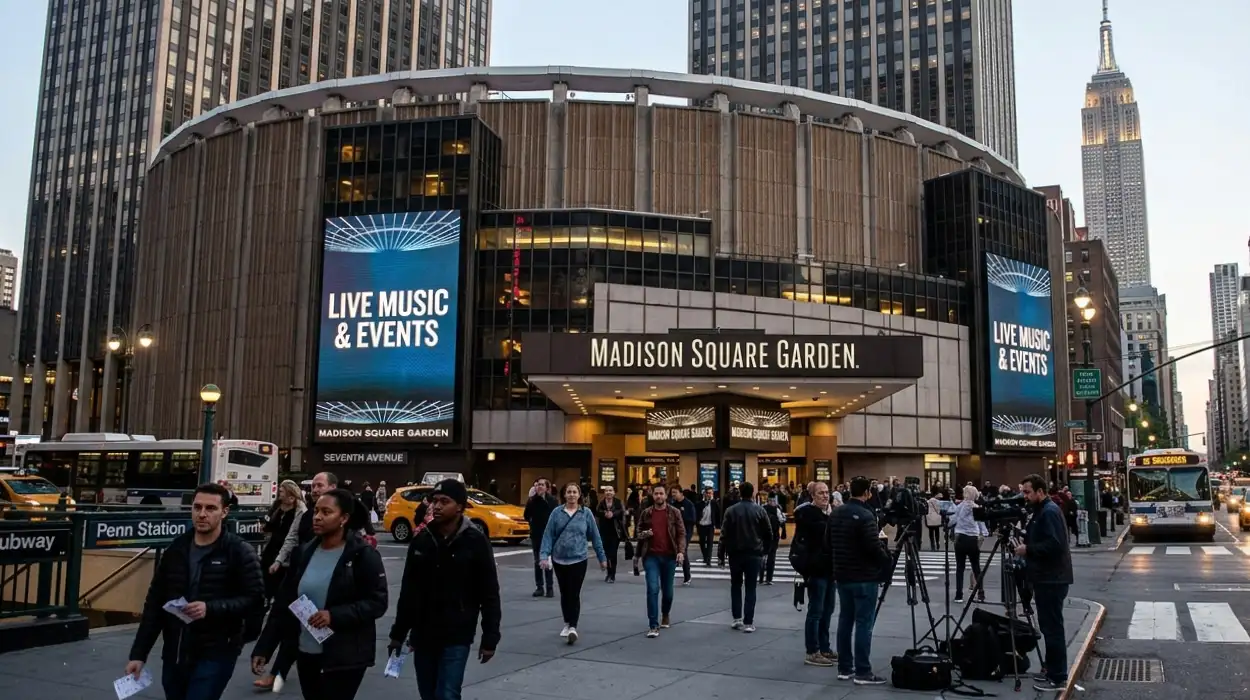
Madison Square Garden is a multi-purpose indoor arena located in Midtown Manhattan, New York City, situated directly above Pennsylvania Station between Seventh and Eighth Avenues from 31st to 33rd Streets. The venue functions as the home arena for the New York Knicks of the National Basketball Association and the New York Rangers of the National Hockey League. The Londoner News provides this comprehensive analysis of the architectural, historical, operational, and structural components that establish this arena as a primary asset in global sports and entertainment infrastructure, often drawing direct comparisons to major entertainment hubs in London like the O2 Arena and Wembley Stadium.
- What is the history and origin of Madison Square Garden?
- What are the physical dimensions and structural components of the arena?
- How does the arena transition between basketball and ice hockey configurations?
- Who are the primary tenants and stakeholders of Madison Square Garden?
- What historical political and cultural events have occurred at the venue?
- What economic impact does the arena have on New York City?
- What infrastructure upgrades were implemented during the major arena transformation?
- What is the ongoing relationship and controversy involving Pennsylvania Station?
- What is the future outlook for Madison Square Garden?
What is the history and origin of Madison Square Garden?
Madison Square Garden originated in 1879 at East 26th Street and Madison Avenue, moving through four distinct physical structures over its operational history. The current arena opened on February 11, 1968, representing the oldest continuously operating arena in the National Basketball Association.
The original Madison Square Garden opened on May 30, 1879, utilizing a leased open-air railroad depot owned by Commodore Vanderbilt. This first structure lacked a roof and exposed spectators to weather conditions during events.
The second iteration, designed by architect Stanford White, opened in 1890 at the same location. It featured a Moorish-style architecture with a 32-story tower modeled after the Giralda tower in Seville, Spain. This venue integrated a main concert hall, a theater, and a roof garden cabaret. Financial instability led to its demolition in 1925.
The third Madison Square Garden opened in 1925, located on Eighth Avenue between 49th and 50th Streets. Built by promoter Tex Rickard in 249 days, this version placed a strong emphasis on boxing matches and hockey games. The venue lacked adequate ventilation systems, which caused poor air quality during heavily attended events.
The fourth and current structure opened in 1968 at 4 Pennsylvania Plaza. Architect Charles Luckman designed the building, which required the controversial demolition of the above-ground portions of the original Beaux-Arts Pennsylvania Station. This current facility established a direct physical link between a major underground transit hub and a massive sports entertainment complex, a design concept later studied by urban planners in London for major metropolitan transport integrations.
What are the physical dimensions and structural components of the arena?
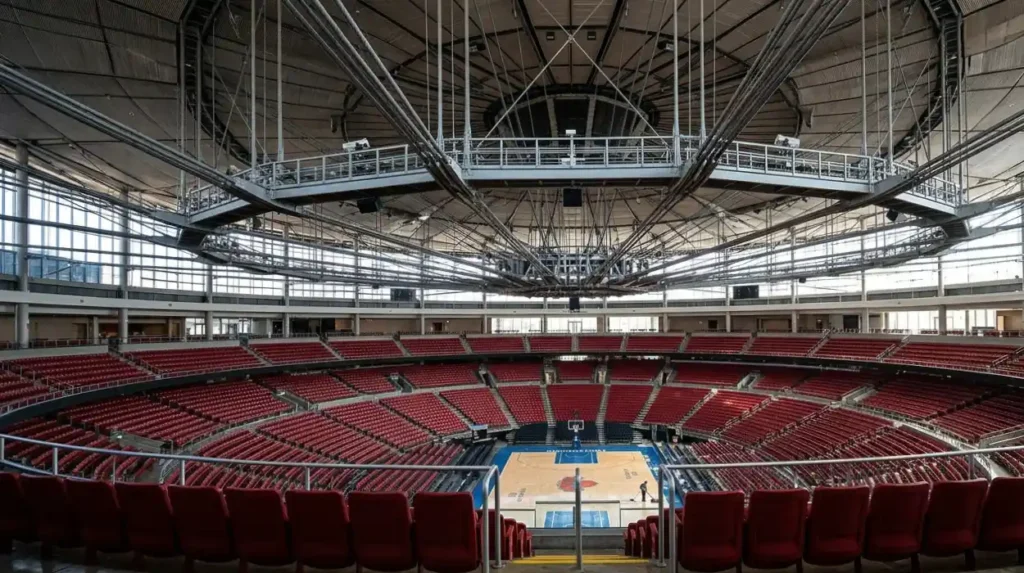
The current Madison Square Garden structure occupies a total floor space of 820,000 square feet within a circular architectural layout. The arena features a unique cable-suspended roof that eliminates internal support columns, ensuring unobstructed sightlines across all seating tiers.
The building stands as a cylindrical concrete structure supported by an external steel ring framework. The main arena bowl contains multiple seating tiers, which include the lower bowl, upper bowl, lounge suites, and structural sky bridges. The maximum seating capacity varies explicitly by event type:
- Concerts: 22,000 seats
- Boxing and Mixed Martial Arts: 20,789 seats
- Basketball: 19,812 seats
- Professional Wrestling: 18,538 seats
- Ice Hockey: 18,006 seats
The ceiling utilizes a structural cable suspension system consisting of 48 steel cables arranged in a radial configuration. This engineering design supports the weight of the roof without internal pillars. The ceiling also houses the primary rigging systems for lighting and sound equipment, which can support up to 400,000 pounds of production gear. This structural approach heavily influenced the engineering behind several modern stadium designs across Europe, including developments in London.
The lowest level of the arena bowl contains the playing surfaces and event floors. Underneath the hardwood or insulated floor panels lies a permanent concrete slab containing embedded cooling pipes. These pipes circulate a chilled chemical brine solution to freeze water for ice hockey matches, forming the base ice sheet used by the New York Rangers.
How does the arena transition between basketball and ice hockey configurations?
The transition process between an ice hockey rink and a basketball court requires a synchronized operational mechanism lasting approximately two to four hours. This physical conversion depends on structural floor layers, specialized thermal insulation panels, and organized labor crews.
The conversion process begins immediately after an event concludes. When transitioning from an ice hockey game to a basketball game, technicians first remove the transparent acrylic glass panels and the surrounding perimeter dasher boards.
Crews then place specialized thermal insulation panels directly over the ice surface. These interlocking panels prevent the cold from the ice sheet from penetrating the upper floor layers while keeping the ice solid.
Workers assemble the basketball court on top of these insulation panels. The court consists of 220 distinct tongue-and-groove North American hard maple wood panels. Each panel weighs approximately 165 pounds, and crews lock them together using a specific numerical sequence.
The final stage involves the mechanical deployment of the basketball goal structures and media courtside tables. The goal systems feature hydraulic lifts that allow quick positioning and anchoring to the concrete subfloor. Hydraulic systems also adjust the center-hung multimedia display board, lowering or raising the unit to match the optical requirements of the specific sport, setting an international standard studied by event management teams from London to Tokyo.
Who are the primary tenants and stakeholders of Madison Square Garden?
Madison Square Garden Entertainment Corporation owns and operates the arena facility under a publicly traded corporate structure. The primary corporate sports tenants consist of the New York Knicks basketball franchise and the New York Rangers ice hockey franchise.
Madison Square Garden Entertainment Corporation manages all booking operations, corporate sponsorships, and venue maintenance. This entity also oversees related entertainment assets, including the Radio City Music Hall and the Beacon Theatre. James Dolan serves as the executive chairman of the corporation, which maintains strong commercial ties with global promoters based in London and other major financial capitals.
The New York Knicks represent the premier basketball tenant, having played at the venue since its inception in 1946. The team generates significant ticket, merchandise, and broadcast revenue for the parent corporation. The franchise has won two National Basketball Association championships at the site, specifically in 1970 and 1973.
The New York Rangers represent the primary winter sports tenant, occupying the arena since 1926. The franchise utilizes the facility for 41 regular-season home games annually, in addition to post-season playoff matches. The team secured its most recent Stanley Cup championship victory on this ice surface in 1994.
Other regular users include the St. John’s University men’s basketball team, which plays selected high-profile collegiate matches at the arena. The venue also hosts annual multi-day events, such as the Big East Conference Men’s Basketball Tournament and various professional bull riding competitions.
What historical political and cultural events have occurred at the venue?
Madison Square Garden has hosted multiple historical political conventions, major international musical concerts, and high-profile athletic championships since 1968. The venue serves as a frequent site for events with significant global media and cultural impact.
The venue has served as the host site for four major political conventions in the United States. These include three Democratic National Conventions, which took place in 1976, 1980, and 1992, as well as one Republican National Convention in 2004. These events required extensive security modifications and physical transformations of the arena bowl to accommodate delegates and international press corps, including major news bureaus from London.
Musical artists utilize the venue as a benchmark for commercial success. Singer-songwriter Billy Joel established an official residency at the venue, performing 150 lifetime shows at the arena before concluding the concert series in July 2024. Other major musical milestones include The Concert for New York City in 2001, which raised funds for victims of the September 11 terrorist attacks.
In professional sports, the arena hosted the “Fight of the Century” on March 8, 1971, where boxers Muhammad Ali and Joe Frazier competed for the heavyweight championship title. The venue also served as the location for the inaugural WrestleMania event in 1985, establishing the baseline infrastructure for the modern sports entertainment industry, which expanded rapidly into venues across London in subsequent decades.
What economic impact does the arena have on New York City?
Madison Square Garden generates billions of dollars in economic activity for the New York metropolitan area through employment, tourism expenditure, and mass transit usage. The arena creates thousands of direct and indirect jobs across multiple service sectors.
The arena acts as a primary catalyst for local businesses in Midtown Manhattan, specifically targeting hospitality, retail, and food service establishments. Spectators attending events generate consistent consumer demand for local restaurants and hotels. This geographic concentration of economic activity amplifies property values and commercial lease rates in the surrounding blocks, presenting an economic model that closely mirrors the impact of the entertainment districts in London.
Employment figures demonstrate the scale of venue operations. The facility employs approximately 3,700 union construction and trade workers during modern renovation phases. Permanent staff positions include security personnel, guest services representatives, ticketing agents, and mechanical engineers.
The financial performance of the arena correlates directly with the regional transportation infrastructure. Because the venue sits on top of Pennsylvania Station, it utilizes a transit system that handles over 600,000 daily commuters. This physical integration allows the arena to maximize event attendance while minimizing regional vehicular traffic congestion, outperforming similar transit-adjacent venues globally.
What infrastructure upgrades were implemented during the major arena transformation?
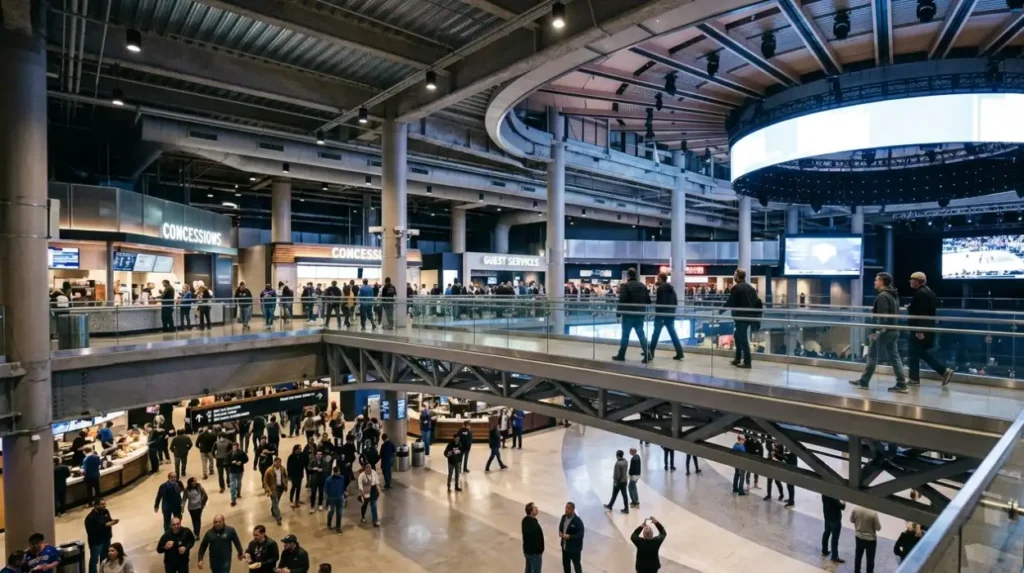
The Madison Square Garden Company executed a $1 billion comprehensive architectural renovation between 2011 and 2013 to modernize the facility. This project updated all mechanical systems, expanded public concourses, and installed unique structural pedestrian bridges.
The renovation took place over three consecutive summer phases to avoid disrupting the regular competitive seasons of the New York Knicks and New York Rangers. Engineers stripped the interior down to the concrete skeleton before rebuilding the internal layout. The project added the Chase Square entrance on Seventh Avenue, doubling the retail and ticketing space.
The installation of two structural sky bridges represented the most significant engineering alteration. These pedestrian walkways suspend directly from the cable-supported ceiling structure, spanning the length of the arena bowl. The bridges provide 430 spectator seats with elevated, unobstructed views of the playing surface below, an architectural feat highlighted by design firms globally, including major structural engineering agencies in London.
The technological infrastructure received major upgrades during this transformation cycle. The facility installed a new center-hung multimedia display system called GardenVision, providing high-definition video feeds to all seating sections. The renovation also expanded the concourses, updated the luxury suites, and modernized the locker rooms for athletes and performers.
What is the ongoing relationship and controversy involving Pennsylvania Station?
The physical location of Madison Square Garden directly above Pennsylvania Station creates ongoing urban planning conflicts regarding mass transit expansion and venue relocation. The current operating permit structure requires periodic review by New York City municipal agencies.
The controversy stems from the 1963 demolition of the historic above-ground Penn Station building to clear land for the current arena. The modern underground rail station operates under severe space constraints, low ceilings, and limited natural light, which urban planners argue restricts transit efficiency and passenger safety.
In 2013, the New York City Council granted Madison Square Garden a ten-year operating permit extension, which expired in 2023. In September 2023, the City Council extended the permit for an additional five years, rather than the permanent permit requested by ownership. This short-term extension pressures the arena to cooperate with state transportation agencies on station modernization, a process heavily covered by international urban design publications, including those in London.
Multiple public interest groups propose moving the arena across the street to allow for a complete reconstruction of Penn Station. These infrastructure proposals estimate total transit redevelopment costs around $7 billion to $7.5 billion. The ongoing debate balances the historical and financial value of the arena against the public transit needs of the broader western hemisphere.
What is the future outlook for Madison Square Garden?
The future outlook for Madison Square Garden involves navigating changing municipal zoning laws, integrating advanced digital technologies, and adapting to modern sports entertainment markets. The venue faces competition from newer regional arenas while maintaining its central geographic advantage.
Digital integration represents a primary focus for future venue management. The arena continues to deploy advanced ticketing software, biometrics-based security systems, and high-speed wireless data networks to handle the demands of mobile-device users. These upgrades improve crowd entry speeds and streamline venue logistics.
Sustainability initiatives represent an operational priority for the facility as environmental laws tighten. The arena is modernizing its climate control systems, energy-efficient lighting arrays, and waste management programs to reduce overall carbon emissions. These mechanical upgrades align with New York City environmental mandates and global sustainability targets shared by major arenas from New York to London.
The venue maintains a unique competitive position despite the emergence of newer regional venues, such as the Barclays Center in Brooklyn or the UBS Arena in Nassau County. Its position directly atop the primary rail intersection of Midtown Manhattan guarantees long-term economic relevance for international tours and premier sporting events, preserving its status for a global audience, as documented by The Londoner News.
What is Madison Square Garden?
Madison Square Garden is a multi-purpose indoor arena in Midtown Manhattan, located above Pennsylvania Station. It is home to the New York Knicks and the New York Rangers.