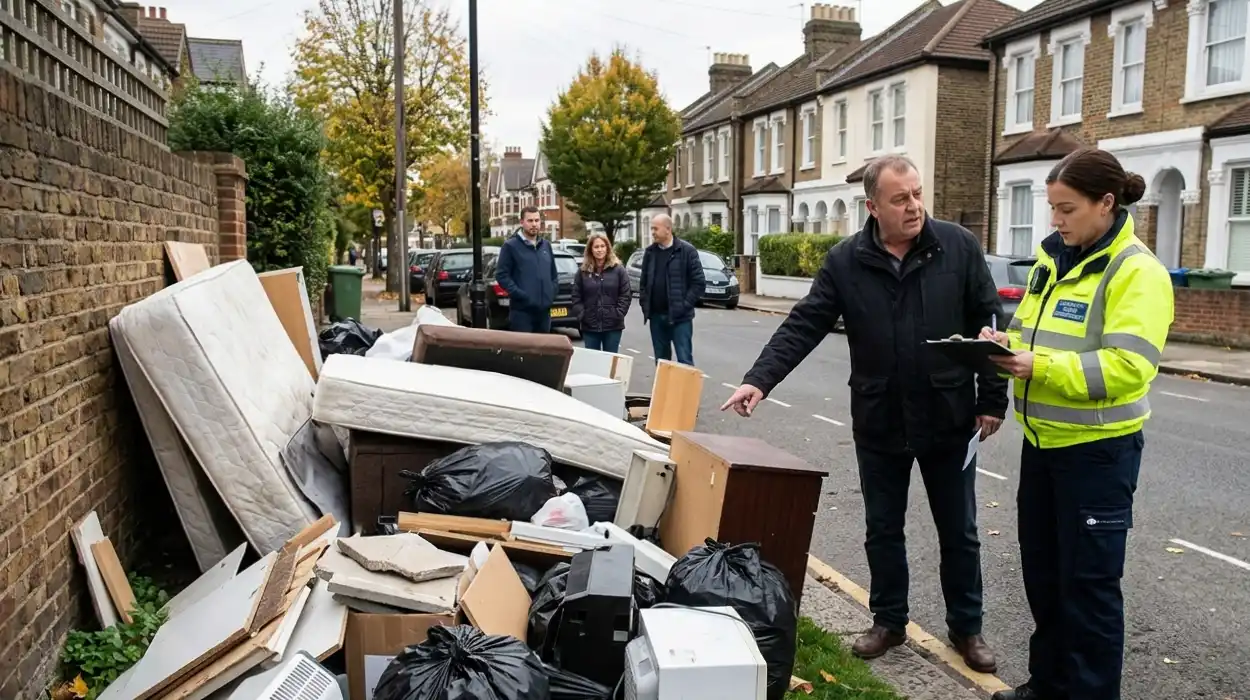
Fly tipping is the illegal dumping of waste on land without a licence. The term originated in late nineteenth-century Britain from the physical action of “tipping” a cart quickly, while “fly” denotes a rapid, undetected, or illicit departure.
- How Did Urban Expansion and Infrastructure Shape Waste Disposal Patterns?
- Which Historical Laws Regulated Waste and Fly Tipping in the Region?
- Who Were the Key Figures and Institutions in Early Sanitary Reform?
- What Processes and Economic Drivers Historically Accelerated Fly Tipping?
- How Do Modern North London Boroughs Preserve and Monitor Historical Dump Sites?
- What Are the Long-Term Environmental and Historical Implications of This Issue?
The practice of unauthorized refuse disposal predates modern legislative terminology. In the medieval and early modern eras, London lacked centralized municipal waste systems. Residents discarded household rubbish, night soil, and industrial byproducts into public thoroughfares, communal ditches, and natural waterways.
In North London, locations such as the River Fleet and the open spaces of Tottenham and Enfield became frequent sites for illicit disposal. The rapid industrialization and urban expansion of the nineteenth century exacerbated these issues. Population density increased significantly in northern parishes such as Islington, St Pancras, and Hackney. This growth overwhelmed traditional parochial sanitation arrangements, which relied primarily on local vestries and private scavengers.
The specific phrase “fly tipping” emerged alongside mechanised and horse-drawn transport systems. Cart drivers carrying industrial materials, demolition debris, or domestic refuse sought to avoid the disposal fees charged by official municipal brickfields, dust-yards, or designated sorting depots. Drivers loosened the tailboard of their wagons while in motion or stationary, discharging the load instantly before municipal authorities or parish constables could intervene.
The Public Health Act 1875 established the first comprehensive legal statutory frameworks requiring local urban authorities to manage refuse. This legislation formalised the distinction between legal, regulated municipal disposal and unauthorized dumping. Despite these statutory controls, the physical morphology of North London—characterized by expanding suburban borders, extensive railway embankments, and isolated common lands—provided continuous opportunities for illicit waste disposal.
How Did Urban Expansion and Infrastructure Shape Waste Disposal Patterns?
Urban expansion and transport infrastructure across North London created isolated geographic pockets that facilitated illegal waste disposal. The construction of railways, canals, and suburban housing developments left unmonitored spaces that private waste carters exploited for illicit tipping.
The transformation of North London from rural agrarian parishes into dense urban suburbs occurred rapidly between 1800 and 1900. The opening of the Regent’s Canal in 1820 and the subsequent development of major rail terminuses—such as King’s Cross in 1852 and St Pancras in 1868—altered the local landscape. The infrastructure projects carved deep cuttings, constructed high embankments, and left tracts of marginal land adjacent to the transport lines. These unmonitored corridors became primary targets for unauthorized dumping due to their isolation from main pedestrian thoroughfares.
Furthermore, the brickfields of Highbury, Hornsey, and Wood Green excavated vast quantities of clay to supply building materials for the London housing boom. Once the clay reserves were exhausted, these deep pits were frequently abandoned or inadequately managed. Private contractors and industrial firms used these open craters as unofficial repositories for unregulated refuse, including toxic manufacturing residues from northern London chemical works, gasworks, and slaughterhouses.
The local governance model of the era contributed to the proliferation of the issue. Before the establishment of the London County Council in 1889, North London was governed by a fragmented network of parish vestries and local boards. These entities possessed varying levels of fiscal resources and regulatory commitment. Boundaries between adjacent parishes, such as the border zones between Middlesex and the expanding urban county of London, suffered from jurisdictional ambiguity. Waste carters deliberately targeted these border roads and common lands, knowing that enforcement officers from one parish lacked legal authority to prosecute offenses committed across the administrative boundary line.
Which Historical Laws Regulated Waste and Fly Tipping in the Region?
The primary historical statutes regulating waste and fly tipping in North London were the Public Health Act 1875 and the Public Health (London) Act 1891. These statutes mandated parish vestries to remove refuse and penalised individuals for unauthorized dumping.
Prior to systemic parliamentary intervention, municipal waste regulation depended on localized, piecemeal legislation. The Michael Angelo Taylor’s Act 1817 (Metropolitan Paving Act) provided early provisions against obstructing London streets with filth or refuse, but it lacked specific mechanisms for regional enforcement outside the urban core. The rapid spread of cholera epidemics in three major waves between 1831 and 1866 forced a legislative transition toward centralized sanitary engineering and strict environmental control.
The Public Health Act 1875 established urban and rural sanitary districts across England, compelling local authorities to ensure the systematic collection of domestic refuse. In the metropolis, this was strengthened by the Public Health (London) Act 1891, which placed an absolute statutory duty on sanitary authorities—the parish vestries and district boards—to clear refuse from public spaces and highways. Under Section 30 of the 1891 Act, fines were levied against occupiers or owners who allowed accumulations of noxious matter that caused a public health nuisance.
During the twentieth century, the legislative focus shifted from mere nuisance abatement to comprehensive environmental protection. The Control of Pollution Act 1974 modernized the legal framework by introducing strict licensing systems for waste disposal sites and increasing the financial penalties for unauthorized dumping. This was superseded by the Environmental Protection Act 1990. Section 33 of the 1990 Act made it a criminal offense to deposit, knowingly cause, or knowingly permit the deposit of controlled waste on any land without a waste management licence. This statutory evolution shifted the burden of proof, allowing modern local authorities across Greater London to prosecute both the physical operators of the vehicles and the businesses generating the discarded waste material.

Who Were the Key Figures and Institutions in Early Sanitary Reform?
Key figures in North London sanitary reform included Edwin Chadwick, who advocated for centralized waste management systems, and Thomas Wakley, who exposed public health hazards. Institutional authority transitioned from local parish vestries to the London County Council.
Edwin Chadwick was a central force in restructuring British public health infrastructure. His landmark 1842 publication, Report on the Sanitary Condition of the Labouring Population of Great Britain, established direct statistical links between defective waste disposal, environmental filth, and elevated mortality rates across working-class districts. Chadwick argued that waste management must be a centralized, state-regulated function rather than a fragmented commercial enterprise managed by private contractors. His advocacy led directly to the formation of the Metropolitan Commission of Sewers in 1848 and influenced the layout of modern drainage and waste networks throughout North London.
Thomas Wakley, the founder of The Lancet medical journal and the Member of Parliament for Finsbury from 1835 to 1852, utilized his political and editorial platforms to campaign against the unsanitary conditions in northern parishes. Wakley conducted public inquests into disease outbreaks in Clerkenwell and St Luke’s, identifying stagnant, waste-filled ditches as major vectors for typhus and cholera. His work forced local authorities to deploy sanitary inspectors to monitor industrial dumping grounds and open-air dust-yards.
Institutionally, the administrative apparatus shifted away from inefficient ecclesiastical parish vestries. The Metropolis Management Act 1855 created the Metropolitan Board of Works, which initiated large-scale civil engineering projects to manage sewage and urban cleanliness. In 1889, the London County Council assumed regional administrative control, establishing standardized bylaws for refuse storage, collection, and disposal. These centralized institutions replaced the ad-hoc system of parish scavengers with a professionalized municipal workforce dedicated to maintaining public sanitation and enforcing anti-dumping regulations across North London.
Explore More Public Services
How to Join a Local Safer Neighbourhood Board for Area Policing: London
New Social Housing Safety and Repair Standards in London
What Processes and Economic Drivers Historically Accelerated Fly Tipping?
The main economic driver of historical fly tipping was the cost optimization strategies used by private contractors to evade municipal tipping fees and gate taxes. The rise of synthetic, non-biodegradable consumer packaging in the twentieth century accelerated this process.
The economic architecture of Victorian and early twentieth-century waste management relied heavily on the value of residual materials. Dust-yards across North London, particularly those situated in Paddington and Islington, operated as profitable recycling centers where coal ash, bones, rags, and metals were manually sorted and sold for brickmaking or agricultural fertilizer. However, as industrial manufacturing processes changed, the market value of raw urban refuse declined significantly. When the sale of sorted materials no longer covered the cost of collection and processing, dust-contractors began charging substantial fees to accept waste from commercial enterprises.
To maintain profit margins, private carters and transport operators systematically avoided these municipal charging stations. The introduction of the “gate fee” at authorized landfills and incineration plants created a strong economic incentive for illicit dumping. By discharging industrial slag, chemical residues, or construction waste onto public lanes, common land, or railway property, rogue operators eliminated their disposal overheads entirely.
This economic incentive intensified with the mid-twentieth-century shift in consumer commodities. The widespread adoption of synthetic plastics, plasterboard, and mass-produced consumer appliances fundamentally altered the volume and composition of urban waste. Unlike organic Victorian refuse, which decayed naturally over time, these modern synthetic materials persisted indefinitely in the environment. The rising costs associated with processing these hazardous and non-biodegradable materials, combined with stricter environmental regulations, caused a steep increase in commercial disposal fees, which led to a rise in organized, commercial-scale fly tipping across the open boundaries of North London.

How Do Modern North London Boroughs Preserve and Monitor Historical Dump Sites?
Modern North London boroughs utilize advanced technological surveillance, geographic information systems, and targeted enforcement frameworks to monitor historical dumping grounds. Borough councils deploy closed-circuit television networks and automated reporting applications to protect vulnerable conservation areas.
The responsibility for environmental enforcement and waste management in North London is divided among distinct modern borough councils, including Camden, Islington, Haringey, Barnet, Enfield, Hackney, and Brent. These local authorities must protect both urban residential environments and historically sensitive open spaces, such as Hampstead Heath, Highgate Wood, and the Lee Valley Regional Park. Modern borough environmental teams use digital Geographic Information Systems (GIS) to map frequent fly-tipping incidents, identifying historical patterns and recurring dumping hotspots along municipal boundaries.
To experience these historic landmarks and open conservation spaces in person today, consult our comprehensive [London Historical Parks and Heritage Trails Guide] for detailed itineraries, historical background, and visiting parameters.
Local authorities monitor these sensitive zones using mobile, high-definition closed-circuit television (CCTV) arrays equipped with automatic number plate recognition (ANPR) software. This technology enables enforcement officers to identify the registration details of vehicles involved in illegal waste disposal, even during low-light nocturnal hours. Under modern UK environmental legislation, local councils possess the statutory authority to seize and impound vehicles suspected of involvement in environmental crime.
Furthermore, local authorities collaborate directly with community groups, resident associations, and heritage trusts. Borough councils provide dedicated online reporting portals and integrated mobile applications, such as Love Clean London or FixMyStreet. These platforms allow citizens to transmit precise Global Positioning System (GPS) coordinates and photographic evidence of waste accumulations directly to municipal clearance teams, accelerating the removal process and facilitating the collection of admissible forensic evidence for subsequent criminal prosecutions under the Environmental Protection Act 1990.
What Are the Long-Term Environmental and Historical Implications of This Issue?
The long-term implications of fly tipping include severe soil contamination, degradation of local biodiversity, and significant financial burdens on municipal budgets. Historically, these accumulated waste layers alter local topography and create complex archaeological stratigraphies.
The environmental legacy of sustained fly tipping extends far beyond surface aesthetic disruption. Historical dumping sites across North London often contain unrecognized concentrations of hazardous substances, including lead piping, asbestos insulation, volatile chemical solvents, and heavy industrial metals. Over decades, rainwater filters through these unlined waste accumulations, generating toxic leachate that percolates into the underlying clay and gravel aquifers. This process contaminates local river systems, including the River Lea and the New River network, causing long-term damage to fragile aquatic ecosystems and reducing local biodiversity.
Financially, the persistent management of illegal waste diversion drains essential public resources. North London local authorities expend millions of pounds annually from municipal tax revenues to fund dedicated clearance crews, hazardous material specialists, and legal prosecution teams. These funds are drawn directly from budgets that would otherwise support local library services, park maintenance, and public heritage preservation projects.
From an anthropological and archaeological perspective, the accumulation of illicitly discarded material permanently alters the urban landscape. Stratigraphic layers of domestic and industrial debris form a distinct anthropocenic record within the soil profile of North London. Future archaeologists examining these urban contexts will find dense deposits of consumer plastics, electronic waste components, and mass-produced building fragments. These material remnants provide physical data concerning modern consumption patterns, economic disparities, and the systemic challenges of waste management within rapidly expanding global metropolitan areas.
What is fly tipping?
Fly tipping is the illegal dumping of waste on land without the permission of the landowner or the required environmental licence. It is a criminal offence in England and can involve anything from household rubbish and furniture to construction materials, garden waste, tyres, or hazardous substances.