
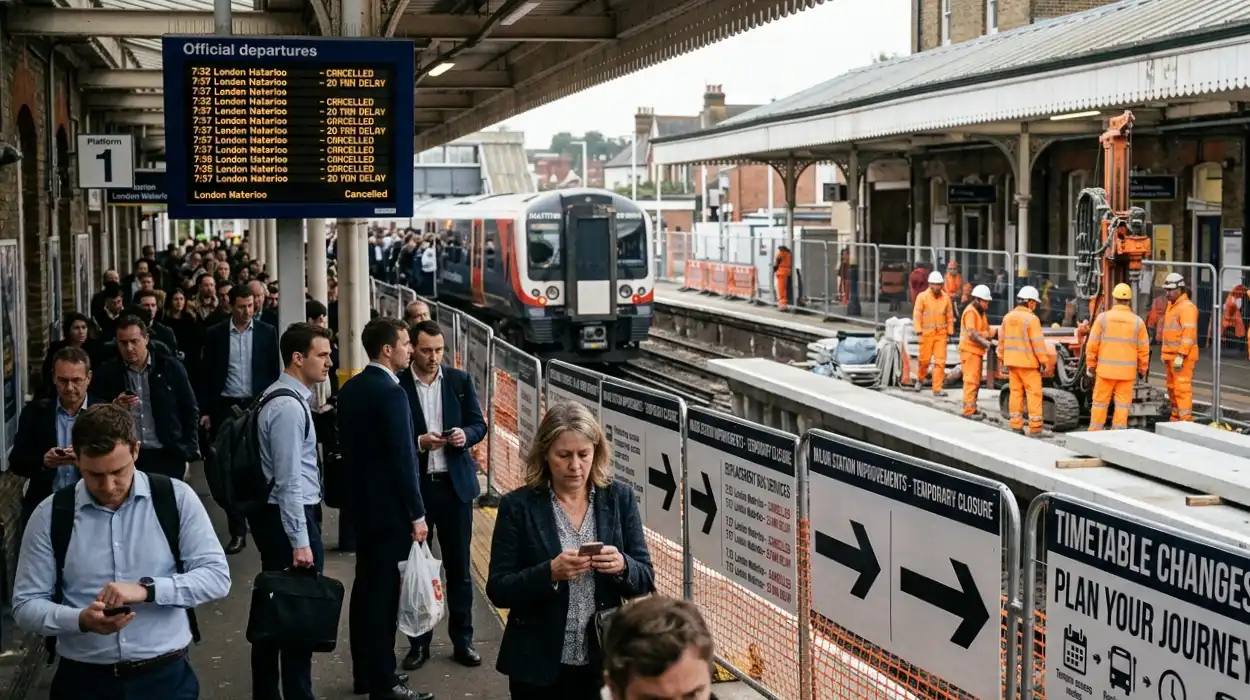
South West London commuters face significant infrastructure changes as a major regional rail modernization program commences. The Londoner News provides this definitive strategic briefing on the extensive platform upgrades, structural renewals, and coordinated timetable alterations centered around the critical Surbiton transport corridor.
- What Is the Strategic Scope of the Surbiton Corridor Upgrades?
- How Are Passenger Services Altered Across South London?
- What Are the Strict Smartcard and Ticketing Rules for Commuters?
- What Specific Timetable Changes and Line Closures Are Scheduled?
- How Does This Modernization Impact the Broader South London Transport Network?
- What Operational Constraints and Real-World Limitations Exist?
- How Will the Surbiton Corridor Evolve Beyond 2026?
What Is the Strategic Scope of the Surbiton Corridor Upgrades?
Network Rail and South Western Railway are executing a £6 million infrastructure renewal program centered on the Surbiton corridor. Running from May 11, 2026, through late September 2026, the project demands full station closures, complete platform reconstruction, and widespread timetable revisions.
The main infrastructure focus centers heavily on Berrylands station, a key suburban asset situated on a five-meter-high embankment directly adjacent to Surbiton. Built originally in the 1930s, the existing station infrastructure has reached the absolute end of its operational design life. The delivery partnership between Network Rail (the state-backed owner of UK rail infrastructure) and South Western Railway (the private train operating company managing the Wessex route) requires a complete asset replacement to prevent long-term structural failure.
The structural composition of the original platforms relies heavily on timber supports and aging concrete elements. These materials are being completely decommissioned and removed. In their place, engineers are installing modular platforms fabricated from glass-reinforced plastic (GRP). GRP is a high-strength, lightweight composite material engineered to withstand severe weather and heavy structural loads, effectively extending the operational life of the station assets by decades.
The physical scope of the site works involves several distinct phases:
- Initial vegetation clearance and ecological mitigation to safeguard native wildlife species along the railway embankment.
- The diversion of critical line-side utilities, signaling cables, and high-voltage power lines.
- Heavy engineering demolition of the 1930s timber and concrete platform surfaces.
- Sub-surface piling operations to reinforce the five-meter embankment and anchor the new structural footings.
- The installation of pre-fabricated, modular GRP platform segments.
- The integration of completely new line-side systems, including upgraded lighting columns, closed-circuit television (CCTV) security networks, Customer Information Screens (CIS), and emergency passenger help points.
Explore More London Local News
Plastic Surgeon Dr Costantino Davide Sanctioned Over Patient Safety: West London 2026
King’s College London and Cranfield University Announce Strategic Merger: London 2026
How Are Passenger Services Altered Across South London?
South Western Railway services will completely bypass the closed infrastructure until late September 2026. National Rail timetables have been comprehensively rewritten, eliminating all scheduled stopping patterns at the affected hub and diverting all localized passenger volume directly into Surbiton and New Malden.
Because the structural works require the complete removal of the passenger platforms, lineside safety regulations prevent any trains from stopping at the site. The four main tracks running through the Surbiton corridor remain open for through-services, but local stopping patterns are completely suspended. Passenger flows must divert to neighboring interchanges, primarily Surbiton station and New Malden station.
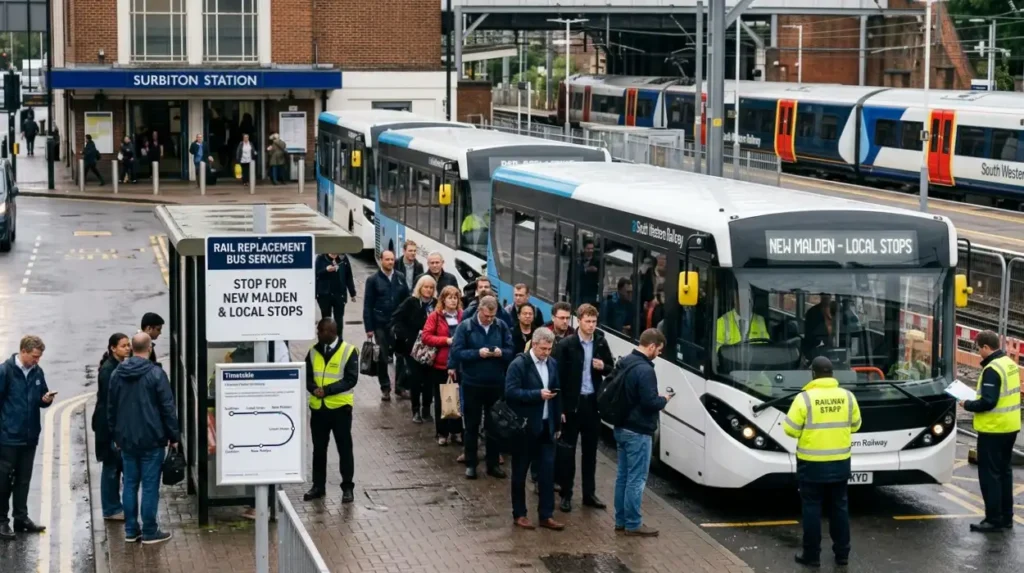
To mitigate the total loss of rail access, transport planners have implemented a dedicated, high-frequency rail replacement bus network. This auxiliary transit system operates strictly every 30 minutes, seven days a week, establishing a continuous loop connecting the affected local community with the wider network. The replacement vehicles depart directly from the Surbiton station forecourt (situated off Victoria Road) and route via localized stops on Surbiton Hill Park before terminating at New Malden.
The operational details of this replacement network demand explicit travel adjustments for commuters:
- London-bound travelers: Passengers aiming for central London terminals must utilize the rail replacement bus to travel to New Malden station, where they can join mainline services heading towards London Waterloo.
- Country-bound travelers: Passengers traveling southbound toward Woking, Guildford, or Basingstoke must utilize the replacement bus to Surbiton station, which serves as the primary regional outer-suburban hub.
- Transit times: The road journey between Surbiton and the neighboring local stops is clocked at approximately 12 minutes under normal traffic conditions, adding mandatory buffer time to daily commuter schedules.
What Are the Strict Smartcard and Ticketing Rules for Commuters?
Commuters must alter their standard tap-in and tap-out behaviors to avoid automated fare penalties. During the structural closure, passengers are legally prohibited from validating Contactless cards, Oyster cards, or South Western Railway Smartcards at the out-of-service suburban platform gates.
The temporary closure of the local station infrastructure includes the complete shutdown of the passenger ticket office, automated ticket vending machines, and localized smartcard validators. Because the station is completely locked down for heavy construction equipment, any physical attempt to access the perimeter violates rail safety bylaws. Transport for London (TfL) and National Rail fare enforcement systems have adjusted their algorithmic revenue collection parameters to reflect the closure.
Passengers must exclusively validate their transit tokens—such as standard paper tickets, Contactless debit cards, Oyster cards (Surbiton sits within London Travelcard Zone 6), and digital Smartcards—at the specific stations where they physically begin or conclude their rail journeys. If a traveler is utilizing the rail replacement bus service, they must not attempt to scan into the network until they arrive on the physical concourse of either Surbiton or New Malden.
The ticketing office hours at Surbiton station remain fully operational to assist passengers with the transition:
- Monday to Friday: 06:30 – 20:30
- Saturday: 06:30 – 20:00
- Sunday: 07:30 – 20:00
South Western Railway ticket machines at Surbiton are configured to sell all standard fare classes, including discounted products using a Disabled Persons Railcard, Senior Railcard, or Network Railcard. Smartcards can also be loaded with Flexi Season tickets directly at these terminals.
What Specific Timetable Changes and Line Closures Are Scheduled?
Mainline timetables are heavily modified on specific dates to permit complex engineering access across the wider network. Full line closures will occur on Sunday, May 17, 2026, between Surbiton and Hampton Court, alongside widespread secondary closures impacting Clapham Junction.
While the platform reconstruction remains a constant factor through autumn, secondary track maintenance and structural engineering works create sharp, short-term disruptions across the broader South London network. Engineers utilize specific weekend windows when passenger volumes are statistically lower to deploy heavy machinery, track-laying trains, and automated ballast tampers.
During the specific Sunday 17 May closure, all direct rail options between Surbiton and Hampton Court are completely severed. The Chessington South branch line and the line running through Worcester Park also face periodic blockages, forcing South Western Railway to run altered, reduced-frequency timetables from London Waterloo. Mainline trains that normally run non-stop through Surbiton may be subjected to temporary speed restrictions or diverted via slower suburban loop lines through Kingston and Twickenham, extending average transit times by 15 to 25 minutes.
Explore More London Local News
Margot Robbie Wear Alexander McQueen at 1536 Premiere: London 2026
New SEND Units at Brackenbury and Wormholt Park Schools, Hammersmith 2026
How Does This Modernization Impact the Broader South London Transport Network?
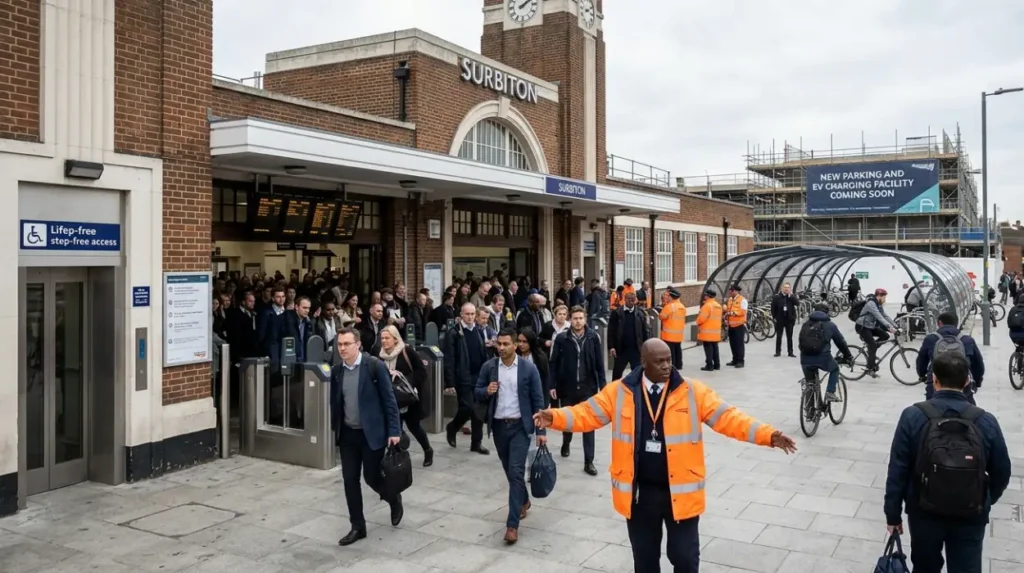
The engineering works trigger cascading operational adjustments across the entire Wessex Route network. Increased passenger footfall at Surbiton station places extreme pressure on its Grade II listed infrastructure, necessitating rapid enhancements to pedestrian access and multi-modal transit exchanges.
Surbiton station acts as one of the most critical structural hubs within the South London rail ecosystem. It serves as a vital bottleneck where the four main tracks of the South Western Main Line split into localized branch lines. By completely closing an adjacent station and routing thousands of additional weekly passengers through Surbiton, the physical pressure on the station’s concourse, stairwells, and platform edges increases substantially.
Surbiton station is a protected architectural asset, designated as a Grade II listed building due to its celebrated 1930s Art Deco design by architect James Robb Scott. Because the historic fabric of the building cannot be easily modified, Network Rail must deploy specialized station staff to manage passenger flow during peak hours. Staffing levels are maintained 24 hours a day, seven days a week, to manage the intense passenger volume and ensure safety across the platform edges.
To offset this long-term pressure, the Office of Rail and Road (ORR) has coordinated with local planning authorities to approve land disposals and funding releases for the Surbiton station precinct. This strategic master plan introduces six distinct infrastructure enhancements:
- The expansion of the public realm outside the south side station entrance to create a safer transport interchange.
- The deployment of modernized, high-capacity cycle parking facilities to promote active travel.
- The permanent refurbishment of the passenger lift systems providing step-free access to the historic station overbridge.
- The construction of a new Multi-Storey Car Park (MSCP) featuring dedicated accessible parking bays and electric vehicle (EV) charging infrastructure.
- The historical restoration of the South Side Ticket Office, converting the space into an accessible retail asset.
- The preservation of the Maintenance Delivery Unit (MDU) access road, ensuring that heavy track maintenance vehicles and Road-Rail Vehicles (RRVs) can access the live rails 24/7 during emergencies.
What Operational Constraints and Real-World Limitations Exist?
A severe nationwide shortage of qualified bus drivers restricts the total volume of rail replacement services available. Furthermore, strict baggage, bicycle, and accessibility regulations apply to all temporary road transport vehicles operating throughout the Surbiton zone.
While Network Rail and South Western Railway meticulously plan engineering works months in advance, the execution of the rail replacement network faces real-world labor constraints. The UK-wide shortage of commercial bus and coach drivers means that securing optimal bus counts is highly challenging during peak multi-line closures. Commuters are warned that service gaps may occur within the 30-minute replacement bus schedule, making early journey planning essential.
The physical design of the replacement coaches introduces rigid operational constraints that differ substantially from standard rail transport. Passengers must adhere to strict luggage and conveyance rules enforced by ground staff:
- Non-folding structures: Prams, pushchairs, and packages that cannot be fully folded are completely prohibited on replacement buses due to storage safety regulations.
- Bicycles: Standard macro-bicycles are strictly banned from all replacement transport vehicles. Only compact, fully folding bicycles are permitted within the lower luggage holds.
- Animals: Domestic pets and livestock are barred from boarding, with the sole exception of certified assistance dogs guiding passengers with visual or auditory impairments.
- Accessibility: Not all contracted road coaches possess native wheelchair lifts. Passengers requiring specialized step-free transport are strictly advised to book their travel assistance at least two hours in advance via the South Western Railway digital portal or by calling the dedicated assisted travel hotline (0800 5282100). This allows the operator to pre-stage accessible taxis or low-floor vehicles at the Victoria Road forecourt.
How Will the Surbiton Corridor Evolve Beyond 2026?
The completion of the £6 million asset renewal secures the long-term structural integrity of South London’s rail architecture. Transitioning from timber to glass-reinforced plastic eliminates recurring structural maintenance, allowing for faster line speeds and higher capacity down the line.
The immediate future of the Surbiton corridor depends heavily on the successful demobilization of the engineering sites in late September 2026. Once the final quality assurance checks, structural snagging lists, and site clearances conclude, the localized rail hub will reopen with completely transformed infrastructure. The new GRP platforms will eliminate the safety hazards associated with rotting timber and deteriorating mid-century concrete.
From an operational standpoint, the modernized platforms will feature narrow sections widened to meet contemporary safety and accessibility mandates. The integration of high-definition CCTV arrays and automated LED lighting structures significantly lowers the station’s carbon footprint while maximizing passenger security. The new Customer Information Screens will link directly into National Rail’s real-time Darwin data engine, delivering instant delay and scheduling updates.
What is the strategic scope of the Surbiton corridor upgrades?
The strategic scope of the Surbiton corridor upgrades is a £6 million railway modernization project led by Network Rail and South Western Railway, focused primarily on Berrylands railway station, which lies on the busy South Western Main Line near Surbiton railway station.