The Royal Borough of Greenwich is executing a comprehensive urban transformation within Woolwich, a historic maritime and military town situated along the southern banks of the River Thames in South East London. As a designated Opportunity Area within the London Plan, the district is undergoing massive structural shifts driven by billions of pounds in public and private capital. Woolwich Regeneration 2026 represents the convergence of multi-phase riverside residential construction, the expansion of a dedicated creative district, and the systemic modernization of public infrastructure to accommodate thousands of new residents moving into the SE18 postal code.
- What Is the Core Objective of the Woolwich Regeneration 2026 Framework?
- How Has the Royal Arsenal Transformed from a Munitions Factory into a Waterfront Residential Community?
- What Specific Infrastructure Upgrades Are Occurring Within the Cultural Hub and Town Center?
- How Has Transport Connectivity Influenced the Economic Viability of Woolwich?
- What Future Mixed-Use Projects and Estate Renewals Are Planned Beyond 2026?
- How Are Local Residents Impacted by the Changing Socioeconomic Landscape?
Managed via collaborative partnerships between the local municipal authority, private developers like Berkeley Group, and national bodies such as Historic England, this infrastructure program addresses historical socio-economic divisions. By retrofitting Grade I and Grade II listed military architectures and building dense, transit-oriented housing, the program aims to establish Woolwich as a premier metropolitan center for London.
What Is the Core Objective of the Woolwich Regeneration 2026 Framework?
The primary objective of the Woolwich Regeneration 2026 framework is to unify the historic municipal town center with the expanding riverside residential quarters while expanding local cultural infrastructure, housing capacity, and transport-led economic opportunities for existing and future residents.
The modern urban framework builds upon foundational masterplans designed to transition Woolwich from a post-industrial military asset into a highly connected, mixed-use residential and commercial hub. A core challenge of this regeneration is overcoming the physical and economic segregation created by the A206 dual carriageway (Plumstead Road and Beresford Street). This arterial road historically isolated the working-class town center from the high-value, riverside developments situated on the former Royal Arsenal lands.
To resolve this spatial fragmentation, the Royal Borough of Greenwich appointed dRMM Architects to lead a comprehensive Urban Regeneration Framework. This strategy coordinates multiple distinct capital projects under a singular blueprint. The local authority utilizes funding sources like the central government’s Future High Streets Fund and Historic England’s High Streets Heritage Action Zone to deliver infrastructure improvements that support inclusive economic growth, climate resilience, and public safety.
The framework operates on a macro-to-micro scale, ensuring that multi-million-pound investments in landmark cultural venues actively stimulate local employment. The primary vehicle for this social return is the Greenwich Local Labour and Business scheme, which enforces localized hiring quotas, structural apprenticeships, and job-readiness training. The overarching goal is to transform Woolwich into a self-sustaining Zone 4 sub-regional economy that balances corporate investment with local civic stability.
How Has the Royal Arsenal Transformed from a Munitions Factory into a Waterfront Residential Community?
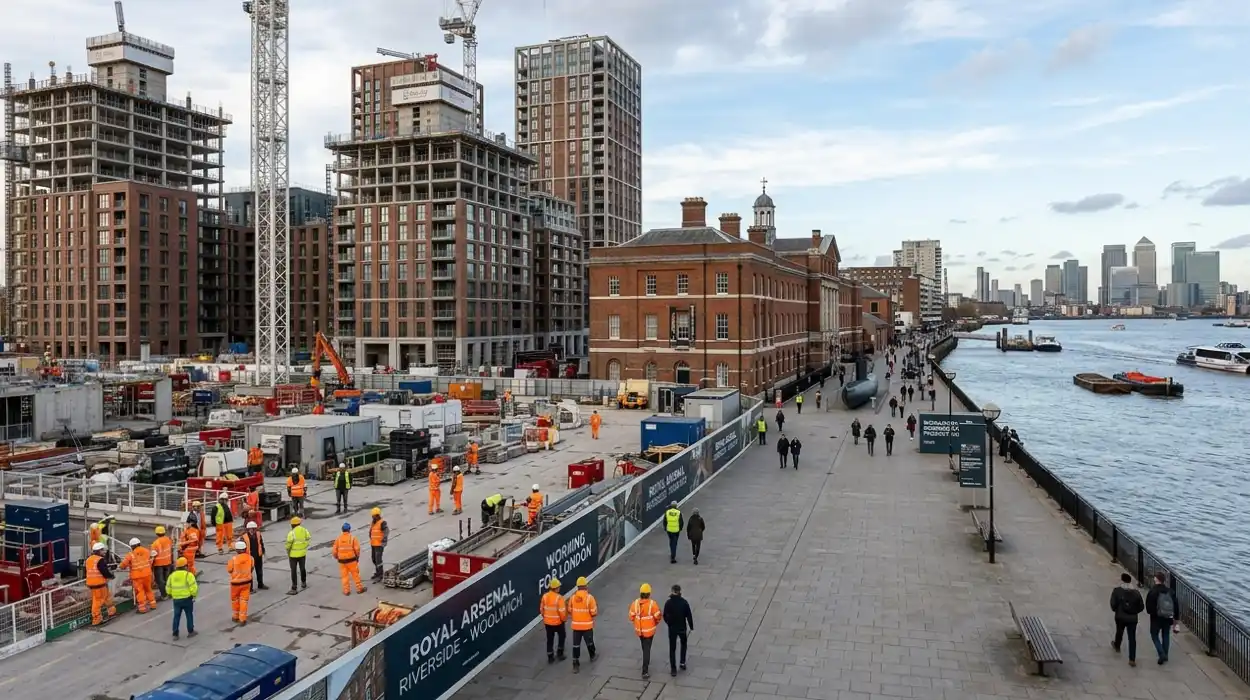
The Royal Arsenal has transformed from a restricted military munitions site into a 36-hectare mixed-use neighborhood through a phased 29-year masterplan that integrates 5,000 new energy-efficient homes with restored heritage structures and public riverside paths.
The Royal Arsenal dates back to 1671, serving for centuries as the British Empire’s primary site for military ordnance manufacture, firearms research, and ammunition storage. At its industrial peak during the First World War, the manufacturing complex employed more than 120,000 workers across its heavily guarded riverfront acreage. Following the post-war decline of British heavy industry and the ultimate decommissioning of the facility in 1967, the site sat derelict, completely sealed away from the civilian population of Woolwich by defensive perimeter walls.
The contemporary transformation began in 2001 through a long-term development agreement between the Royal Borough of Greenwich and Berkeley Group. By 2026, the masterplan has delivered more than 3,500 completed residential apartments, alongside commercial retail spaces, medical facilities, and green spaces. The architectural approach relies on adaptive reuse. Developers have renovated 23 distinct listed historic buildings, preserving external brickwork and structural cast iron while converting internal spaces into modern housing.
Architectural firms like Cowen+Partners have updated the final residential phases of the masterplan to align with updated safety and environmental regulations. These final plots include four high-density buildings constructed directly over the underground Elizabeth Line ventilation and extraction structures. The design features industrial-style detailing, gunmetal finishes, and engineering-grade brickwork to match the surrounding historic structures.
These developments provide 35% affordable housing allocations, split between intermediate shared ownership schemes and social rented housing managed by the local council. The inclusion of these housing options ensures that lower-income households retain a physical presence within the high-value waterfront zone.
Explore More Things To Do
New Town Masterplan and 2026 Planning Updates: Crews Hill
Primrose Hill Weekend Closures: Schedules & Tips, Camden
What Specific Infrastructure Upgrades Are Occurring Within the Cultural Hub and Town Center?
The cultural hub and town center are receiving more than £70 million in public investments to construct the Woolwich Waves leisure complex, restore the Grade II listed Tramshed Theatre, and modernize public spaces at Beresford Square.
The anchor of the town center’s cultural expansion is Woolwich Works, a creative district that repurposes five historic military buildings, including the former Royal Laboratory offices, the Gun Carriage Shop, and the Royal Military Academy. Backed by a £45.6 million investment from the Royal Borough of Greenwich and technical engineering consultation from Buro Happold, these spaces feature soundproofed insulation and adaptive ventilation systems. The complex functions as an arts destination, housing major performance organizations like the immersive theater group Punchdrunk and the inclusive youth arts company Tramshed.
To provide modern athletic and wellness infrastructure, the council is completing construction on the Woolwich Waves leisure center. This asset sits next to General Gordon Square on the former site of Viscount House. It replaces the outdated, energy-inefficient Waterfront Leisure Center on the river. The new facility contains:
- An eight-lane, 25-meter competition swimming pool
- Extensive community health suites, saunas, and steam facilities
- A double-story fitness gym, sports halls, and multi-purpose exercise spaces
- Integrated family amenities, such as a nursery, soft-play areas, and an on-site cafe
Simultaneously, the municipal government has cleared the old riverfront leisure site for demolition, preparing the land for competitive sale to deliver affordable residential housing blocks.
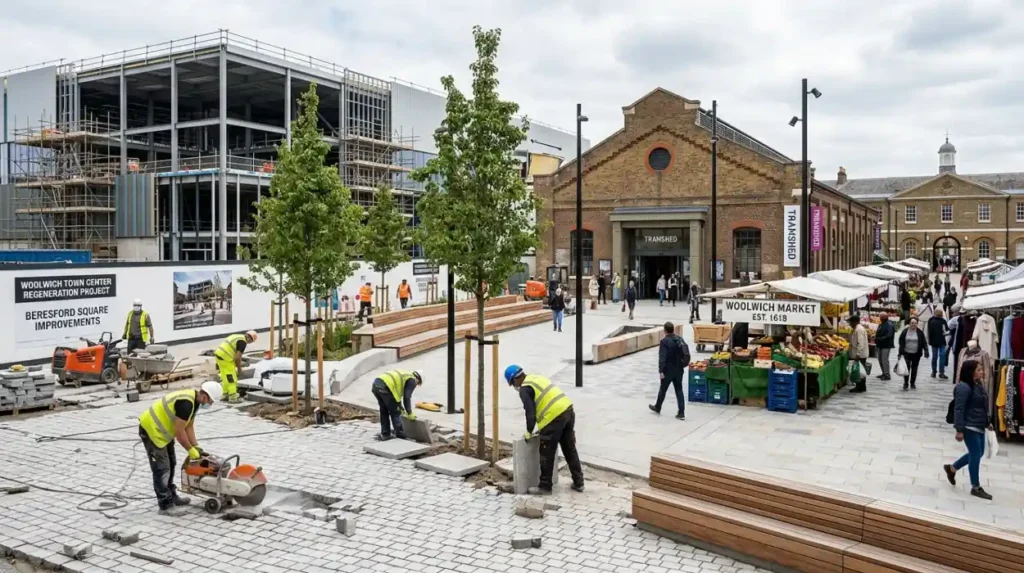
Further inland, civil works are altering the public realm at Beresford Square and Powis Street. Contractors have cleared street clutter, laid natural stone paving, planted semi-mature trees, and installed low-energy LED lighting schemes. Beresford Square—which hosts a historic charter market dating back to 1618—now incorporates a modular market pavilion, accessible public restrooms, terraced seating structures, and interactive water fountains designed to lower ambient urban temperatures during seasonal heatwaves.
How Has Transport Connectivity Influenced the Economic Viability of Woolwich?
Transport connectivity has increased property values and rental demand in Woolwich by providing a Public Transport Accessibility Level rating of 6b, reducing commute times to Central London business districts via the Elizabeth Line.
The opening of the subterranean Woolwich Elizabeth Line station has changed the socioeconomic profile of South East London. The infrastructure project yields direct rail paths to Canary Wharf in 8 minutes, Liverpool Street in 14 minutes, and Tottenham Court Road in 19 minutes. This connectivity gives local commuters direct access to major employment zones without needing to transfer across multiple transit networks. The high level of access earns Woolwich a Public Transport Accessibility Level rating of 6b, which represents the highest tier of transit density calculated by Transport for London.
This connectivity combines with pre-existing transport choices to create a multi-modal transit hub. These options include:
- The Docklands Light Railway network, which connects directly to London City Airport and the Stratford international rail station
- Southeastern and Thameslink national rail services running lines to London Bridge and Cannon Street
- Uber Boat by Thames Clippers river bus services operating from the Royal Arsenal Pier
This transit access has generated a notable “infrastructure premium” within the local real estate market. Statistical data compiled from the Land Registry and Dataloft demonstrates that average flat values within Woolwich increased by 49% over a ten-year period, while average monthly rental prices grew by 41%. Research by real estate consultancies shows that homes positioned within a 500-meter radius of the Elizabeth Line entrance command an 8% rental price premium over properties located further inland. This variance highlights how transport access directly affects local property demand.
What Future Mixed-Use Projects and Estate Renewals Are Planned Beyond 2026?
Future developments beyond 2026 will expand via the Woolwich Exchange town center project, the multi-phase Woolwich Estates residential renewals, and the long-term conversion of the historic Woolwich Barracks site.
The next major structural project is the Woolwich Exchange development, an 801-home mixed-use project situated on land between Plumstead Road and Spray Street. Led by joint venture partners St Modwen and Notting Hill Genesis, this project updates underutilized land parcels while protecting local architectural landmarks. The plan transforms the Grade II listed former Woolwich Covered Market into a five-screen boutique cinema and central food hall. This design protects the historic 1930s reinforced concrete roof structure while adding outdoor public squares, cafes, and independent retail spaces.
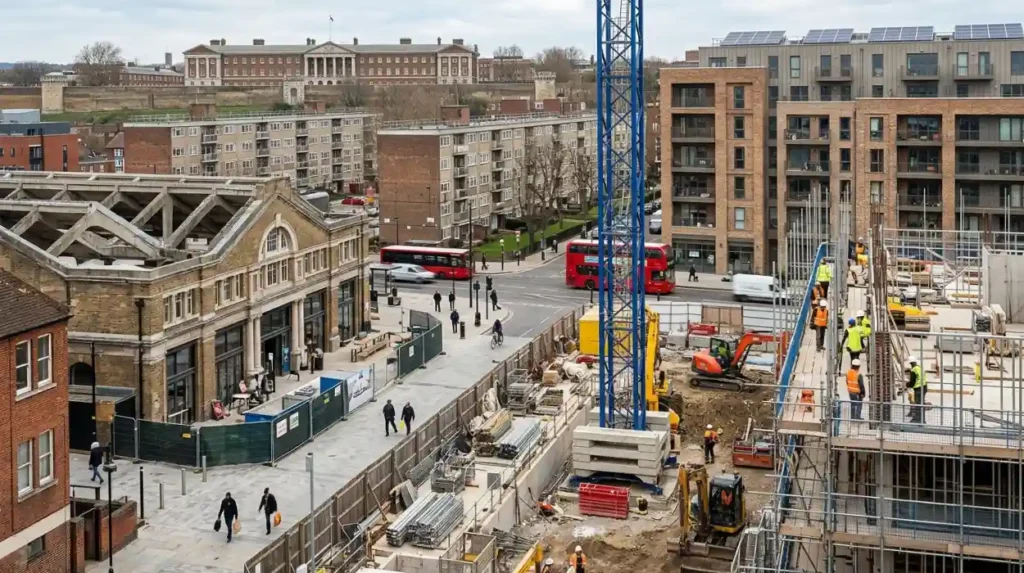
Concurrently, the Royal Borough of Greenwich is advancing its large-scale Woolwich Estates estate renewal project. This public housing initiative involves the phased demolition and replacement of outdated mid-century housing estates, specifically the Connaught, Morris Walk, Maryon Road, and Grove End developments. In their place, the council is building mixed-income neighborhoods featuring energy-efficient insulation, solar panel installations, and localized district heating networks. These homes help the borough meet its local housing targets while lowering fuel poverty risks for lower-income tenants.
Looking further ahead, the long-term planning pipeline includes the redevelopment of the historic Woolwich Barracks. Following the Ministry of Defence’s strategic decision to sell the historic military asset, the Greenwich Council and regional planners began drafting an urban plan for the site. Initial proposals suggest the site can support nearly 2,000 new homes alongside commercial offices, healthcare facilities, and expansive public parklands. This approach preserves the long-standing, historic perimeter garrison walls and the landmark Grade II listed facade of the Royal Artillery Barracks building.
How Are Local Residents Impacted by the Changing Socioeconomic Landscape?
Local residents experience a changing neighborhood dynamic marked by improved public spaces, better employment programs, and rising housing costs that require targeted affordable housing initiatives.
The influx of capital into the SE18 area has created a complex mix of local benefits and displacement pressures. On the positive side, the physical improvements to the public realm have produced safer, well-lit spaces for families and older residents. The expansion of cultural programs at venues like the Tramshed Theatre and Woolwich Works offers accessible educational opportunities for local youth, while new public plazas host free community festivals, seasonal markets, and outdoor theatrical events.
However, changing neighborhood demographics bring clear economic challenges. As property values rise, long-term tenants in the private rental sector face increased living costs. To prevent local displacement, the Royal Borough of Greenwich enforces planning policies requiring a minimum 35% affordable housing allocation on all major private construction developments. The municipal government also prioritizes community retail space within new developments, allowing independent merchants and local street vendors from Beresford Square to remain active on the high street.
Ultimately, the long-term success of the Woolwich 2026 regeneration depends on balancing historic preservation with urban growth. By modernizing transport links, preserving military heritage sites, and building mixed-tenure housing, planners aim to establish Woolwich as a functional model for sustainable urban growth. For readers of The Londoner News, the ongoing evolution of this riverside district shows how targeted public investment can transform a historic industrial town into a modern, connected London community.
Editorial Summary: Woolwich Growth Metrics
The following data points highlight the long-term structural changes occurring across the Woolwich regeneration sector:
- Housing Target: 5,000 new residential units scheduled across the Royal Arsenal masterplan by final completion in 2030.
- Economic Investment: £45.6 million allocated to establish the Woolwich Works creative district.
- Transit Accessibility: Maximum PTAL rating of 6b achieved adjacent to the Elizabeth Line station hub.
- Asset Growth: 49% average increase in local flat values documented over a ten-year tracking period.
- Affordable Housing: 35% mandatory minimum allocation enforced across major estate renewals and private developments.
What is the Woolwich Regeneration 2026 project?
Woolwich Regeneration 2026 is a large-scale urban redevelopment program transforming Woolwich into a modern mixed-use district through new housing, transport upgrades, cultural infrastructure, and public realm improvements.