
Key Points
- New Suspect Detained: The Metropolitan Police have arrested a 44-year-old man on suspicion of attempted grievous bodily harm (GBH) in connection with the notorious 2017 Putney Bridge incident.
- The Offence: On 5 May 2017, a male jogger forcefully knocked a 33-year-old female pedestrian into the path of an oncoming double-decker bus during morning rush hour.
- Heroic Evade: The victim escaped catastrophic injury solely due to the reflex actions of bus driver Oliver Salbris, who swerved the vehicle inches away from her head.
- Unprecedented Confrontation: The suspect allegedly jogged back across the bridge 15 minutes later, ignoring the distressed victim’s calls to stop.
- Case History: Detectives initially interviewed 50 men and arrested three individuals—including an American investment banker who proved he was out of the country—before closing the inquiry in 2018 due to exhausted leads.
- Political & Public Reaction: Local MP Fleur Anderson welcomed the breakthrough as a “significant step forward” for the community and the victim after nearly a decade of waiting.
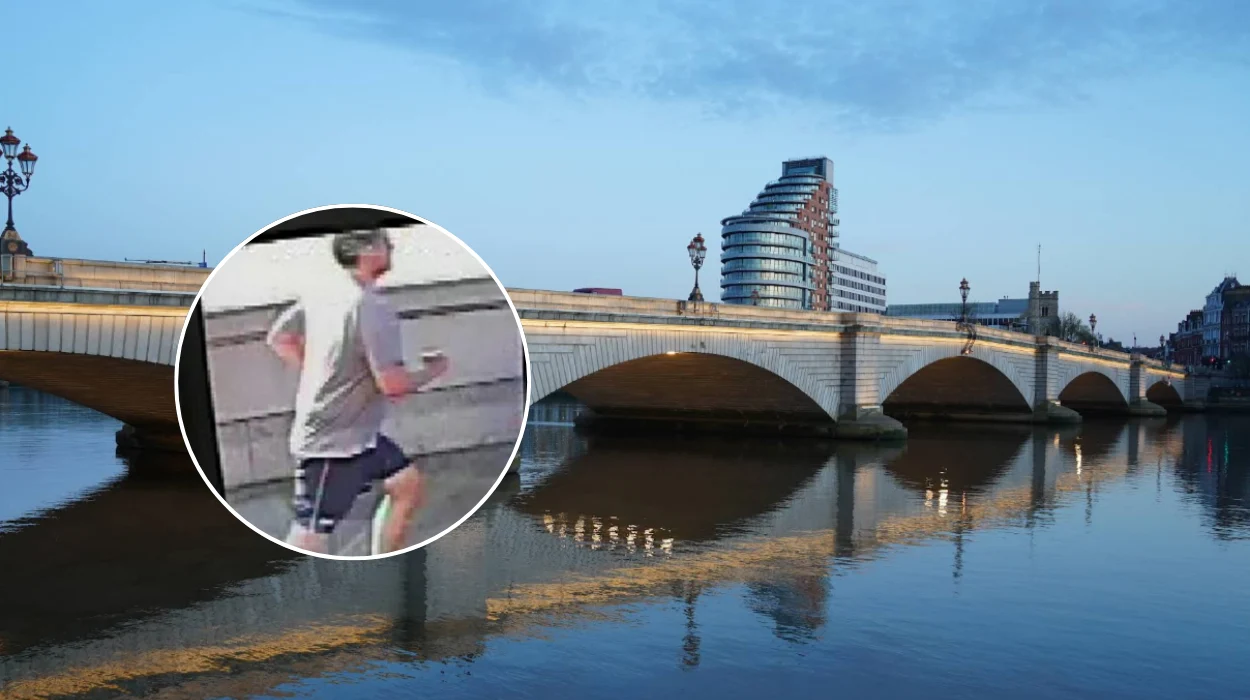
London (The Londoner News) June 15, 2026 – A 44-year-old man has been arrested at his residential property in west London on suspicion of attempted grievous bodily harm, marking the first major breakthrough in the infamous nine-year manhunt for the “Putney Pusher”. The Metropolitan Police confirmed on Monday that the suspect remains in police custody after detectives received new information regarding the May 2017 incident, in which a male jogger was captured on closed-circuit television (CCTV) shoving a female pedestrian directly into the path of an oncoming double-decker bus.
As reported by crime reporters across the United Kingdom, Scotland Yard released an official operational update outlining the status of the detainee. A Metropolitan Police spokesperson stated that: “On Monday, 15 June, a 44-year-old man was arrested on suspicion of attempted grievous bodily harm. He was taken to police custody, where he remains. The arrest relates to an incident on 5 May 2017, where a woman was pushed into the path of a bus on Putney Bridge in Putney. Inquiries continue.”
The arrest effectively reopens a high-profile case that had been inactive for eight years. As reported by legal and police correspondents for The Guardian, the suspect was apprehended at his £1.4 million home located in west London. The sudden police action ends a prolonged stalemate that began when local authorities formally shelved the physical investigation in June 2018 after admitting they had exhausted every viable line of enquiry.
What Happened on Putney Bridge in May 2017?
The underlying incident took place at approximately 7:40 am on Friday, 5 May 2017, during the peak of the morning commuter rush hour. A 33-year-old woman was walking across Putney Bridge toward south London when a male runner, heading in the opposite direction, forcefully knocked her to the ground. The momentum of the impact sent the pedestrian falling sideways off the pavement and directly into the active bus lane.
As detailed by multiple news outlets, including Sky News, dramatic CCTV footage captured from both local municipal cameras and internal recording equipment on the passing vehicle showed the victim tumbling into the road just as a number 430 double-decker bus approached. The footage, which was subsequently released to the public by Scotland Yard in an effort to crowd-source identification, showed that the vehicle missed the fallen pedestrian’s head by mere inches.
The severity of the close call prompted immediate praise for the operational staff handling the public transit vehicle. Writing for The Independent, journalists noted that the driver’s response was considered the primary reason the incident did not result in a fatal casualty. Police records confirm that the victim, who has maintained her anonymity throughout the nine-year period, survived the encounter with only minor physical injuries, though she required immediate roadside assistance from shocked passers-by.
How Did the Bus Driver Avoid a Fatal Accident?
The driver of the number 430 bus, Oliver Salbris, was universally hailed as a hero by emergency services and the British public for his rapid split-second decision-making. Salbris was forced to execute an emergency steering manoeuvre, swinging the heavy double-decker bus into the adjacent traffic lane to avoid running over the fallen woman.
In an exclusive interview published shortly after the encounter by The Sunday Times, Oliver Salbris recounted the terrifying moment from his perspective behind the wheel: “If I hadn’t swerved, I would have smashed her head. It was reflex. The consequences would have been terrible for her – and for me.” Salbris later added that the jogger desperately needed “to be caught and to explain himself.”
The operational response from police supervisors at the time mirrored this sentiment. In statement archives from 2017, Sergeant Mat Knowles of the Metropolitan Police praised the transit worker’s skill, stating publicly that:
“It was only due to the superb quick reactions of the bus driver that she was not hit by the vehicle.”
Why Did the Suspect Return to the Scene?
One of the most troubling aspects of the Putney Pusher case, which fueled widespread public outrage and intense media coverage, occurred roughly fifteen minutes after the initial assault. According to historical police logs preserved by ITV News London, the exact same jogger reappeared on the opposite side of Putney Bridge, running back in the northward direction toward the River Thames.
The victim, who was still on the bridge receiving assistance and recovering from shock, spotted her assailant as he approached. Despite being visibly shaken, she attempted to confront the runner and spoke to him directly. However, police reports indicate that the jogger completely ignored her calls to stop, refused to acknowledge her presence, and continued his run without checking on her well-being.
Detectives used this subsequent appearance to compile a comprehensive description of the suspect. Officers described the runner as a white male, then believed to be in his early to mid-30s, with brown eyes, short brown hair, and a stocky physical build. At the time of the offence, he was wearing dark blue athletic shorts, standard running trainers, and a grey T-shirt.
Explore more West London News:
Beavers Save London Tube Station from Flooding: West London 2026
882 New Homes Planned Beside Sudbury Hill Station: West London 2026
What Happened During the Initial Police Investigation?
Following the release of the public video appeals, the Metropolitan Police launched a massive logistical operation that lasted for over a year. Detectives engaged in extensive tracking methods, which included checking local transit data, reviewing private security footage, and interviewing approximately 50 separate men who matched the general description or frequently used the bridge for exercise.
During the course of the initial 2017 investigation, officers arrested three separate individuals. Among them was Eric Bellquist, a 41-year-old American investment banker who was apprehended at a residential address in the affluent Chelsea district of London on suspicion of causing grievous bodily harm. The arrest generated massive global headlines before hitting an immediate evidentiary wall.
As reported by CBS News and The Associated Press in August 2017, Bellquist’s legal representatives quickly produced irrefutable electronic and travel documentation proving that their client was physically located in the United States when the incident occurred on May 5. The Metropolitan Police subsequently issued a formal retraction, stating that the American businessman had been “eliminated from the investigation.” The two other men arrested during that phase were similarly released without charge, leading to the case being officially closed in June 2018.
How Did a Stage Play Help Keep the Case Alive?
The unsolved nature of the crime and its profound psychological impact on the individuals involved eventually transitioned from the news cycle into British popular culture. The incident became the core inspiration for a dramatic stage play titled Once Upon a Bridge, written by playwright Sonya Kelly.
The production, which officially premiered to audiences in 2024, examined the event by interweaving the fictionalized internal monologues of the three people present at the scene: the runner, the pedestrian, and the bus driver. At the time of the play’s opening, Metropolitan Police representatives publicly backed the artistic project, stating they hoped the renewed cultural interest would encourage someone with lingering or suppressed information to contact authorities.
As recorded by theatre reviewers for The Guardian, Sonya Kelly made an explicit appeal to the public alongside the production’s launch. Kelly stated to reporters: “The footage is clear. If he was, say, my cousin, I would know him. So if there is somebody watching the play, thinking they have more information, I hope they will come forward.” Criminologists suggest that this sustained media profile may have directly contributed to the fresh leads that prompted Monday’s arrest.
How Has the Putney Community Responded to the Arrest?
The announcement of Monday’s arrest has brought an immediate wave of relief to residents of south-west London and political representatives who have lived with the shadow of the unsolved assault for nearly a decade. The bridge remains a heavy commuter artery, and the case has long been cited in local discussions regarding pedestrian safety and public space harassment.
Fleur Anderson, the Member of Parliament (MP) for Putney, issued a formal statement on Monday afternoon expressing gratitude to the Met’s cold-case unit. As published by The Independent, Anderson remarked: “This is a significant step forward and one that many people in Putney will welcome after such a long time. My thoughts are with the woman involved – I hope this brings her some reassurance. I’d like to thank the police for sticking with this case over the years. It’s important now that the investigation is able to proceed properly.”
Legal experts note that because the 44-year-old suspect is currently in active custody, strict reporting restrictions under UK contempt of court laws now apply. The media is legally barred from publishing any details that could potentially prejudice a future trial, including the suspect’s name, photograph, or specific employment details, until formal charges are filed by the Crown Prosecution Service.