Chelsea is one of London’s most recognisable historic neighbourhoods because centuries of aristocratic landownership, riverside development, artistic communities, architecture and fashion culture combined to create a distinctive identity. Its transformation connected Tudor associations, Georgian expansion, Victorian creativity and twentieth-century cultural change.
- How did Chelsea begin as a historic London settlement?
- Why did aristocratic landownership shape fashionable Chelsea?
- How did Georgian and Victorian architecture change Chelsea?
- Why did Chelsea become a centre for artists and writers?
- How did transport and urban growth make Chelsea more fashionable?
- Why did the King’s Road become central to Chelsea’s identity?
- How did Mary Quant make Chelsea important to British fashion?
- How did punk fashion transform Chelsea in the 1970s?
- How did architecture help preserve Chelsea’s fashionable image?
- What historic institutions still define Chelsea today?
- Why is Chelsea still considered fashionable today?
- What does Chelsea’s history reveal about London’s cultural development?
- How should Chelsea’s historic character be understood in the future?
- Frequently Asked Question
Chelsea occupies a historic stretch of London on the north bank of the River Thames in the Royal Borough of Kensington and Chelsea. Its modern reputation for fashion, wealth and design did not emerge from a single period. The neighbourhood developed through a long sequence of social, architectural and cultural changes that reshaped a riverside village into an internationally recognised urban district.
The foundations of fashionable Chelsea were established through royal and aristocratic connections. Later generations of artists, writers, architects, designers and musicians added cultural influence. The King’s Road then transformed Chelsea into one of the most important locations in twentieth-century British fashion.
Today, Chelsea combines historic streets, listed buildings, cultural institutions, luxury retail and surviving evidence of its artistic past. The neighbourhood demonstrates how landownership, urban planning and cultural production can preserve a recognisable local identity while adapting to economic and social change.
How did Chelsea begin as a historic London settlement?
Chelsea began as a Thames-side settlement with medieval origins and developed into an important village outside historic London. Its riverside position, royal connections, wealthy residents and large houses established the social foundations that later supported Chelsea’s transformation into a fashionable metropolitan neighbourhood.
Chelsea existed long before it became part of the continuous urban landscape of modern London. Its position beside the River Thames gave the settlement practical and social importance. The river provided transport at a time when movement by road was slower and less reliable.
For centuries, Chelsea remained physically separate from the dense commercial centre of London. This separation made the area attractive to wealthy residents seeking larger houses, gardens and cleaner surroundings while remaining connected to Westminster and the City by river.
The neighbourhood became associated with prominent residents during the Tudor period. Sir Thomas More, lawyer, statesman and Lord Chancellor to Henry VIII, lived in Chelsea during the sixteenth century. Royal and aristocratic connections subsequently strengthened the area’s social status.
Chelsea’s historic identity was therefore established through location and land use. It developed as a settlement where influential people maintained substantial residences beside the Thames.
This pattern created an important long-term distinction. Chelsea was not originally shaped as an industrial district or a dense commercial centre. Its historic development concentrated on houses, gardens, institutions and estates.
The surviving riverside environment remains central to understanding this history. Cheyne Walk, for example, preserves the association between Chelsea and prestigious Thames-side residential development.
The modern Chelsea Heritage Quarter describes Chelsea as a historic Thames-side village whose development connected royal residents, artistic communities and later fashion culture. This long continuity explains why modern Chelsea combines several historical identities rather than representing only one architectural or cultural period.
Why did aristocratic landownership shape fashionable Chelsea?
Aristocratic landownership shaped Chelsea by controlling large areas of development over generations. Estate planning created coordinated streets, squares, houses and commercial areas, producing architectural consistency and preserving high-status environments that became essential to Chelsea’s long-term fashionable identity.
The most important influence on Chelsea’s physical development came from large private estates. Unlike neighbourhoods divided among many unrelated landowners, significant parts of Chelsea developed under long-term estate ownership.
Sir Hans Sloane played a major role in this process. Sloane was a physician, naturalist, collector and President of the Royal Society. His name survives throughout the neighbourhood in Sloane Square, Sloane Street and Hans Town.
Sloane married Elizabeth Langley Rose, widow of Fulke Rose, and his family’s landholdings later became connected with the Cadogan family through marriage. This relationship shaped the development of large parts of modern Chelsea.
The Cadogan family’s association with Chelsea extends for more than 300 years. Long-term estate management allowed successive generations to influence the neighbourhood’s streets, buildings and commercial character.
During the Georgian period, London expanded westward. Estate development transformed previously open land into planned urban districts. The Cadogan Estate became a major participant in this expansion.
The development of Hans Town from the late eighteenth century demonstrated the importance of planned landownership. Streets and squares were designed as parts of a wider urban environment rather than as isolated developments.
This planning produced a physical setting associated with social status. Houses, gardens and streets formed a coordinated environment that attracted wealthy residents.
The process also established a pattern that continued into later centuries. Estate owners could replace outdated buildings, manage commercial property and preserve the broader appearance of streets.
Chelsea’s fashionable identity therefore had an economic and institutional foundation. Fashionable districts require more than wealthy residents. They also depend on long-term investment, location and a built environment capable of attracting cultural and commercial activity.
How did Georgian and Victorian architecture change Chelsea?
Georgian expansion and Victorian redevelopment gave Chelsea much of its recognisable architectural character. Planned terraces, garden squares, institutional buildings and distinctive red-brick streets created an urban environment that connected residential prestige with architectural identity and long-term heritage value.
The eighteenth and nineteenth centuries fundamentally changed Chelsea’s physical appearance.
Georgian development introduced planned streets and terraces associated with London’s westward growth. Wealthy households increasingly occupied houses designed around formal urban layouts.
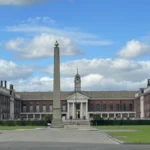
The architectural landscape also included major institutions. The Royal Hospital Chelsea, founded by King Charles II and designed by Sir Christopher Wren, became one of the most important buildings in the neighbourhood.
The institution was established to provide care for army veterans. Its continued presence gives Chelsea a direct architectural connection to the late seventeenth century.
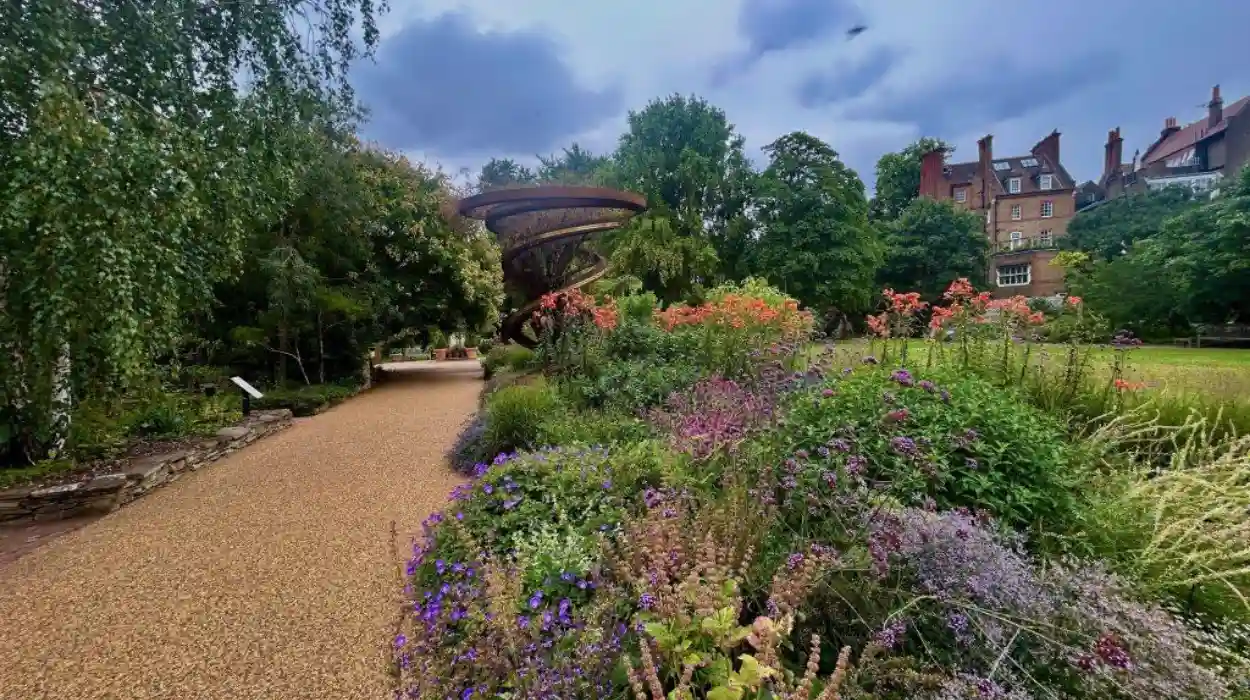
Chelsea Physic Garden provides another important example of institutional history. Founded in 1673 by the Worshipful Society of Apothecaries, the garden occupies four acres and preserves more than 350 years of botanical and scientific history.
Victorian redevelopment introduced another major architectural transformation.
From the late nineteenth century, parts of the Cadogan Estate were rebuilt in a distinctive red-brick style. This architectural character became associated with the term “Pont Street Dutch.”
The redevelopment reflected changing expectations of urban housing. Older Georgian buildings that no longer met contemporary requirements were replaced or altered, while the broader prestige of the district remained intact.
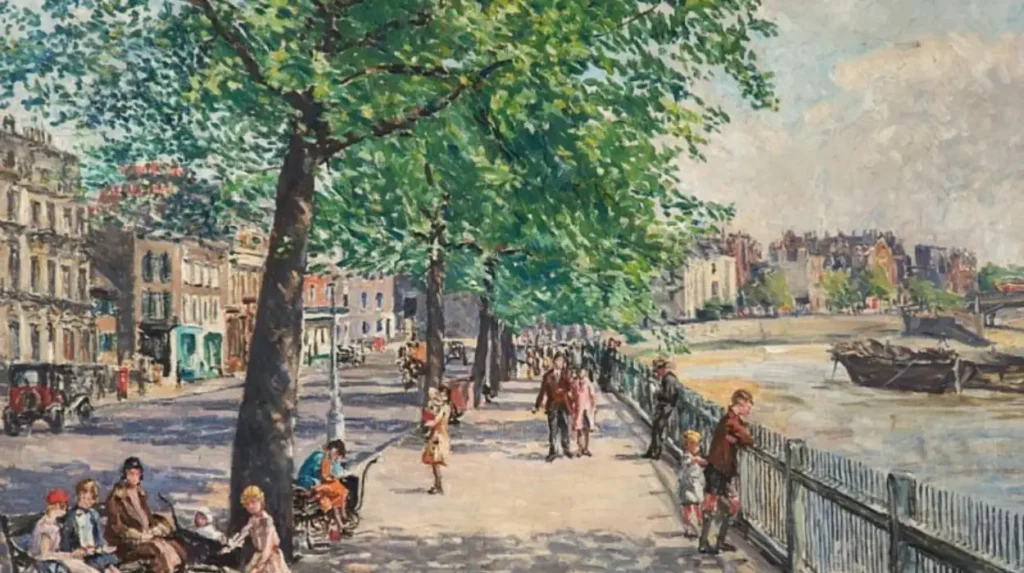
The construction of Chelsea Embankment represented another major Victorian intervention. Completed in 1874, the project was engineered by Joseph Bazalgette and combined a new riverside road with major sewer infrastructure.
The Embankment improved the riverside environment while providing a new public route. It demonstrates how nineteenth-century engineering affected Chelsea’s appearance and public health infrastructure.
These architectural changes created several visible layers of history, including Georgian terraces, Victorian red-brick development and major institutional buildings. This architectural diversity remains one reason Chelsea functions simultaneously as a residential neighbourhood and a heritage landscape.
Why did Chelsea become a centre for artists and writers?
Chelsea became an artistic centre because its picturesque riverside environment, established residential character and relative separation from central commercial London attracted creative residents. During the nineteenth century, painters, writers and designers established communities that permanently linked Chelsea with British cultural history.
Chelsea’s fashionable identity cannot be explained only through wealth. Its artistic reputation became equally important.
During the nineteenth century, artists were attracted to Chelsea’s houses, studios and views of the Thames. The neighbourhood developed a reputation for creative activity that differed from the formal aristocratic image associated with other parts of west London.
J. M. W. Turner, one of Britain’s most important landscape painters, lived and worked in Chelsea. James McNeill Whistler also became closely associated with the area.
The Pre-Raphaelite movement strengthened Chelsea’s cultural significance. Dante Gabriel Rossetti lived at Cheyne Walk, one of the neighbourhood’s historic riverside streets.
William Morris and Edward Burne-Jones were among the figures associated with Chelsea’s artistic networks. Their presence connected the area with major developments in Victorian art, design and decorative arts.
Chelsea therefore became associated with a distinctive combination of social environments. Wealthy households occupied prestigious streets while artists and writers established studios and creative communities nearby.
This mixture became an important part of the local identity.
The Cadogan historical record identifies the mid-nineteenth century as a period when Chelsea developed a strong reputation as an artistic and bohemian environment, associated with Turner, Whistler, Rossetti, Morris and other major cultural figures.
The concentration of creative people also influenced how Chelsea was represented in British culture. The neighbourhood became associated with artistic independence and cultural experimentation.
That reputation continued into the twentieth century. Chelsea Arts Club, literary residents and theatrical institutions maintained the connection between the area and cultural production.
Fashion later developed within this existing creative environment.
How did transport and urban growth make Chelsea more fashionable?
Improved transport integrated Chelsea more closely with metropolitan London and increased access for residents, workers and visitors. Railway infrastructure, new streets and commercial development transformed a historically separate village into an accessible cultural district without removing its distinctive neighbourhood identity.
Chelsea’s transformation depended partly on improved connections with the expanding metropolis.
For much of its earlier history, the River Thames provided an important transport route. As London expanded during the nineteenth century, railway infrastructure changed patterns of movement.
Sloane Square Underground station opened in 1868. The station connected Chelsea more directly with London’s developing metropolitan transport system.
Improved accessibility affected residential and commercial development. People could travel more efficiently between Chelsea and other parts of London.
This change supported the growth of shops, theatres and cultural institutions.
Urban infrastructure also reshaped the streets themselves. Chelsea Embankment created a new riverside route, while later changes altered the layout around Sloane Square.
During the twentieth century, Sloane Square developed into an important transport and commercial centre. Peter Jones became a significant architectural and retail landmark.
The relationship between accessibility and exclusivity is important to Chelsea’s history. Improved transport did not remove the neighbourhood’s high-status character. Instead, it made the district more connected while estate ownership and planning continued to influence its physical environment.
This combination helped create the conditions for Chelsea’s later cultural prominence.
Why did the King’s Road become central to Chelsea’s identity?
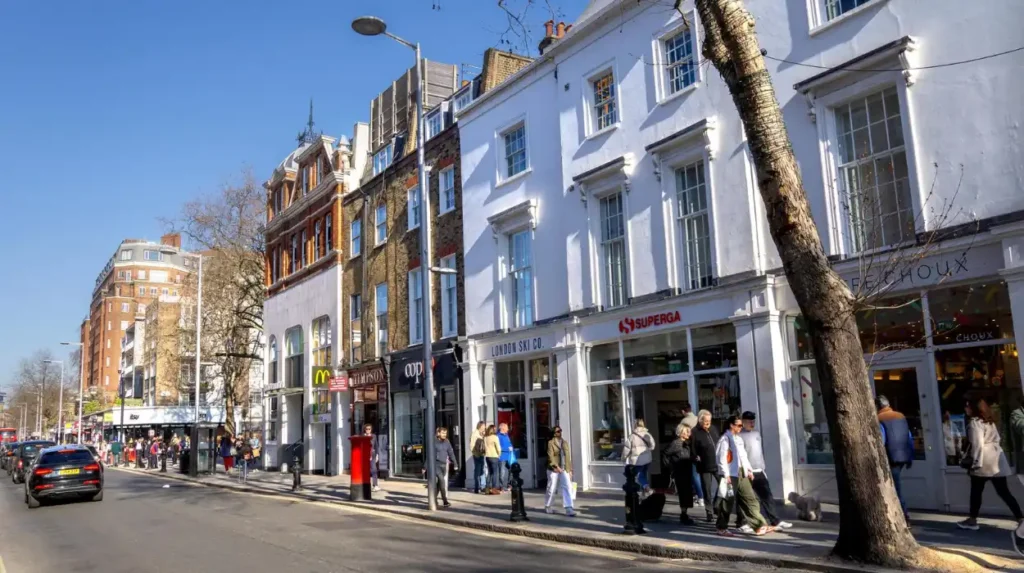
The King’s Road became central to Chelsea because its royal origins evolved into commercial and cultural importance. During the twentieth century, independent retailers, designers, musicians and young consumers transformed the street into an internationally influential centre for fashion and youth culture.
The King’s Road provides the clearest example of Chelsea’s transition from historic prestige to modern fashion influence.
The road originated as a private route associated with the monarchy. It was created in the seventeenth century for use by King Charles II and connected royal interests with the area.
Its later development was radically different.
By the twentieth century, the King’s Road had become a commercial street capable of supporting new forms of retail and cultural activity.
Its importance increased dramatically after the Second World War. London experienced major changes in consumer culture, youth identity and fashion production.
Chelsea became one of the places where these changes became visible.
The King’s Road attracted young designers and customers who rejected older conventions of dress. Independent boutiques offered clothing that differed from traditional department-store fashion.
This commercial environment gave designers direct access to consumers. Fashion could be designed, produced and sold within a rapidly changing local market.
The result was a major shift in Chelsea’s identity.
The neighbourhood remained historically associated with wealth and established society. The King’s Road simultaneously became associated with youth culture and experimentation.
This combination made Chelsea distinctive within London.
The official Cadogan history identifies the King’s Road as a location associated with the Swinging Sixties, punk and major twentieth-century musicians, designers and cultural movements.
To experience this historic neighbourhood in person today, consult our comprehensive [Best Attractions in Kensington for Royal Heritage, Gardens, and World-Class Museums] for itineraries and visiting parameters.
How did Mary Quant make Chelsea important to British fashion?
Mary Quant made Chelsea internationally important to fashion by using the King’s Road as a base for innovative retail. Her Bazaar boutique helped connect youth culture, new clothing styles and independent design, establishing Chelsea as a defining location of the Swinging Sixties.
Mary Quant was one of the most influential British fashion designers of the twentieth century.
In 1955, Alexander Plunket Greene purchased Markham House on the King’s Road in Chelsea. Quant and her business partners established Bazaar, a boutique that became closely associated with new approaches to fashion and retail.
The Victoria and Albert Museum identifies Quant as a major design and retail pioneer whose work popularised high hemlines and became central to the visual culture of the 1960s.
Quant’s importance extended beyond individual garments.
Her work represented changes in the relationship between fashion and young consumers. Clothing increasingly reflected youth identity rather than simply reproducing formal adult conventions.
Chelsea provided an appropriate environment for this change because the neighbourhood already possessed an established artistic reputation.
The King’s Road also offered a visible commercial setting where new ideas could reach consumers quickly.
The “Chelsea Set” became associated with young artists, filmmakers and social figures interested in new approaches to lifestyle and dress.
Fashionable Chelsea was therefore produced through interaction between designers and consumers. Boutique culture created a local environment where trends developed through direct contact between creative businesses and the public.
Quant’s association with the King’s Road permanently connected Chelsea with the history of British fashion.
The Swinging Sixties subsequently became a global cultural reference point, and Chelsea became one of its most important geographic centres.
How did punk fashion transform Chelsea in the 1970s?
Punk transformed Chelsea by turning the King’s Road into a centre of radical fashion and youth identity. Vivienne Westwood and Malcolm McLaren used independent retail to challenge established clothing conventions, extending Chelsea’s influence from 1960s fashion into international subcultural history.
Chelsea’s cultural influence did not end with the Swinging Sixties.
During the 1970s, the King’s Road became associated with punk. This movement rejected established ideas about fashion, music and social behaviour.
The relationship between Chelsea and punk was closely connected with Vivienne Westwood and Malcolm McLaren.
Their King’s Road shop operated under several identities and became internationally associated with the development of punk style.
The shop’s clothing used deliberately provocative imagery and unconventional construction. Fashion became a visible form of cultural and political expression.
This represented another transformation of Chelsea’s public image.
The fashionable Chelsea of the 1950s and 1960s had been associated with youthful modernity. Punk introduced a more confrontational visual language.
The King’s Road therefore became important across multiple cultural eras, including the boutique revolution of the 1950s and 1960s and punk fashion during the 1970s.
These examples demonstrate the continuity of Chelsea’s role as a place where fashion innovation reached the public.
The neighbourhood’s existing retail structure supported this process. Independent businesses could experiment with ideas that larger traditional institutions were less likely to adopt.
Chelsea’s fashion history consequently includes both commercial success and cultural disruption.
How did architecture help preserve Chelsea’s fashionable image?
Chelsea’s architecture preserves its fashionable image by maintaining visible links between historic development and modern life. Conservation policies protect significant buildings and streetscapes, while long-term estate management allows commercial and residential change to occur within recognisable historic urban environments.
Historic architecture remains one of Chelsea’s most important assets.
Fashion changes rapidly. Buildings preserve continuity.
Chelsea’s streets contain evidence from several major periods, including seventeenth-century institutions, Georgian development, Victorian redevelopment and twentieth-century architecture.
Conservation policy protects important elements of this environment.
The Royal Borough of Kensington and Chelsea uses conservation areas and Article 4 Directions as planning mechanisms for protecting historic character and controlling certain forms of alteration.
The Chelsea Estates Conservation Area provides a specific example of modern heritage recognition. The Royal Borough designated the area in 2019 because the William Sutton and Samuel Lewis Estates possess historic and architectural significance as early twentieth-century planned social housing.
This point is important because Chelsea’s history includes more than aristocratic houses and luxury property.
The neighbourhood also contains evidence of social housing, institutional development and working communities.
Preservation therefore protects a broader historical record.
Long-term estate stewardship has also influenced Chelsea’s appearance. Major landholdings allow coordinated approaches to maintenance, redevelopment and commercial occupation.
This system helps explain why Chelsea retains a strong visual identity despite continuous economic change.
Historic buildings provide the setting in which modern fashion businesses, galleries and restaurants operate.
The result is a neighbourhood where contemporary commercial activity occupies a landscape shaped by centuries of development.
What historic institutions still define Chelsea today?
Chelsea’s historic institutions define the neighbourhood by preserving military, scientific, artistic and cultural heritage within active public spaces. The Royal Hospital Chelsea, Chelsea Physic Garden, theatres and galleries connect centuries of local history with contemporary education, tourism and cultural activity.
The Royal Hospital Chelsea remains one of the neighbourhood’s most important historic institutions.
Founded in the seventeenth century, it continues to house Chelsea Pensioners, retired soldiers of the British Army who meet the institution’s eligibility requirements.
Its architecture and grounds provide visible evidence of Chelsea’s relationship with the monarchy, the military and British institutional history.
Chelsea Physic Garden represents another major historical tradition.
Founded in 1673, the garden began as a place where medicinal plants could be studied by apothecaries. It remains a significant centre for botanical heritage and public education.
Together, these institutions demonstrate the diversity of Chelsea’s historical development.
The neighbourhood also contains major cultural institutions.
The Royal Court Theatre at Sloane Square became internationally important for new writing and contemporary theatre. The Saatchi Gallery contributes to Chelsea’s continuing association with modern art.
Cadogan Hall provides another example of cultural adaptation. The building originally opened as a church in 1907 and later developed into a major concert venue.
These institutions show how Chelsea’s fashionable identity depends on more than luxury shopping.
Culture gives the neighbourhood continuing relevance.
The Chelsea Heritage Quarter, established through collaboration between Chelsea Physic Garden, the National Army Museum, the Royal Hospital Chelsea and Cadogan, formally connects these institutions within a wider interpretation of more than 350 years of local history.
Why is Chelsea still considered fashionable today?
Chelsea remains fashionable because historic prestige, cultural institutions, distinctive architecture and influential retail continue to reinforce one another. Modern luxury businesses operate alongside independent shops and heritage landmarks, preserving the combination of exclusivity, creativity and historic identity established over several centuries.
Modern Chelsea remains internationally associated with fashion and luxury.
Sloane Street contains major high-end retailers. The King’s Road continues its historical role as a shopping and cultural destination.
Duke of York Square combines retail, restaurants and cultural activity around a former military site.
Pavilion Road maintains a smaller-scale commercial character associated with specialist shops and local services.
These locations demonstrate that Chelsea’s modern economy developed from its historical structure.
The neighbourhood’s fashionable status is not based exclusively on recent luxury investment. It rests on several interconnected historical foundations.
Aristocratic landownership created planned urban development.
Architectural investment created distinctive streets and squares.
Artists established a reputation for creativity.
Designers transformed the King’s Road into an international fashion reference point.
Musicians and subcultures expanded Chelsea’s cultural influence.
Heritage protection preserved the physical evidence of these developments.
Modern Chelsea therefore combines several historical identities, including royal associations, artistic communities, fashion innovation and luxury retail.
Official estate information continues to describe Chelsea through this combination of historic architecture, cultural activity, independent businesses and internationally recognised shopping destinations.
What does Chelsea’s history reveal about London’s cultural development?
Chelsea’s history reveals how London neighbourhoods develop cultural influence through the interaction of geography, wealth, planning and creativity. Its transformation demonstrates that historic places remain economically and culturally significant when institutions, architecture and local identity continue adapting across generations.
Chelsea provides an important case study in London’s urban history.
Its development began with a riverside settlement outside the historic centre. Royal and aristocratic associations established prestige.
Estate ownership then shaped large areas through planned development.
Victorian artists created a new cultural identity that extended beyond wealth and social status.
Twentieth-century designers transformed that creative identity into international fashion influence.
The King’s Road demonstrated how a specific street could become globally important through retail and youth culture.
Modern preservation demonstrates another stage in the process.
Historic neighbourhoods survive through management as well as memory. Buildings require maintenance. Streets require planning controls. Institutions require continued public and financial support.
Chelsea’s continued relevance depends on the relationship between preservation and change.
The neighbourhood cannot remain historically important by becoming static.
Its history shows continuous adaptation.
Old buildings have acquired new functions. Former institutional and military spaces have developed new cultural roles. Historic streets continue to support modern businesses.
This process explains why Chelsea remains significant to historians, tourists, educators and heritage researchers.
For genealogical researchers, Chelsea also provides a rich local landscape of institutional, residential and social history. Changes in estates, housing and population reflect broader patterns in London’s development.
For students, the neighbourhood offers evidence of urban planning, architecture, fashion history and cultural geography within a relatively concentrated area.
For visitors, Chelsea demonstrates how London’s historic districts can contain several centuries of history within active modern streets.
How should Chelsea’s historic character be understood in the future?
Chelsea’s future historical importance depends on protecting architectural character while documenting continued social and cultural change. Conservation, active institutions and responsible redevelopment ensure that future generations can understand both the neighbourhood’s famous landmarks and the wider communities that shaped its identity.
Chelsea’s history continues to develop.
Heritage preservation must therefore recognise the full range of the neighbourhood’s past.
Chelsea includes royal and aristocratic history, but it also includes artists, designers, soldiers, theatre workers, shopkeepers and residents.
Its historic importance comes from these interconnected communities.
Conservation provides one mechanism for protecting physical evidence. Listed buildings, conservation areas and planning policies help preserve significant streets and structures.
Research and interpretation provide another mechanism.
Institutions such as the Royal Hospital Chelsea and Chelsea Physic Garden preserve historical knowledge through their buildings and collections.
Cultural organisations continue the neighbourhood’s creative traditions.
The future of Chelsea’s heritage depends on maintaining this relationship between evidence and activity.
A historic street remains more understandable when its buildings continue to function.
A cultural tradition remains more relevant when new generations engage with it.
Chelsea’s long development explains its position among London’s most fashionable historic neighbourhoods.
Its identity was created through centuries rather than decades.
The Thames-side settlement established the location. Aristocratic estates created prestige and planned development. Georgian and Victorian architecture created a distinctive urban landscape. Artists established cultural influence. Mary Quant and the King’s Road transformed Chelsea into a global fashion centre. Punk extended that influence into another international movement.
Those layers remain visible today.
Chelsea is therefore not simply a fashionable part of London with historic buildings. It is a historic neighbourhood whose modern fashion identity emerged directly from its geography, architecture, landownership and creative communities.
Frequently Asked Question
Why is Chelsea one of London’s most fashionable neighbourhoods?
Chelsea became fashionable through centuries of aristocratic influence, planned estate development, distinctive architecture, artistic communities and the international fashion culture created around the King’s Road.